Bone-modifying agents were associated with longer time to skeletal-related events in high-risk prostate cancer
Bone-Modifying Agents in Patients With High-Risk Metastatic Castration-Sensitive Prostate Cancer Treated With Abiraterone Acetate
Post hoc analysis of a randomized clinical trialBenefit found
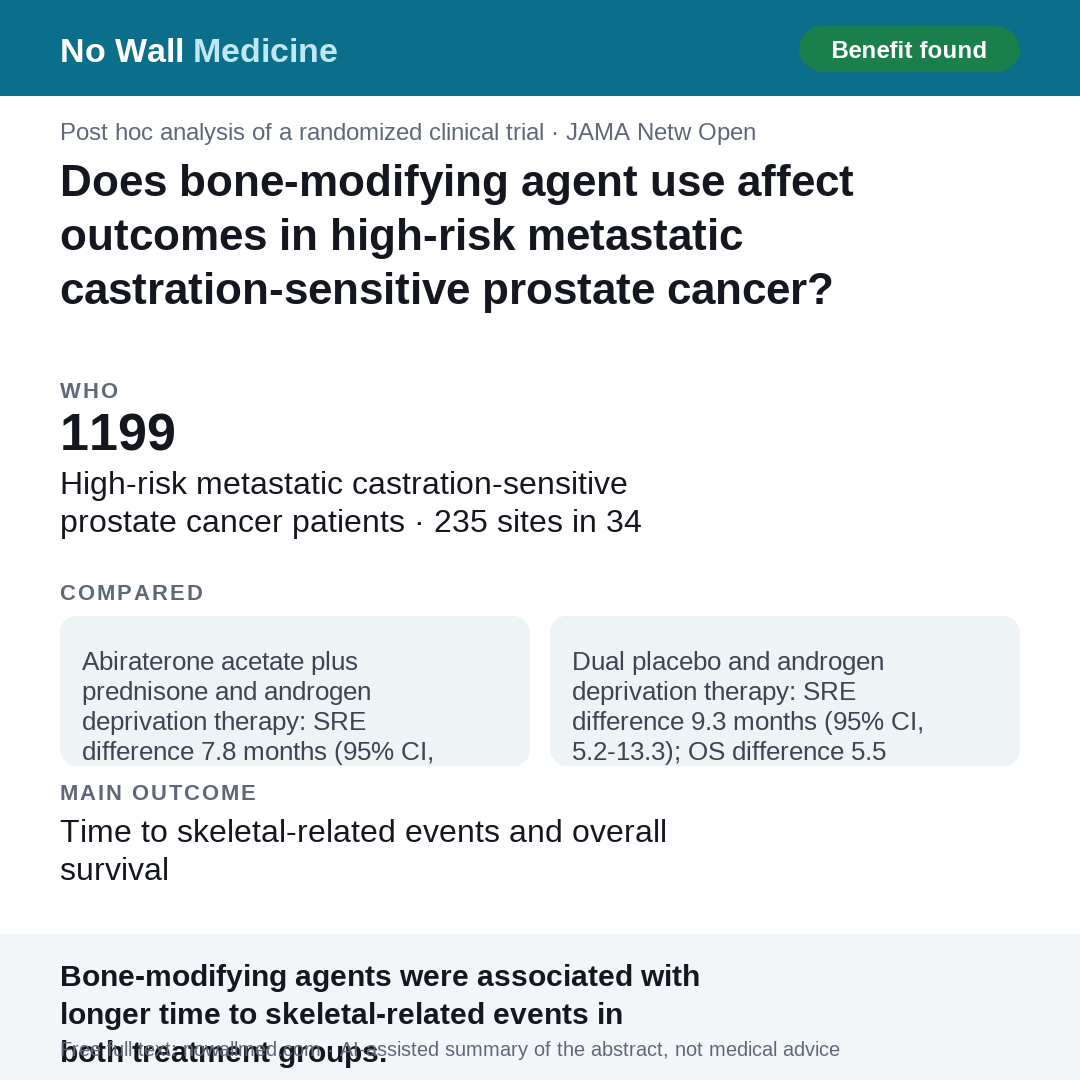
Does bone-modifying agent use affect outcomes in high-risk metastatic castration-sensitive prostate cancer?
Who
1199
High-risk metastatic castration-sensitive prostate cancer patients · 235 sites in 34 countries
Compared
Abiraterone acetate plus prednisone and androgen deprivation therapy: SRE difference 7.8 months (95% CI, 4.2-11.3); OS difference 1.6 months (95% CI, -2.5 to 5.8)
Dual placebo and androgen deprivation therapy: SRE difference 9.3 months (95% CI, 5.2-13.3); OS difference 5.5 months (95% CI, 3.2-9.8)
Main outcome
Time to skeletal-related events and overall survival
Result: hazard ratio for time to SRE 0.99 (95% CI 0.48-2.08); hazard ratio for OS 1.31 (95% CI 0.88-1.96)
Bottom line: Bone-modifying agents were associated with longer time to skeletal-related events in both treatment groups.
JAMA Netw Open · 2024-03-04Download image
Clinical question: Does bone-modifying agent use affect outcomes in high-risk metastatic castration-sensitive prostate cancer?
Why it matters: The association between bone-modifying agents and clinical outcomes in patients with high-risk metastatic castration-sensitive prostate cancer treated with abiraterone acetate plus prednisone remains unclear.
Key points
- This cohort study analyzed 1199 patients with high-risk metastatic castration-sensitive prostate cancer from the LATITUDE trial.
- In patients receiving abiraterone acetate plus prednisone and androgen deprivation therapy, bone-modifying agent use was associated with a 7.8 month longer time to skeletal-related events.
- In the group receiving only androgen deprivation therapy, bone-modifying agent use was associated with a 9.3 month longer time to skeletal-related events and a 5.5 month longer overall survival.
Headline and key points written with AI from the paper’s abstract, with every number checked against it. Read the paper before relying on them.
Was this summary helpful?
Subject terms
Cite this article
Fukuokaya W, Mori K, Urabe F, Igarashi T, Yanagisawa T, Tsuzuki S. Bone-Modifying Agents in Patients With High-Risk Metastatic Castration-Sensitive Prostate Cancer Treated With Abiraterone Acetate. JAMA Netw Open. 2024. doi:10.1001/jamanetworkopen.2024.2467
Spotted a mistake? Suggest a correction
Top studies every Monday
The week’s key trials and guidelines in your specialties, plus any topics you follow. By email, free.
Get the weekly digest