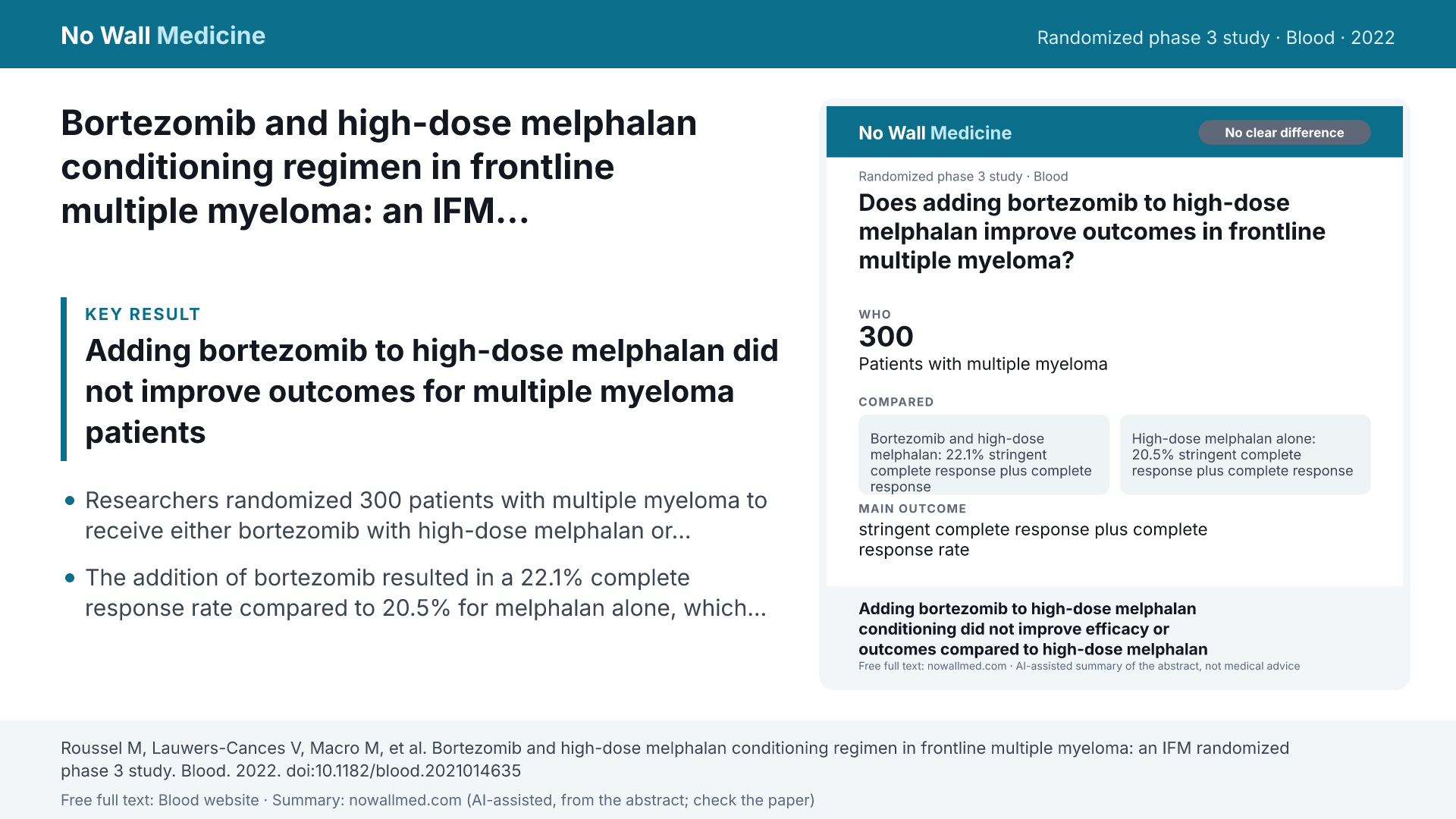
Bortezomib and high-dose melphalan conditioning regimen in frontline multiple myeloma: an IFM randomized phase 3 study
Key result: Adding bortezomib to high-dose melphalan did not improve outcomes for multiple myeloma patients
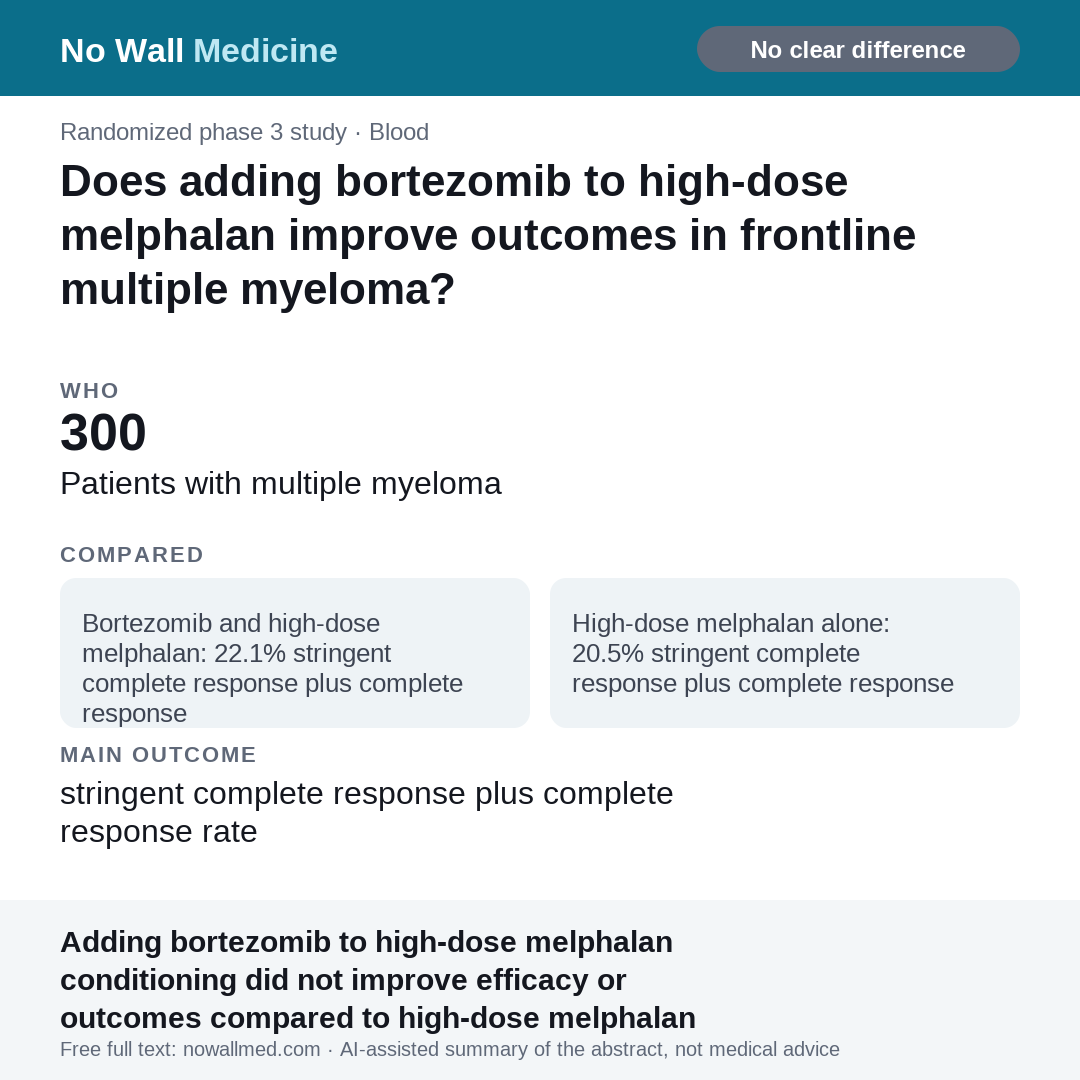
Randomized phase 3 studyNo clear difference
Does adding bortezomib to high-dose melphalan improve outcomes in frontline multiple myeloma?
Who
300
Patients with multiple myeloma
Compared
Bortezomib and high-dose melphalan: 22.1% stringent complete response plus complete response
High-dose melphalan alone: 20.5% stringent complete response plus complete response
Main outcome
stringent complete response plus complete response rate
Result: adjusted hazard ratio 0.82 (95% CI 0.61-1.13)
Bottom line: Adding bortezomib to high-dose melphalan conditioning did not improve efficacy or outcomes compared to high-dose melphalan alone.
Blood · 2022-05-05Download image
Key points
- Researchers randomized 300 patients with multiple myeloma to receive either bortezomib with high-dose melphalan or high-dose melphalan alone before a stem cell transplant.
- The addition of bortezomib resulted in a 22.1% complete response rate compared to 20.5% for melphalan alone, which was not a statistically significant difference.
- Serious adverse events occurred in 18.7% of patients receiving bortezomib plus melphalan compared to 13.1% of those receiving melphalan alone.
Discussion prompts
- Would these patients look like yours? Who was left out?
- Is the main outcome one that matters to patients?
- Is the difference large enough to change what you do?
Cite: Roussel M, Lauwers-Cances V, Macro M, et al. Bortezomib and high-dose melphalan conditioning regimen in frontline multiple myeloma: an IFM randomized phase 3 study. Blood. 2022. doi:10.1182/blood.2021014635
Free full text: Blood website · Summary and visual abstract: nowallmed.com/a/bortezomib-and-high-dose-melphalan-conditioning-regimen-in-frontline-1tsz2wj/ (AI-assisted from the abstract; check the paper before relying on it).