Brain structure and white matter integrity are associated with cognitive impairment in late-life depression
Brain-cognition relationships in late-life depression: a systematic review of structural magnetic resonance imaging studies
Systematic reviewMixed results
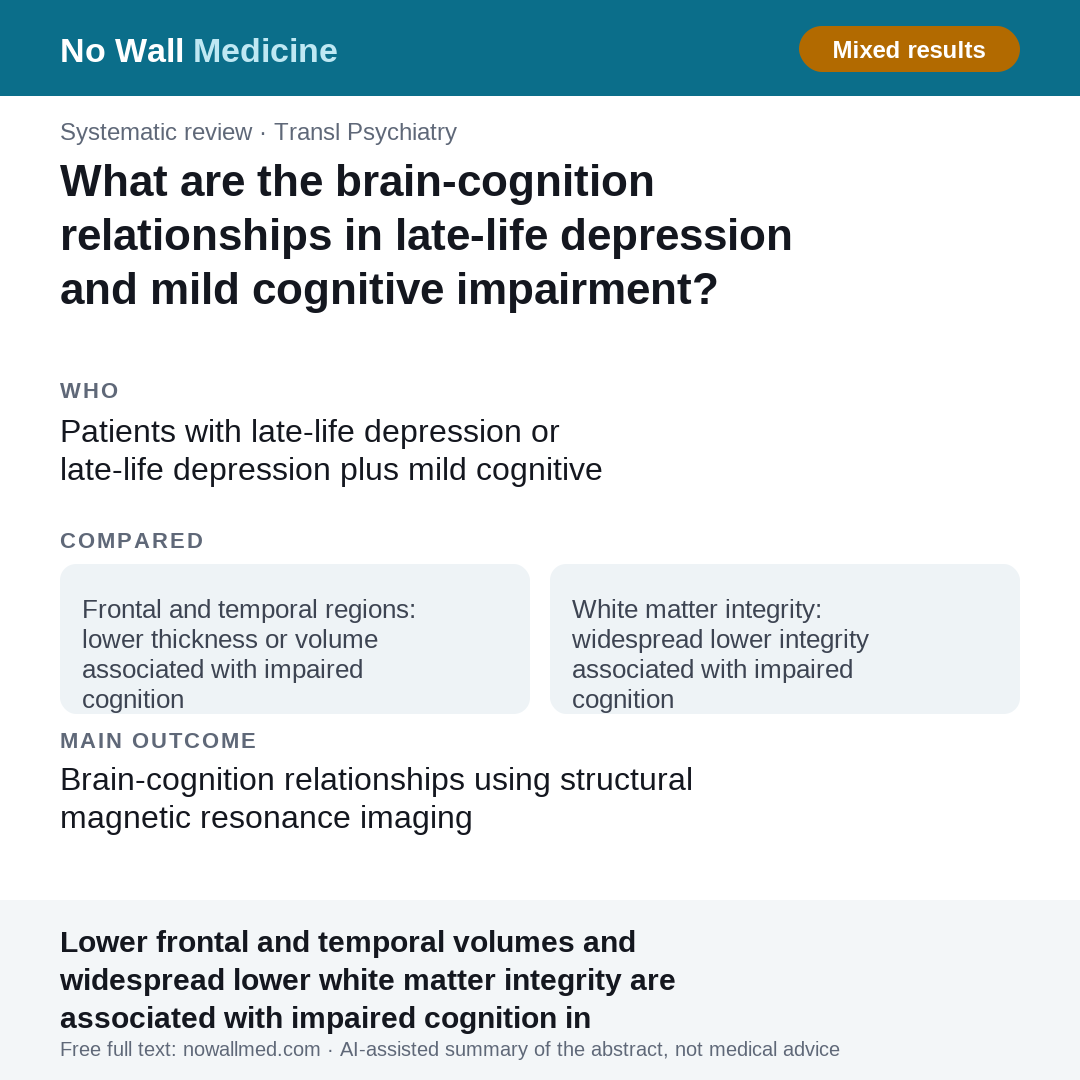
What are the brain-cognition relationships in late-life depression and mild cognitive impairment?
Who
Patients with late-life depression or late-life depression plus mild cognitive impairment
Compared
Frontal and temporal regions: lower thickness or volume associated with impaired cognition
White matter integrity: widespread lower integrity associated with impaired cognition
Main outcome
Brain-cognition relationships using structural magnetic resonance imaging
Bottom line: Lower frontal and temporal volumes and widespread lower white matter integrity are associated with impaired cognition in late-life depression.
Limitation: Heterogeneity in studies required only a descriptive synthesis.
Transl Psychiatry · 2023-08-19Download image
Clinical question: What are the brain-cognition relationships in late-life depression and mild cognitive impairment?
Why it matters: The mechanisms linking late-life depression to mild cognitive impairment and the brain alterations underlying impaired cognition remain poorly understood.
Key points
- Researchers reviewed 51 articles involving patients with late-life depression or late-life depression combined with mild cognitive impairment.
- Lower gray matter volume or thickness in frontal and temporal regions and lower white matter integrity were associated with impaired cognition.
- Lower white matter integrity in the posterior cingulate region was more associated with executive function and processing speed impairment than memory.
Headline and key points written with AI from the paper’s abstract, with every number checked against it. Read the paper before relying on them.
Topics
Cite this article
Marawi T, Ainsworth NJ, Zhukovsky P, Rashidi-Ranjbar N, Rajji TK, Tartaglia MC. Brain-cognition relationships in late-life depression: a systematic review of structural magnetic resonance imaging studies. Transl Psychiatry. 2023. doi:10.1038/s41398-023-02584-2
Spotted a mistake? Suggest a correction
Top studies every Monday
The week’s key trials and guidelines in your specialties, plus any topics you follow. By email, free.
Get the weekly digest