Artificial intelligence improves the accuracy of genetic risk scores for predicting cardiovascular disease
Bridging Genomics to Cardiology Clinical Practice: Artificial Intelligence in Optimizing Polygenic Risk Scores: A Systematic Review
Systematic reviewBenefit found
Can artificial intelligence optimize polygenic risk scores for cardiovascular disease prediction?
Who
Individuals at risk for cardiovascular disease
Compared
Artificial intelligence optimized polygenic risk scores: enhance predictive accuracy
Nonoptimized polygenic risk scores: outperformed by artificial intelligence optimized models
Main outcome
Predictive accuracy for cardiovascular disease
Bottom line: Artificial intelligence optimized polygenic risk scores improve predictive accuracy and patient stratification for cardiovascular disease.
JACC Adv · 2025-06-28Download image
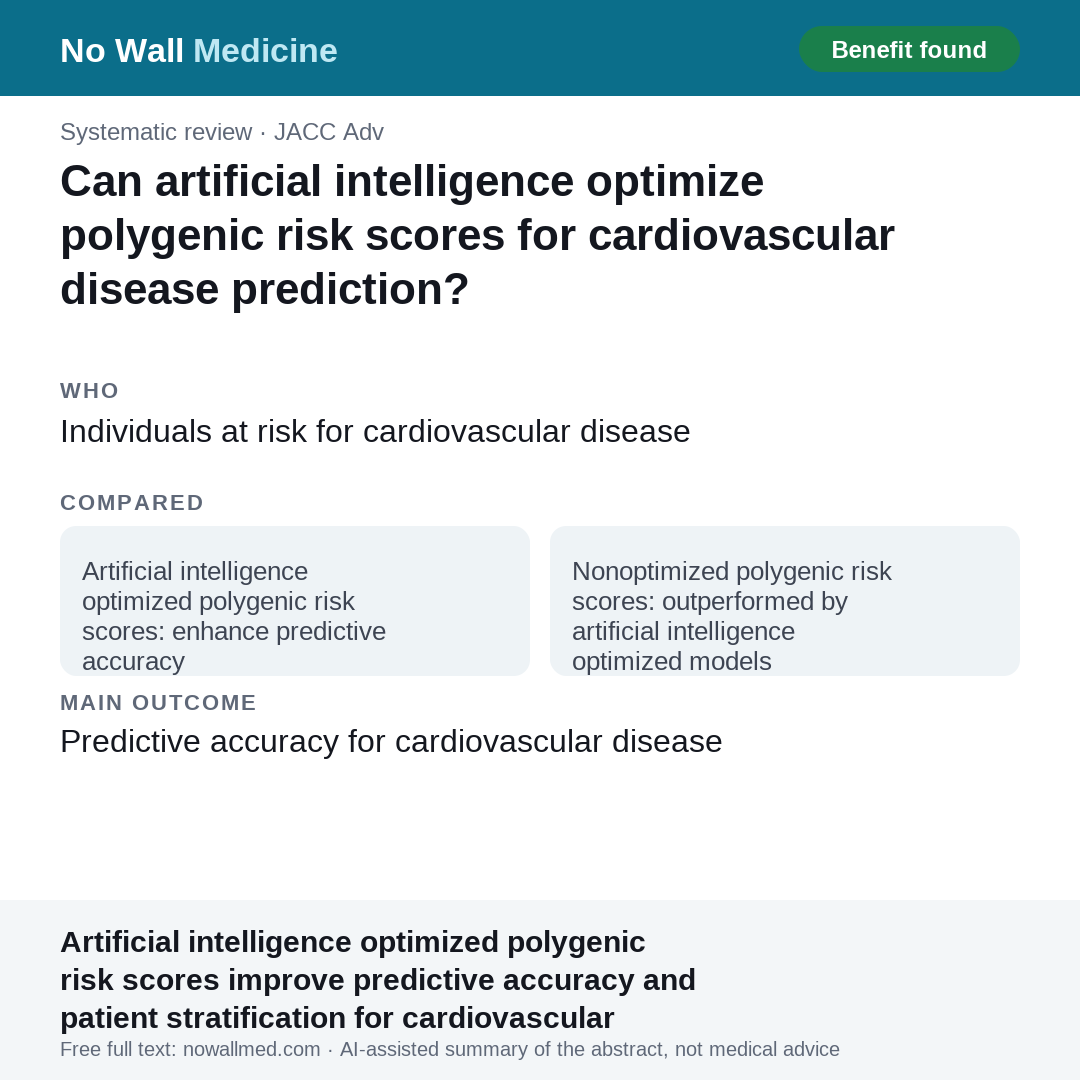
Clinical question: Can artificial intelligence optimize polygenic risk scores for cardiovascular disease prediction?
Why it matters: Traditional risk prediction models often fail to identify high-risk individuals before adverse events occur, creating a need for more precise tools.
Key points
- Researchers conducted a systematic review of 13 studies to evaluate how artificial intelligence and machine learning algorithms can optimize polygenic risk scores, which are tools that aggregate genetic variants to quantify susceptibility.
- The review found that artificial intelligence-optimized models outperform nonoptimized polygenic risk scores by improving feature selection and integrating clinical risk factors, biomarkers, and imaging data.
- These optimized models were associated with enhanced predictive accuracy and better patient stratification for cardiovascular disease.
Headline and key points written with AI from the paper’s abstract, with every number checked against it. Read the paper before relying on them.
Cite this article
Hosseini K, Anaraki N, Dastjerdi P, Kazemian S, Hasanzad M, Alkhouli M. Bridging Genomics to Cardiology Clinical Practice: Artificial Intelligence in Optimizing Polygenic Risk Scores: A Systematic Review. JACC Adv. 2025. doi:10.1016/j.jacadv.2025.101803
Spotted a mistake? Suggest a correction
Top studies every Monday
The week’s key trials and guidelines in your specialties, plus any topics you follow. By email, free.
Get the weekly digest