Digital writing intervention did not significantly reduce overall test anxiety in adolescents during exams
Brief digital narrative intervention for adolescent depression, anxiety, and insomnia during academic stress: a cluster randomized controlled trial
Cluster randomized controlled trialMixed results
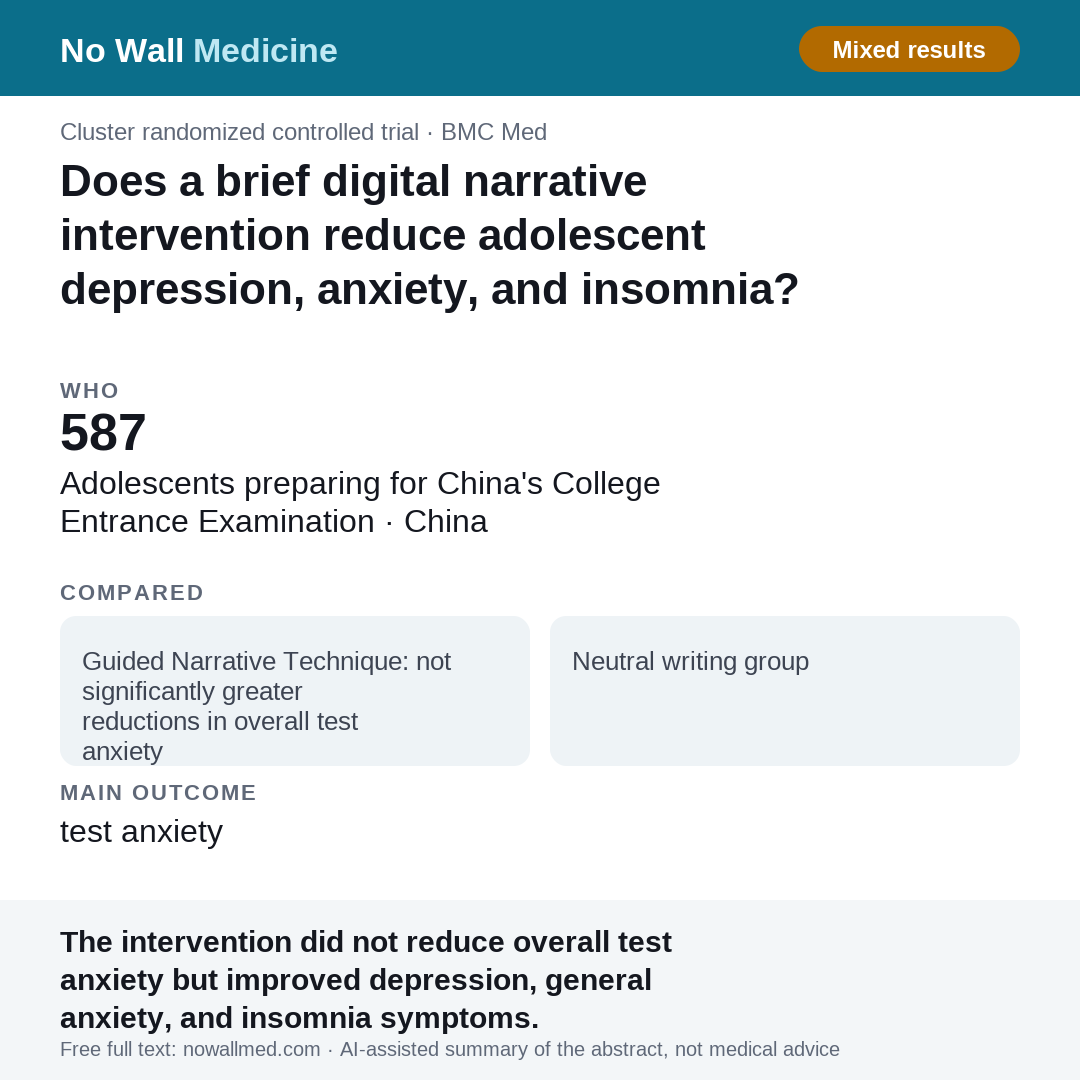
Does a brief digital narrative intervention reduce adolescent depression, anxiety, and insomnia?
Who
587
Adolescents preparing for China's College Entrance Examination · China
Compared
Guided Narrative Technique: not significantly greater reductions in overall test anxiety
Neutral writing group
Main outcome
test anxiety
Result: d = 0.18 (95% CI [0.01, 0.36]) for TAI worry subscale
Bottom line: The intervention did not reduce overall test anxiety but improved depression, general anxiety, and insomnia symptoms.
Limitation: warranting further evaluation in adequately powered trials
BMC Med · 2026-07-03Download image
Clinical question: Does a brief digital narrative intervention reduce adolescent depression, anxiety, and insomnia?
Why it matters: Effective interventions to address depression, anxiety, and insomnia during high-stakes examinations for adolescents remain scarce due to implementation barriers.
Key points
- Researchers studied 587 adolescents preparing for exams, comparing a brief digital writing intervention called Guided Narrative Technique to a neutral writing group.
- The digital writing intervention did not produce significantly greater reductions in overall test anxiety than the neutral writing group in the full sample.
- The intervention showed significantly greater reductions in depression (d = 0.35), general anxiety (d = 0.37), and insomnia (d = 0.23) during the intervention period.
Headline and key points written with AI from the paper’s abstract, with every number checked against it. Read the paper before relying on them.
Topics
Spotted a mistake? Suggest a correction
More in Psychiatry & Mental Health
Depressive symptoms linked to stronger defensive response in panic disorder patients
Defensive reactivity to interoceptive perturbation in panic disorder: Depressive symptom burden and panic severity dimensions
Genes linked to mitochondria implicated in psychiatric disorders
Brain-derived multi-omics prioritization of mitochondria-related genes in schizophrenia, bipolar disorder, and major depressive disorder
Brain structure variations linked to alcohol use severity in large studies
A reproducible structural brain axis of alcohol use severity
Most animal psychedelic studies use stress-inducing methods and brief testing
Animal models in psychedelic research - Tripping over translation