Peer-supported web-based skills training improved mental health symptoms and functioning in trauma-exposed veterans
Brief Peer-Supported Web-Based Skills Training in Affective and Interpersonal Regulation (BPS webSTAIR) for Trauma-Exposed Veterans in the Community: Randomized Controlled Trial
Randomized controlled trialBenefit found
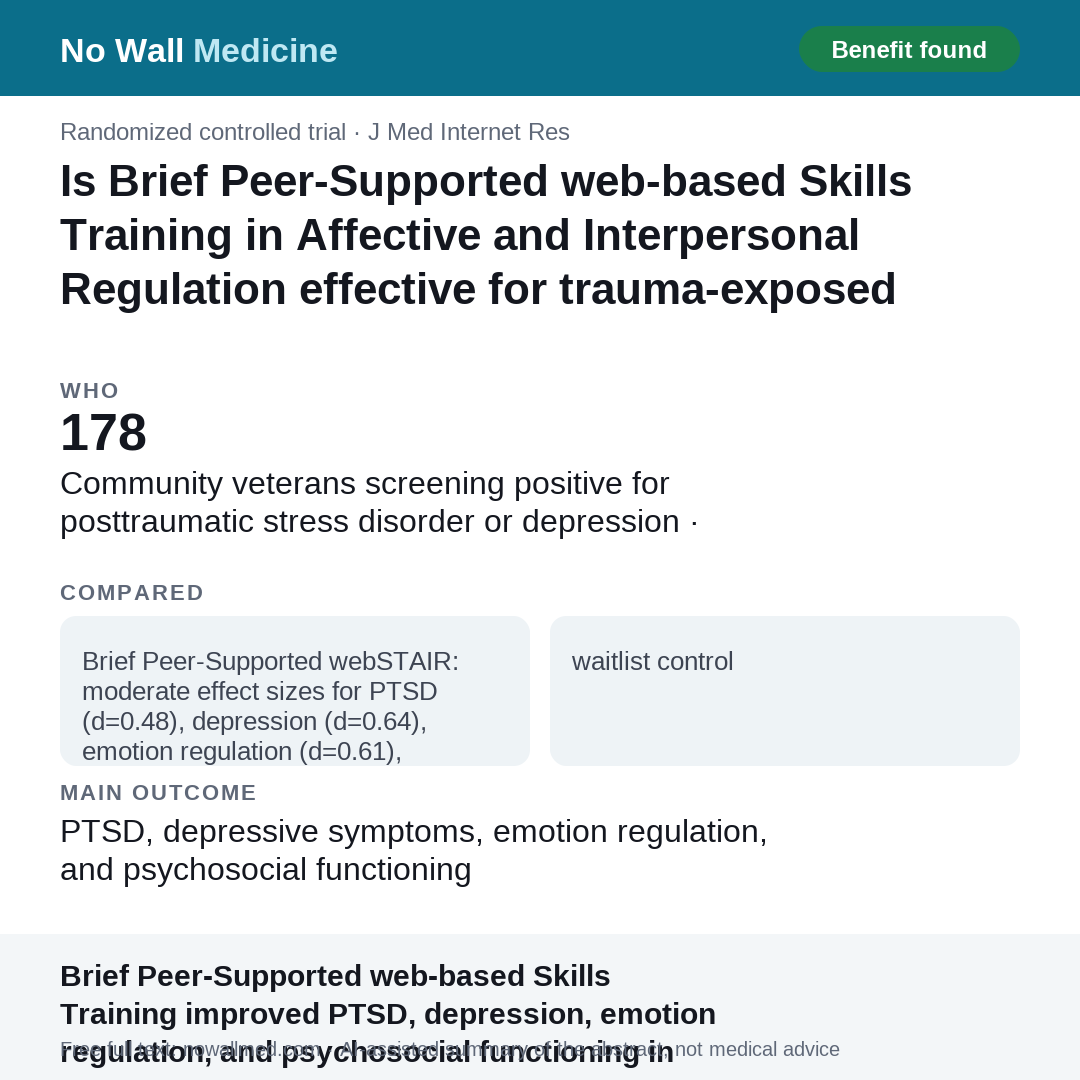
Is Brief Peer-Supported web-based Skills Training in Affective and Interpersonal Regulation effective for trauma-exposed veterans?
Who
178
Community veterans screening positive for posttraumatic stress disorder or depression · Community
Compared
Brief Peer-Supported webSTAIR: moderate effect sizes for PTSD (d=0.48), depression (d=0.64), emotion regulation (d=0.61), and functional impairment (d=0.61)
waitlist control
Main outcome
PTSD, depressive symptoms, emotion regulation, and psychosocial functioning
Bottom line: Brief Peer-Supported web-based Skills Training improved PTSD, depression, emotion regulation, and psychosocial functioning in community veterans.
Limitation: Investigation among other populations is necessary to evaluate the generalizability of the findings.
J Med Internet Res · 2024-10-02Download image
Clinical question: Is Brief Peer-Supported web-based Skills Training in Affective and Interpersonal Regulation effective for trauma-exposed veterans?
Why it matters: It is unknown if peer-supported mobile health programs can improve symptom outcomes and daily functioning for veterans experiencing posttraumatic stress and depression.
Key points
- The study randomized 178 veterans, with 117 assigned to a peer-supported digital skills program and 61 assigned to a waitlist control group.
- Participants using the digital program showed greater improvement in posttraumatic stress disorder symptoms (d=0.48), depression (d=0.64), emotion regulation (d=0.61), and functional impairment (d=0.61).
- Gains in symptoms and functioning were maintained at an 8-week follow-up, and those who completed more modules reported greater improvement.
Limitation the authors note: Investigation of peer-supported programs among other populations is necessary to evaluate the generalizability of the findings.
Headline and key points written with AI from the paper’s abstract, with every number checked against it. Read the paper before relying on them.
Topics
Cite this article
Ong LE, Speicher S, Villasenor D, Kim J, Jacobs A, Macia KS. Brief Peer-Supported Web-Based Skills Training in Affective and Interpersonal Regulation (BPS webSTAIR) for Trauma-Exposed Veterans in the Community: Randomized Controlled Trial. J Med Internet Res. 2024. doi:10.2196/52130
Spotted a mistake? Suggest a correction
Top studies every Monday
The week’s key trials and guidelines in your specialties, plus any topics you follow. By email, free.
Get the weekly digest