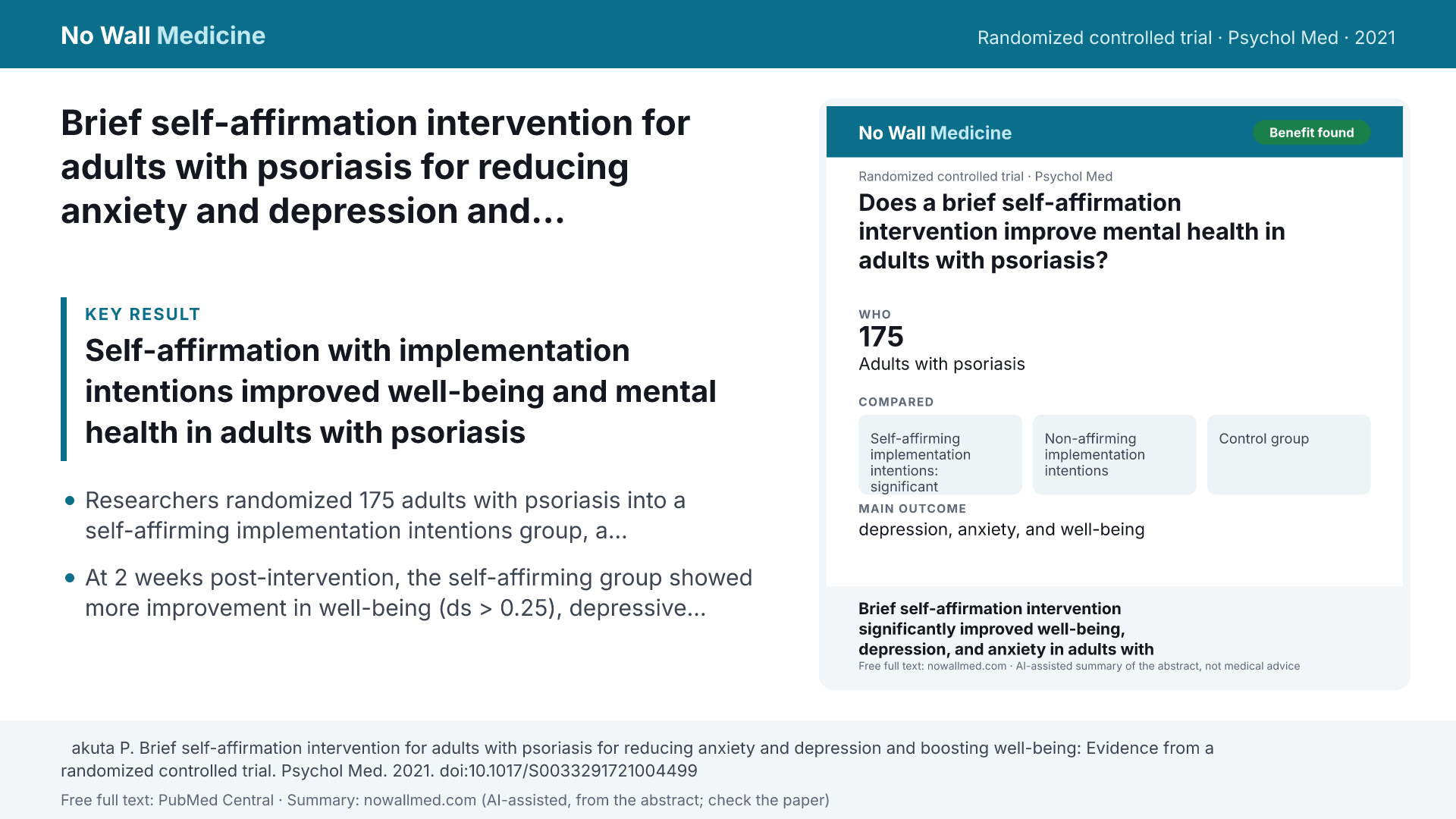
Self-affirmation with implementation intentions improved well-being and mental health in adults with psoriasis
Brief self-affirmation intervention for adults with psoriasis for reducing anxiety and depression and boosting well-being: Evidence from a randomized controlled trial
Randomized controlled trialBenefit found
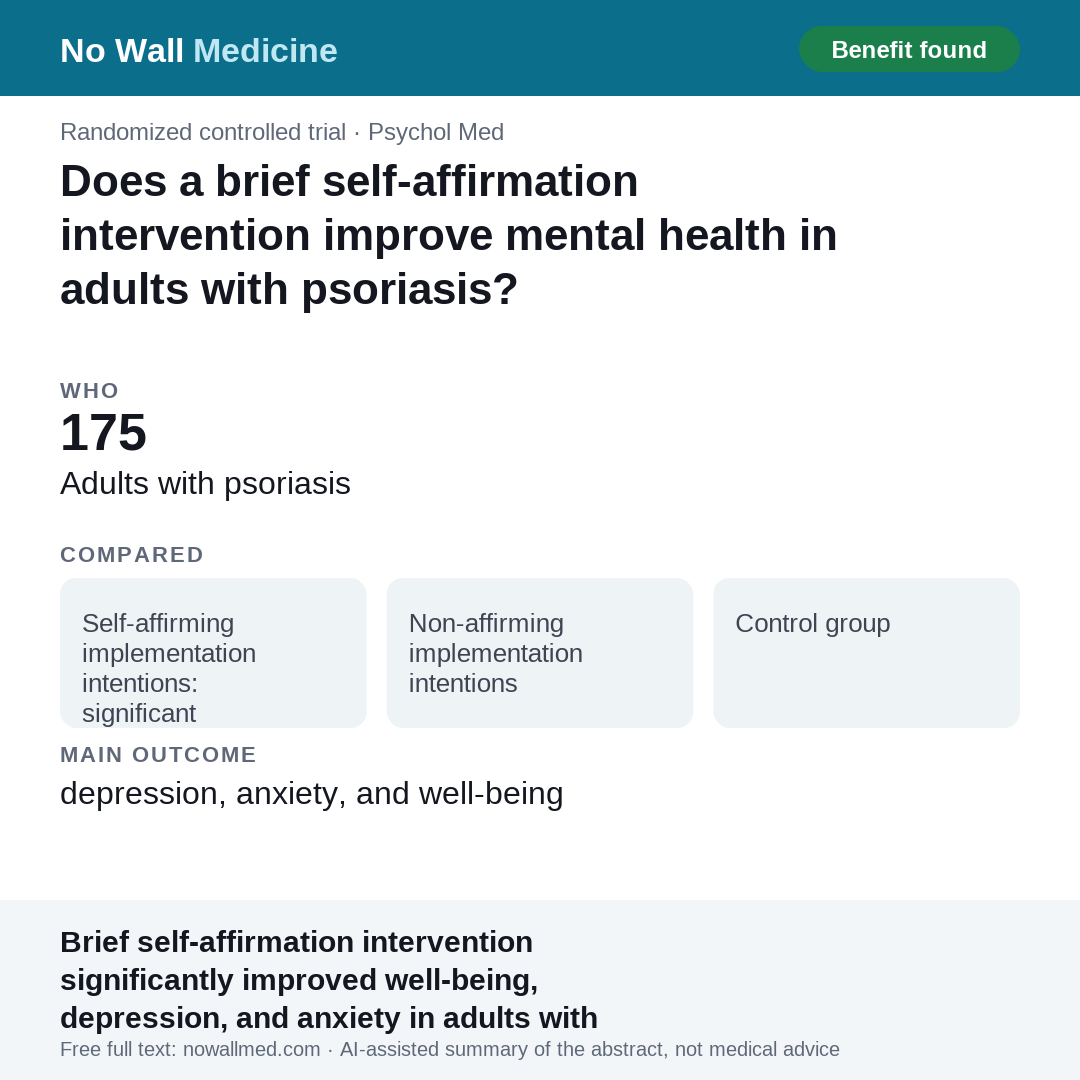
Does a brief self-affirmation intervention improve mental health in adults with psoriasis?
Who
175
Adults with psoriasis
Compared
Self-affirming implementation intentions: significant improvement in well-being, depressive symptoms, and anxiety
Non-affirming implementation intentions
Control group
Main outcome
depression, anxiety, and well-being
Bottom line: Brief self-affirmation intervention significantly improved well-being, depression, and anxiety in adults with psoriasis at two weeks.
Psychol Med · 2021-11-05Download image
Clinical question: Does a brief self-affirmation intervention improve mental health in adults with psoriasis?
Why it matters: It is unknown if brief self-affirmation interventions can address the mental health implications of living with a chronic condition like psoriasis.
Key points
- Researchers randomized 175 adults with psoriasis into a self-affirming implementation intentions group, a non-affirming implementation intentions group, or a control group.
- At 2 weeks post-intervention, the self-affirming group showed more improvement in well-being (ds > 0.25), depressive symptoms (ds > -0.40), and anxiety (ds > -0.45) than the other groups.
- While differences between the groups faded at the 1-month follow-up, the self-affirming group maintained significant changes in all mental health outcomes over time.
Headline and key points written with AI from the paper’s abstract, with every number checked against it. Read the paper before relying on them.
Was this summary helpful?
Subject terms
Cite this article
Łakuta P. Brief self-affirmation intervention for adults with psoriasis for reducing anxiety and depression and boosting well-being: Evidence from a randomized controlled trial. Psychol Med. 2021. doi:10.1017/S0033291721004499
Spotted a mistake? Suggest a correction