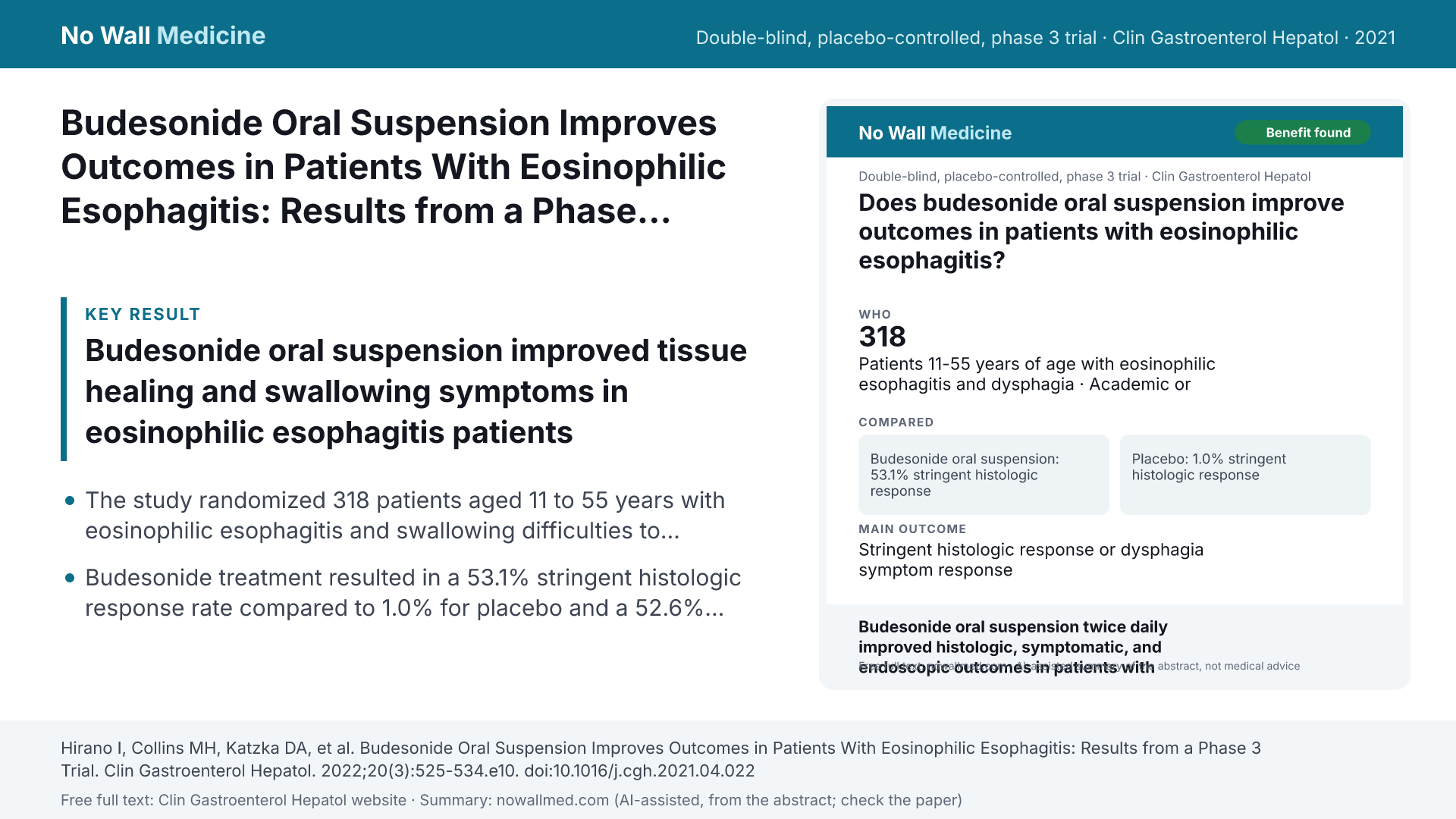
Budesonide oral suspension improved tissue healing and swallowing symptoms in eosinophilic esophagitis patients
Budesonide Oral Suspension Improves Outcomes in Patients With Eosinophilic Esophagitis: Results from a Phase 3 Trial
Double-blind, placebo-controlled, phase 3 trialBenefit found
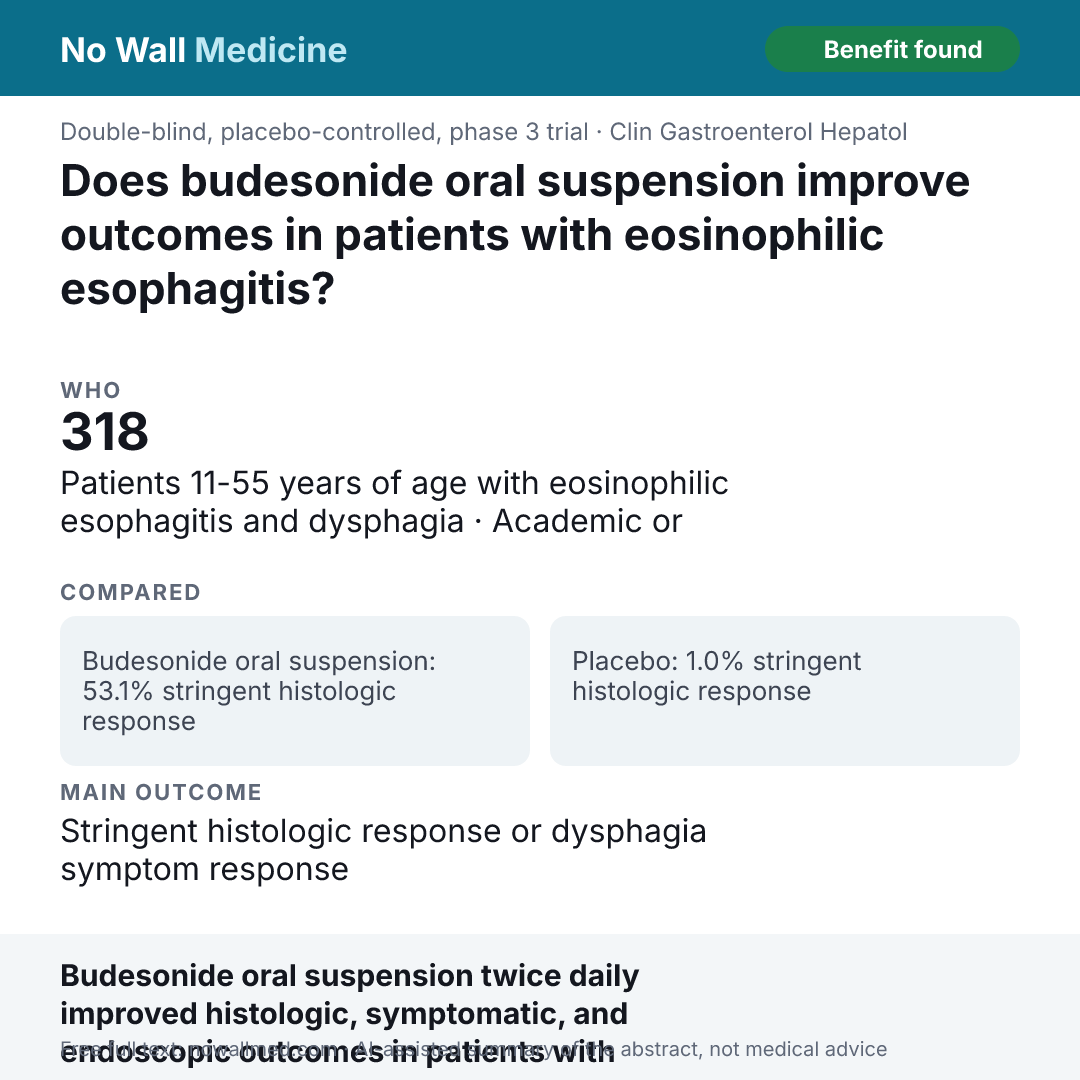
Does budesonide oral suspension improve outcomes in patients with eosinophilic esophagitis?
Who
318
Patients 11-55 years of age with eosinophilic esophagitis and dysphagia · Academic or community care practices
Compared
Budesonide oral suspension: 53.1% stringent histologic response
Placebo: 1.0% stringent histologic response
Main outcome
Stringent histologic response or dysphagia symptom response
Result: Δ52% [95% confidence interval (CI), 43.3%-59.1%]
Bottom line: Budesonide oral suspension twice daily improved histologic, symptomatic, and endoscopic outcomes in patients with eosinophilic esophagitis.
Clin Gastroenterol Hepatol · 2021-04-19 · Save PNG
Same trial (NCT02605837)
Papers we list that report this registered trial, oldest first. Read a secondary analysis alongside the main results.
- Main results Benefit found
This paper Clin Gastroenterol Hepatol 2021-04 - Related analysis Mixed results
Continuing budesonide oral suspension was associated with lower relapse rates in eosinophilic esophagitis patients Clin Gastroenterol Hepatol 2021-06 - Secondary analysis Mixed results
Esophageal dilation history did not affect histologic response to budesonide oral suspension in eosinophilic esophagitis Am J Gastroenterol 2024-11
Clinical question: Does budesonide oral suspension improve outcomes in patients with eosinophilic esophagitis?
Why it matters: There was currently no pharmacologic therapy approved by the US Food and Drug Administration for eosinophilic esophagitis, a chronic immune-mediated disease.
In absolute numbers
Budesonide oral suspension: 53.1% · Placebo: 1% → a difference of 52.1 percentage points, so about 2 people would need the treatment for 1 more to benefit (number needed to treat) over the trial’s follow-up.
Worked out by us from the two group results above, not reported by the authors. Check the paper for the exact outcome and timing.
Key points
- The study randomized 318 patients aged 11 to 55 years with eosinophilic esophagitis and swallowing difficulties to receive either budesonide oral suspension or a placebo.
- Budesonide treatment resulted in a 53.1% stringent histologic response rate compared to 1.0% for placebo and a 52.6% symptom response rate compared to 39.1% for placebo.
- Patients receiving budesonide showed greater improvements in swallowing questionnaire scores and endoscopic appearance scores over 12 weeks than those receiving the placebo.
Headline and key points written with AI from the paper’s abstract, with every number checked against it. Read the paper before relying on them.
Was this summary helpful?
Subject terms
Headline, design, result, key points, caveat and citation as plain text.
Cite this article
Hirano I, Collins MH, Katzka DA, et al. Budesonide Oral Suspension Improves Outcomes in Patients With Eosinophilic Esophagitis: Results from a Phase 3 Trial. Clin Gastroenterol Hepatol. 2022;20(3):525-534.e10. doi:10.1016/j.cgh.2021.04.022
Spotted a mistake? Suggest a correction