Bupropion slow release did not show overall benefit over placebo for cocaine abstinence in methadone patients
Bupropion Slow Release vs Placebo With Adaptive Incentives for Cocaine Use Disorder in Persons Receiving Methadone for Opioid Use Disorder: A Randomized Clinical Trial
Double-blind, placebo-controlled randomized clinical trialNo clear difference
Does bupropion slow release enhance a tailored abstinence incentive program for cocaine use disorder?
Who
80
Persons receiving methadone for opioid use disorder with cocaine use disorder · 4 methadone treatment programs in Baltimore, Maryland
Compared
Bupropion slow release
Placebo
Main outcome
Cocaine abstinence by urinalysis or self-report
Bottom line: Bupropion slow release did not significantly improve cocaine abstinence compared to placebo when combined with an incentive program.
JAMA Netw Open · 2023-03-01Download image
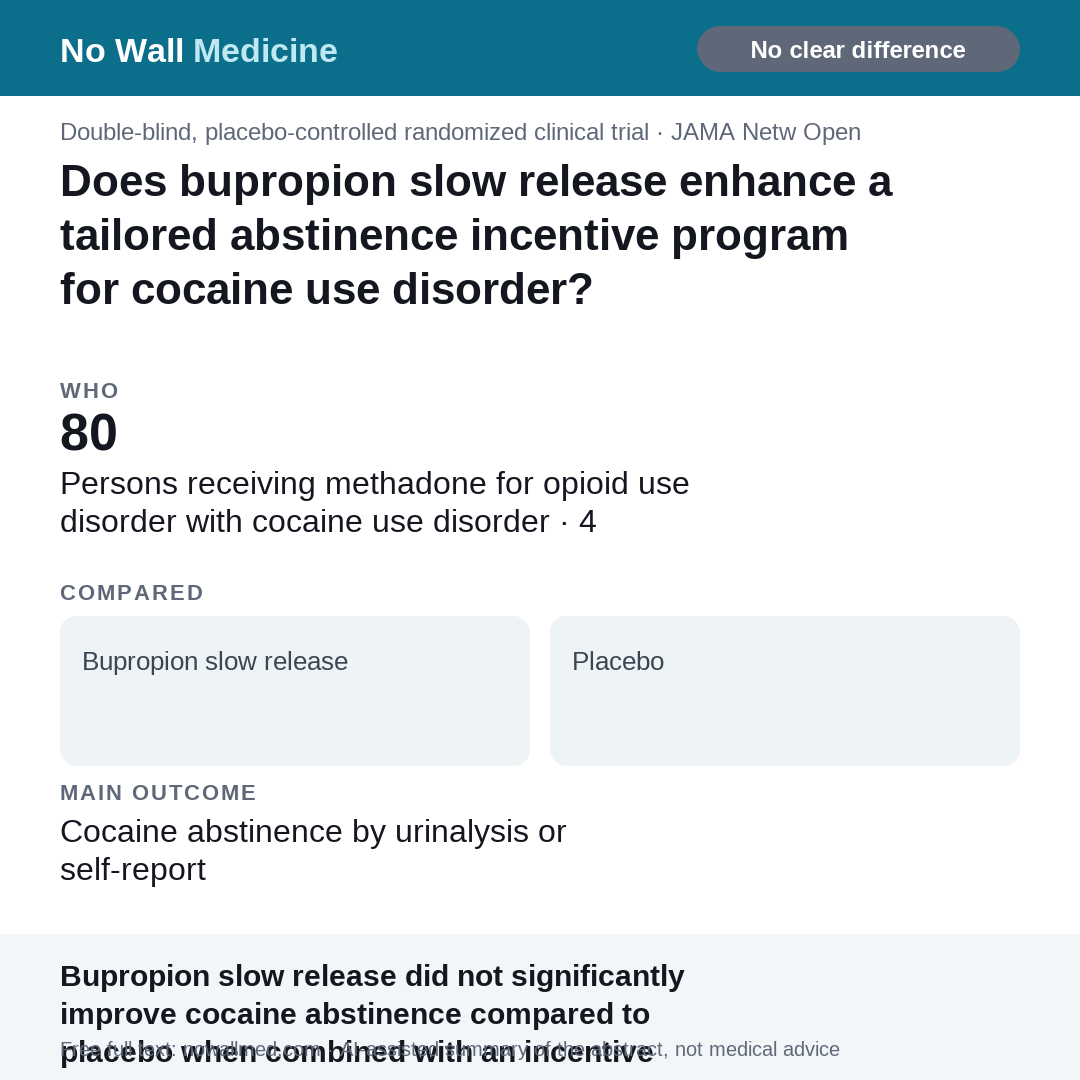
Clinical question: Does bupropion slow release enhance a tailored abstinence incentive program for cocaine use disorder?
Why it matters: Evidence-based treatments for people using both opioids and stimulants are currently limited.
Key points
- This randomized clinical trial studied 80 people receiving methadone for opioid use disorder who also had cocaine use disorder.
- There was no significant difference between the bupropion slow release group and the placebo group regarding cocaine use via urinalysis or self-reports.
- In a subgroup of participants in the abstinence initiation phase, 66.7% of those on bupropion were abstinent at the end of the study compared to 30.0% on placebo.
Headline and key points written with AI from the paper’s abstract, with every number checked against it. Read the paper before relying on them.
Was this summary helpful?
Subject terms
Cite this article
Ware OD, Sweeney MM, Cunningham C, Umbricht A, Stitzer M, Dunn KE. Bupropion Slow Release vs Placebo With Adaptive Incentives for Cocaine Use Disorder in Persons Receiving Methadone for Opioid Use Disorder: A Randomized Clinical Trial. JAMA Netw Open. 2023. doi:10.1001/jamanetworkopen.2023.2278
Spotted a mistake? Suggest a correction
Top studies every Monday
The week’s key trials and guidelines in your specialties, plus any topics you follow. By email, free.
Get the weekly digest