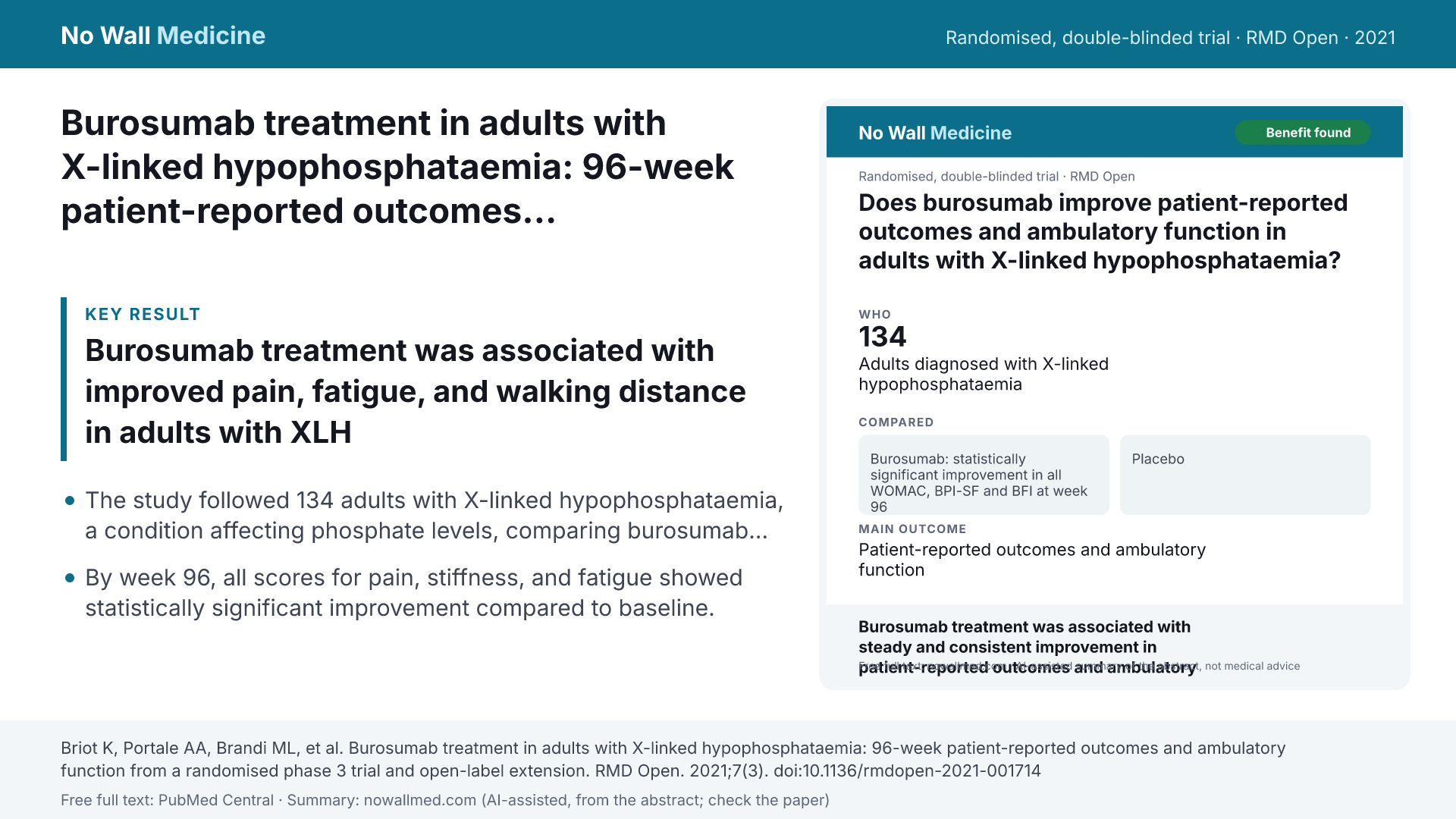
Burosumab treatment was associated with improved pain, fatigue, and walking distance in adults with XLH
Burosumab treatment in adults with X-linked hypophosphataemia: 96-week patient-reported outcomes and ambulatory function from a randomised phase 3 trial and open-label extension
Randomised, double-blinded trialBenefit found
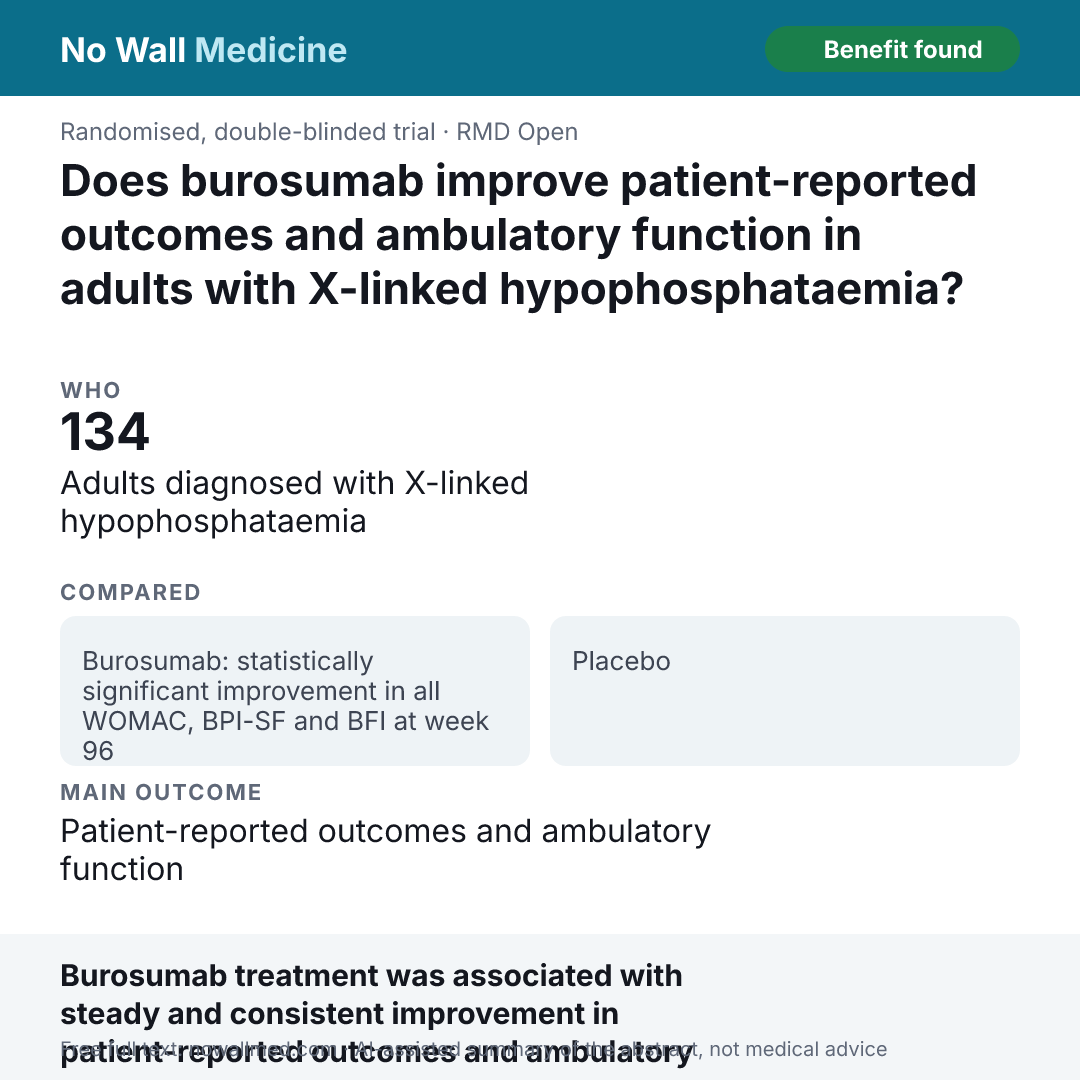
Does burosumab improve patient-reported outcomes and ambulatory function in adults with X-linked hypophosphataemia?
Who
134
Adults diagnosed with X-linked hypophosphataemia
Compared
Burosumab: statistically significant improvement in all WOMAC, BPI-SF and BFI at week 96
Placebo
Main outcome
Patient-reported outcomes and ambulatory function
Bottom line: Burosumab treatment was associated with steady and consistent improvement in patient-reported outcomes and ambulatory function.
RMD Open · 2021-09-22 · NCT02526160
Headline and visual abstract written with AI from the paper’s abstract, with every number checked against it. Read the paper before relying on them.
Was this summary helpful?
Abstract
Objectives
To report the impact of burosumab on patient-reported outcomes (PROs) and ambulatory function in adults with X-linked hypophosphataemia (XLH) through 96 weeks. Methods
Adults diagnosed with XLH were randomised 1:1 in a double-blinded trial to receive subcutaneous burosumab 1 mg/kg or placebo every 4 weeks for 24 weeks (NCT02526160). Thereafter, all subjects received burosumab every 4 weeks until week 96. PROs were measured using the Western Ontario and the McMaster Universities Osteoarthritis Index (WOMAC), Brief Pain Inventory-Short Form (BPI-SF) and Brief Fatigue Inventory (BFI), and ambulatory function was measured with the 6 min walk test (6MWT). Results
Subjects (N=134) were randomised to burosumab (n=68) or placebo (n=66) for 24 weeks. At baseline, subjects experienced pain, stiffness, and impaired physical and ambulatory function. At week 24, subjects receiving burosumab achieved statistically significant improvement in some BPI-SF scores, BFI worst fatigue (average and greatest) and WOMAC stiffness. At week 48, all WOMAC and BPI-SF scores achieved statistically significant improvement, with some WOMAC and BFI scores achieving meaningful and significant change from baseline. At week 96, all WOMAC, BPI-SF and BFI achieved statistically significant improvement, with selected scores in all measures also achieving meaningful change. Improvement in 6MWT distance and percent predicted were statistically significant at all time points from 24 weeks. Conclusions
Adults with XLH have substantial burden of disease as assessed by PROs and 6MWT. Burosumab treatment improved phosphate homoeostasis and was associated with a steady and consistent improvement in PROs and ambulatory function. Trial registration number
NCT02526160.
Abstract reproduced under the article’s CC BY NC licence.
Subject terms
Cite this article
Briot K, Portale AA, Brandi ML, et al. Burosumab treatment in adults with X-linked hypophosphataemia: 96-week patient-reported outcomes and ambulatory function from a randomised phase 3 trial and open-label extension. RMD Open. 2021;7(3). doi:10.1136/rmdopen-2021-001714
Spotted a mistake? Suggest a correction