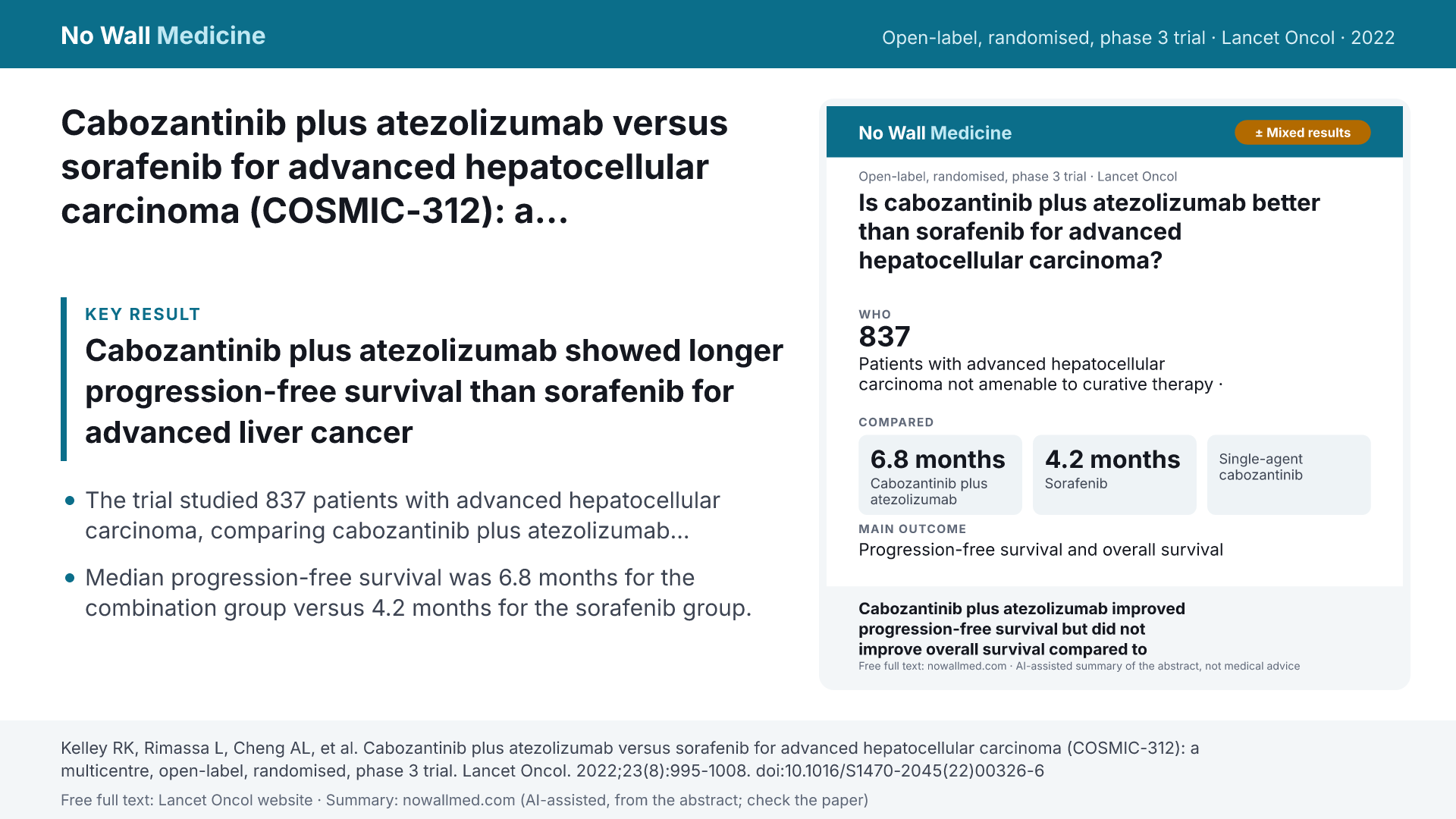
Cabozantinib plus atezolizumab showed longer progression-free survival than sorafenib for advanced liver cancer
Cabozantinib plus atezolizumab versus sorafenib for advanced hepatocellular carcinoma (COSMIC-312): a multicentre, open-label, randomised, phase 3 trial
Open-label, randomised, phase 3 trialMixed results
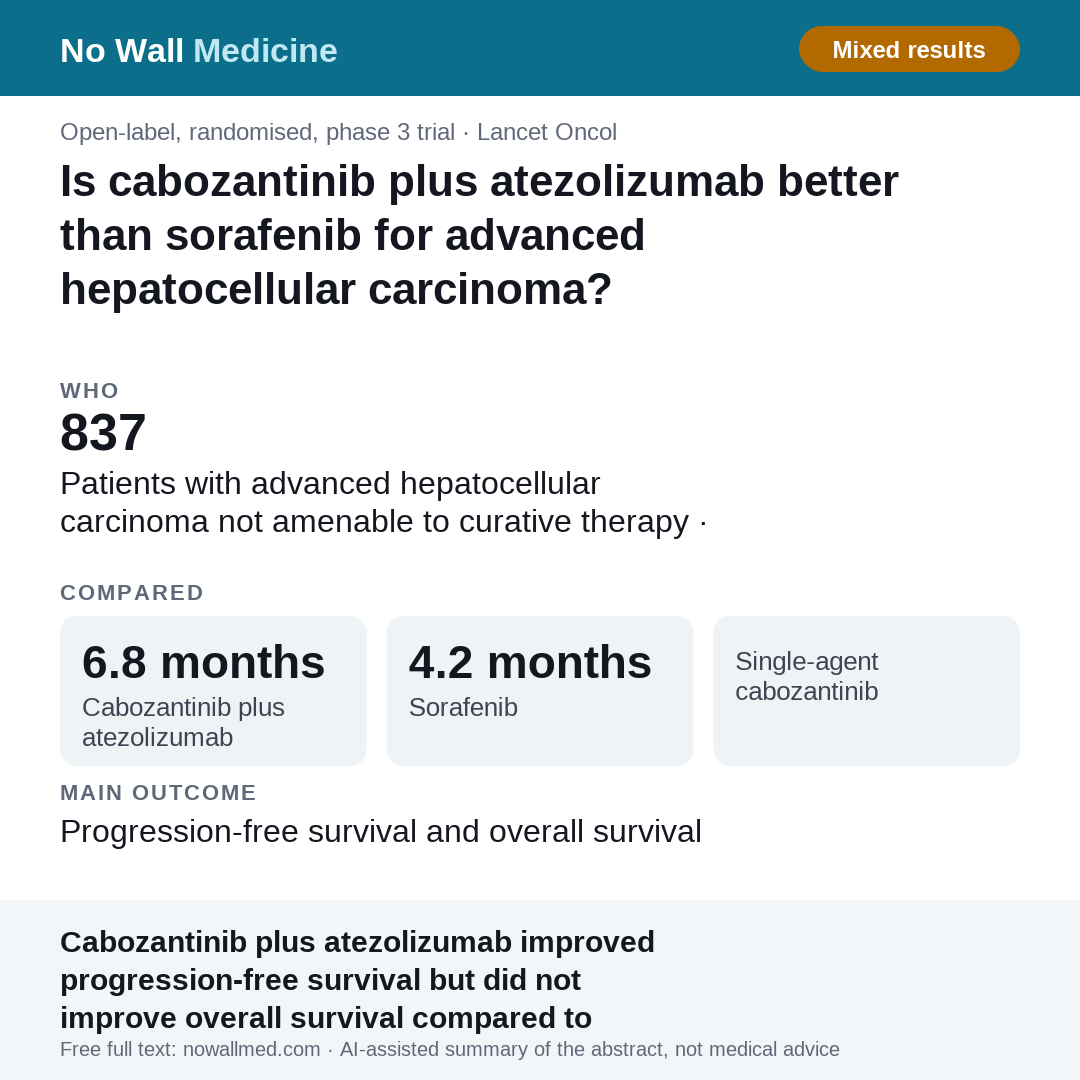
Is cabozantinib plus atezolizumab better than sorafenib for advanced hepatocellular carcinoma?
Who
837
Patients with advanced hepatocellular carcinoma not amenable to curative therapy · 178 centres in 32 countries
Compared
6.8 monthsCabozantinib plus atezolizumab (99% CI 5.6-8.3)
4.2 monthsSorafenib (2.8-7.0)
Single-agent cabozantinib
Main outcome
Progression-free survival and overall survival
Result: hazard ratio 0.63 (99% CI 0.44-0.91)
Bottom line: Cabozantinib plus atezolizumab improved progression-free survival but did not improve overall survival compared to sorafenib.
Lancet Oncol · 2022-07-04Download image
Clinical question: Is cabozantinib plus atezolizumab better than sorafenib for advanced hepatocellular carcinoma?
Why it matters: It was unknown if combining cabozantinib with atezolizumab provided better outcomes than the standard treatment sorafenib for patients with advanced liver cancer.
Key points
- The trial studied 837 patients with advanced hepatocellular carcinoma, comparing cabozantinib plus atezolizumab to sorafenib or single-agent cabozantinib.
- Median progression-free survival was 6.8 months for the combination group versus 4.2 months for the sorafenib group.
- Median overall survival was 15.4 months for the combination group compared to 15.5 months for the sorafenib group, which was not a statistically significant difference.
Headline and key points written with AI from the paper’s abstract, with every number checked against it. Read the paper before relying on them.
Was this summary helpful?
Abstract
Background
Cabozantinib has shown clinical activity in combination with checkpoint inhibitors in solid tumours. The COSMIC-312 trial assessed cabozantinib plus atezolizumab versus sorafenib as first-line systemic treatment for advanced hepatocellular carcinoma. Methods
COSMIC-312 is an open-label, randomised, phase 3 trial that enrolled patients aged 18 years or older with advanced hepatocellular carcinoma not amenable to curative or locoregional therapy and previously untreated with systemic anticancer therapy at 178 centres in 32 countries. Patients with fibrolamellar carcinoma, sarcomatoid hepatocellular carcinoma, or combined hepatocellular cholangiocarcinoma were not eligible. Tumours involving major blood vessels, including the main portal vein, were permitted. Patients were required to have measurable disease per Response Evaluation Criteria in Solid Tumors version 1.1 (RECIST 1.1), Barcelona Clinic Liver Cancer stage B or C disease, an Eastern Cooperative Oncology Group performance status of 0 or 1, adequate organ and marrow function, and Child-Pugh class A. Previous resection, tumour ablation, radiotherapy, or arterial chemotherapy was allowed if more than 28 days before randomisation. Patients were randomly assigned (2:1:1) via a web-based interactive response system to cabozantinib 40 mg orally once daily plus atezolizumab 1200 mg intravenously every 3 weeks, sorafenib 400 mg orally twice daily, or single-agent cabozantinib 60 mg orally once daily. Randomisation was stratified by disease aetiology, geographical region, and presence of extrahepatic disease or macrovascular invasion. Dual primary endpoints were progression-free survival per RECIST 1.1 as assessed by a blinded independent radiology committee in the first 372 patients randomly assigned to the combination treatment of cabozantinib plus atezolizumab or sorafenib (progression-free survival intention-to-treat [ITT] population), and overall survival in all patients randomly assigned to cabozantinib plus atezolizumab or sorafenib (ITT population). Final progression-free survival and concurrent interim overall survival analyses are presented. This trial is registered with ClinicalTrials.gov, NCT03755791. Findings
Analyses at data cut-off (March 8, 2021) included the first 837 patients randomly assigned between Dec 7, 2018, and Aug 27, 2020, to combination treatment of cabozantinib plus atezolizumab (n=432), sorafenib (n=217), or single-agent cabozantinib (n=188). Median follow-up was 15·8 months (IQR 14·5-17·2) in the progression-free survival ITT population and 13·3 months (10·5-16·0) in the ITT population. Median progression-free survival was 6·8 months (99% CI 5·6-8·3) in the combination treatment group versus 4·2 months (2·8-7·0) in the sorafenib group (hazard ratio [HR] 0·63, 99% CI 0·44-0·91, p=0·0012). Median overall survival (interim analysis) was 15·4 months (96% CI 13·7-17·7) in the combination treatment group versus 15·5 months (12·1-not estimable) in the sorafenib group (HR 0·90, 96% CI 0·69-1·18; p=0·44). The most common grade 3 or 4 adverse events were alanine aminotransferase increase (38 [9%] of 429 patients in the combination treatment group vs six [3%] of 207 in the sorafenib group vs 12 [6%] of 188 in the single-agent cabozantinib group), hypertension (37 [9%] vs 17 [8%] vs 23 [12%]), aspartate aminotransferase increase (37 [9%] vs eight [4%] vs 18 [10%]), and palmar-plantar erythrodysaesthesia (35 [8%] vs 17 [8%] vs 16 [9%]); serious treatment-related adverse events occurred in 78 (18%) patients in the combination treatment group, 16 (8%) patients in the sorafenib group, and 24 (13%) in the single-agent cabozantinib group. Treatment-related grade 5 events occurred in six (1%) patients in the combination treatment group (encephalopathy, hepatic failure, drug-induced liver injury, oesophageal varices haemorrhage, multiple organ dysfunction syndrome, and tumour lysis syndrome), one (<1%) patient in the sorafenib group (general physical health deterioration), and one (<1%) patient in the single-agent cabozantinib group (gastrointestinal haemorrhage). Interpretation
Cabozantinib plus atezolizumab might be a treatment option for select patients with advanced hepatocellular carcinoma, but additional studies are needed. Funding
Exelixis and Ipsen.
Abstract reproduced under the article’s CC BY NC ND licence.
Subject terms
Cite this article
Kelley RK, Rimassa L, Cheng AL, Kaseb A, Qin S, Zhu AX. Cabozantinib plus atezolizumab versus sorafenib for advanced hepatocellular carcinoma (COSMIC-312): a multicentre, open-label, randomised, phase 3 trial. Lancet Oncol. 2022. doi:10.1016/S1470-2045(22)00326-6
Spotted a mistake? Suggest a correction
Top studies every Monday
The week’s key trials and guidelines in your specialties, plus any topics you follow. By email, free.
Get the weekly digest