Calcium during cardiac arrest: A systematic review
Systematic reviewNo clear difference
Does calcium administration improve outcomes during cardiac arrest compared to no calcium?
Who
Adults and children with cardiac arrest · Any setting
Compared
Calcium administration
No calcium
Main outcome
Return of spontaneous circulation, survival, and neurologic outcome
Bottom line: Routine calcium administration does not improve outcomes for adults or children during cardiac arrest.
Limitation: Heterogeneity across studies precluded meaningful meta-analyses and risk of bias was high or critical.
Resusc Plus · 2023-03-27Download image
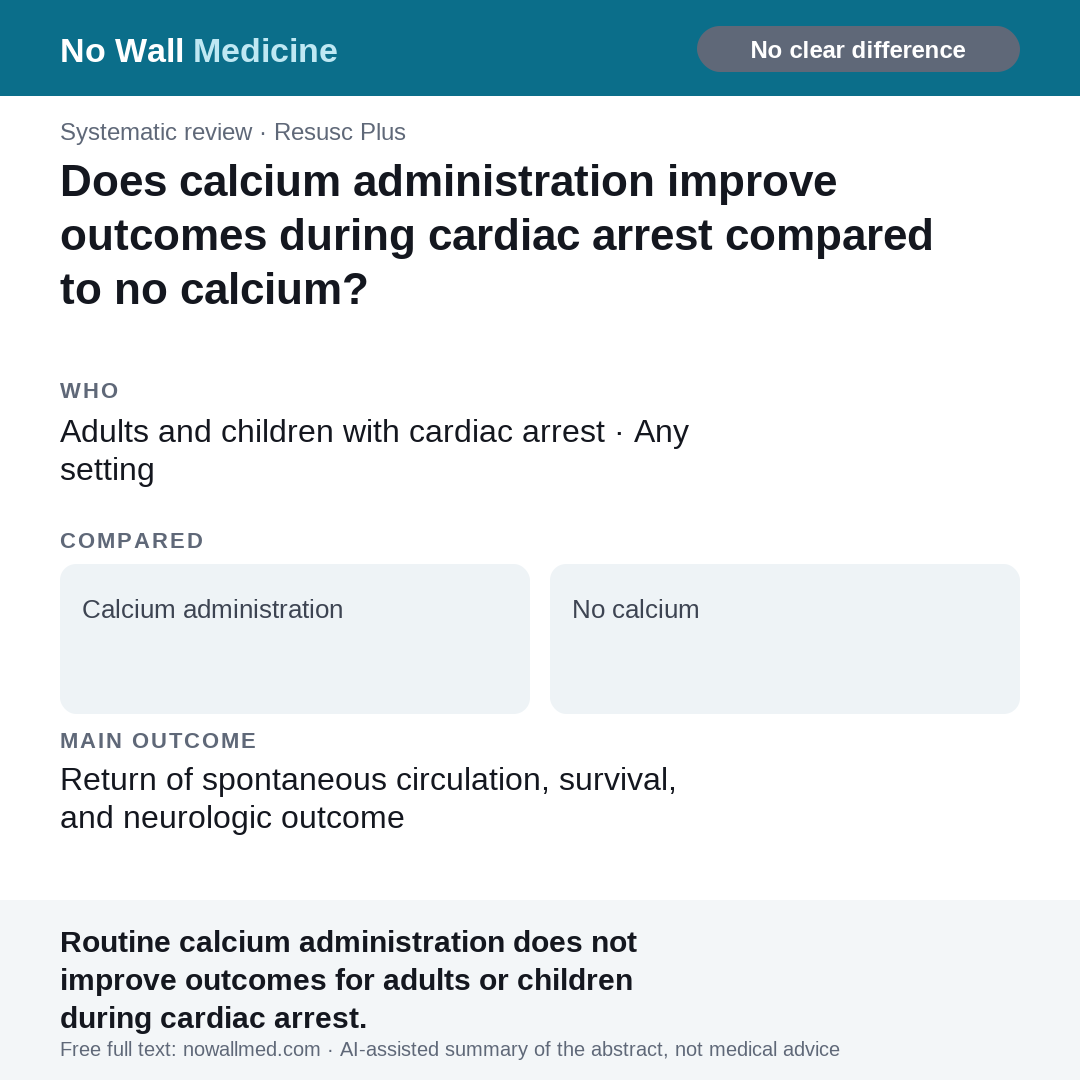
Clinical question: Does calcium administration improve outcomes during cardiac arrest compared to no calcium?
Abstract
Aim
To perform a systematic review of administration of calcium compared to no calcium during cardiac arrest. Methods
The search included Medline (PubMed), Embase, Cochrane, Web of Science, and CINAHL Plus and was conducted on September 30, 2022. The population included adults and children in any setting with cardiac arrest. The outcomes included return of spontaneous circulation, survival, survival with favourable neurologic outcome to hospital discharge and 30 days or longer, and quality of life outcome. Cochrane Risk of Bias 2 and ROBINS-I were performed to assess risk of bias for controlled and observational studies, respectively. Results
The systematic review identified 4 studies on 3 randomised controlled trials on 554 adult out-of-hospital cardiac arrest (OHCA) patients, 8 observational studies on 2,731 adult cardiac arrest patients, and 3 observational studies on 17,449 paediatric in-hospital cardiac arrest (IHCA) patients. The randomised controlled and observational studies showed that routine calcium administration during cardiac arrest did not improve the outcome of adult OHCA or IHCA or paediatric IHCA. The risk of bias for the adult trials was low for one recent trial and high for two earlier trials, with randomization as the primary source of bias. The risk of bias for the individual observational studies was assessed to be critical due to confounding. The certainty of evidence was assessed to be moderate for adult OHCA and low for adult and paediatric IHCA. Heterogeneity across studies precluded any meaningful meta-analyses. Conclusions
This systematic review found no evidence that routine calcium administration improves the outcomes of cardiac arrest in adults or children.PROSPERO Registration: CRD42022349641.
Cite this article
Hsu CH, Couper K, Nix T, Drennan I, Reynolds J, Kleinman M. Calcium during cardiac arrest: A systematic review. Resusc Plus. 2023. doi:10.1016/j.resplu.2023.100379
Spotted a mistake? Suggest a correction
Top studies every Monday
The week’s key trials and guidelines in your specialties, plus any topics you follow. By email, free.
Get the weekly digest