Electronic health record data results were different from a randomized trial for lung cancer treatment
Calibrating Observational Health Record Data Against a Randomized Trial
Retrospective cohort studyMixed results
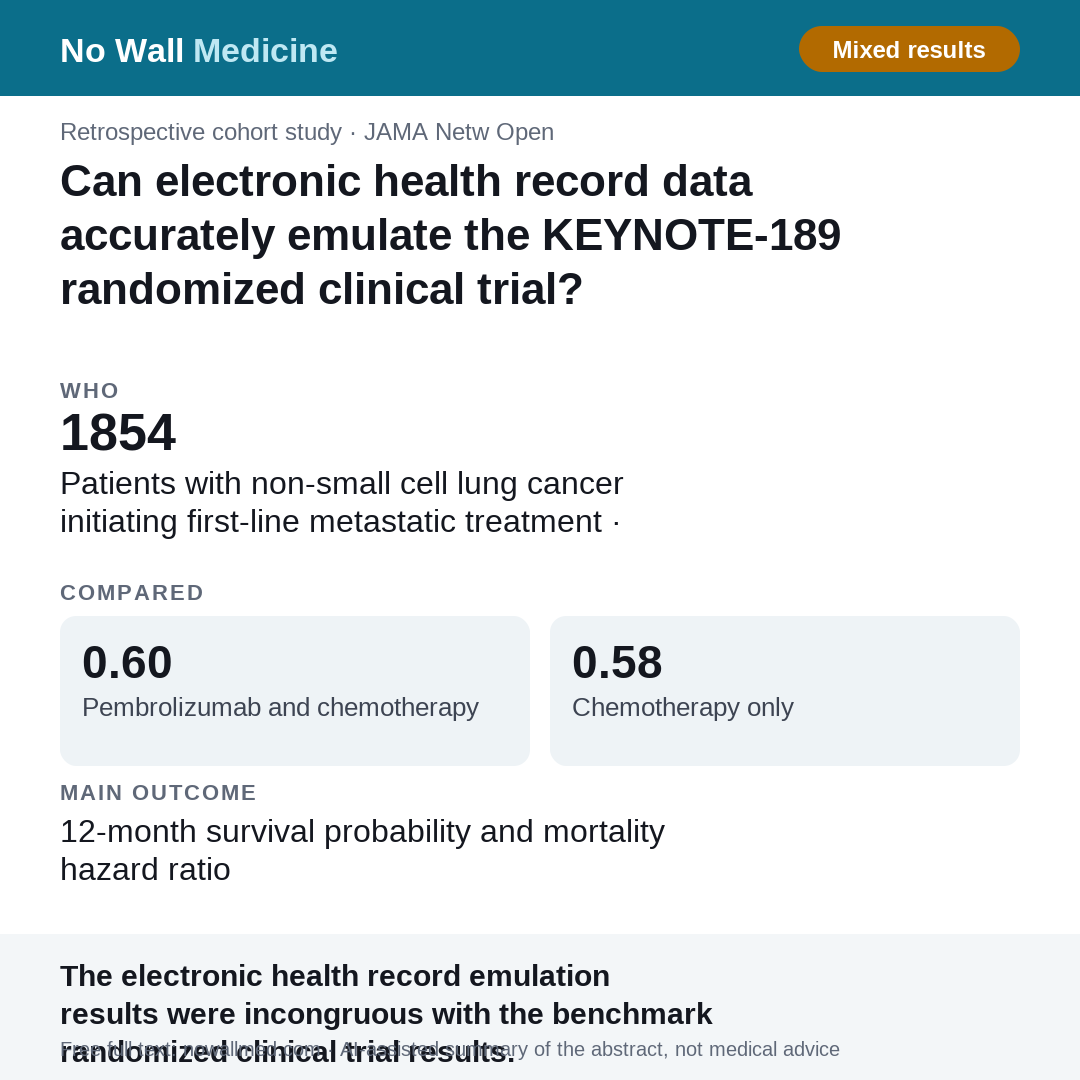
Can electronic health record data accurately emulate the KEYNOTE-189 randomized clinical trial?
Who
1854
Patients with non-small cell lung cancer initiating first-line metastatic treatment · 52 health systems across the US
Compared
0.60Pembrolizumab and chemotherapy (95% CI, 0.54-0.65)
0.58Chemotherapy only (95% CI, 0.55-0.62)
Main outcome
12-month survival probability and mortality hazard ratio
Result: hazard ratio 0.95 (95% CI, 0.78-1.16)
Bottom line: The electronic health record emulation results were incongruous with the benchmark randomized clinical trial results.
Limitation: Differences in patient treatment, data capture, confounding by indication, and treatment crossover may explain findings.
JAMA Netw Open · 2024-09-03Download image
Clinical question: Can electronic health record data accurately emulate the KEYNOTE-189 randomized clinical trial?
Why it matters: It is unclear what conditions are required for electronic health record data to accurately assess how effective a treatment is.
Key points
- Researchers studied 1854 patients with metastatic non-small cell lung cancer using an electronic health record database from 52 US health systems.
- The 12-month survival probability was 0.60 in the pembrolizumab and chemotherapy group and 0.58 in the chemotherapy-only group.
- The mortality hazard ratio was 0.95, which was different from the 0.49 reported in the KEYNOTE-189 randomized clinical trial.
Limitation the authors note: The authors noted that differences in patient treatment, data capture, confounding by indication, treatment crossover, and diagnosis accuracy may explain the findings.
Headline and key points written with AI from the paper’s abstract, with every number checked against it. Read the paper before relying on them.
Topics
Cite this article
Merola D, Campbell U, Lenis D, Schneeweiss S, Wang S, Madsen A. Calibrating Observational Health Record Data Against a Randomized Trial. JAMA Netw Open. 2024. doi:10.1001/jamanetworkopen.2024.36535
Spotted a mistake? Suggest a correction
Top studies every Monday
The week’s key trials and guidelines in your specialties, by email. Free.
Get the weekly digest