Short-term high-dose oat intake decreased gut permeability markers in people with metabolic syndrome
Calorie-restricted oat diet is associated with zonulin and short-chain fatty acid response in metabolic syndrome: a randomized controlled trial
Randomized, controlled parallel designBenefit found
Do different oat diets affect gut permeability markers in metabolic syndrome?
Who
Individuals with metabolic syndrome
Compared
2-day calorie-restricted oat diet: serum zonulin decreased
6-week isocaloric oat diet: parameters remained stable
Main outcome
gut permeability markers
Bottom line: Short-term high-dose calorie-restricted oat intake may improve gut permeability markers in metabolic syndrome.
Gut Microbes · 2026-04-23Download image
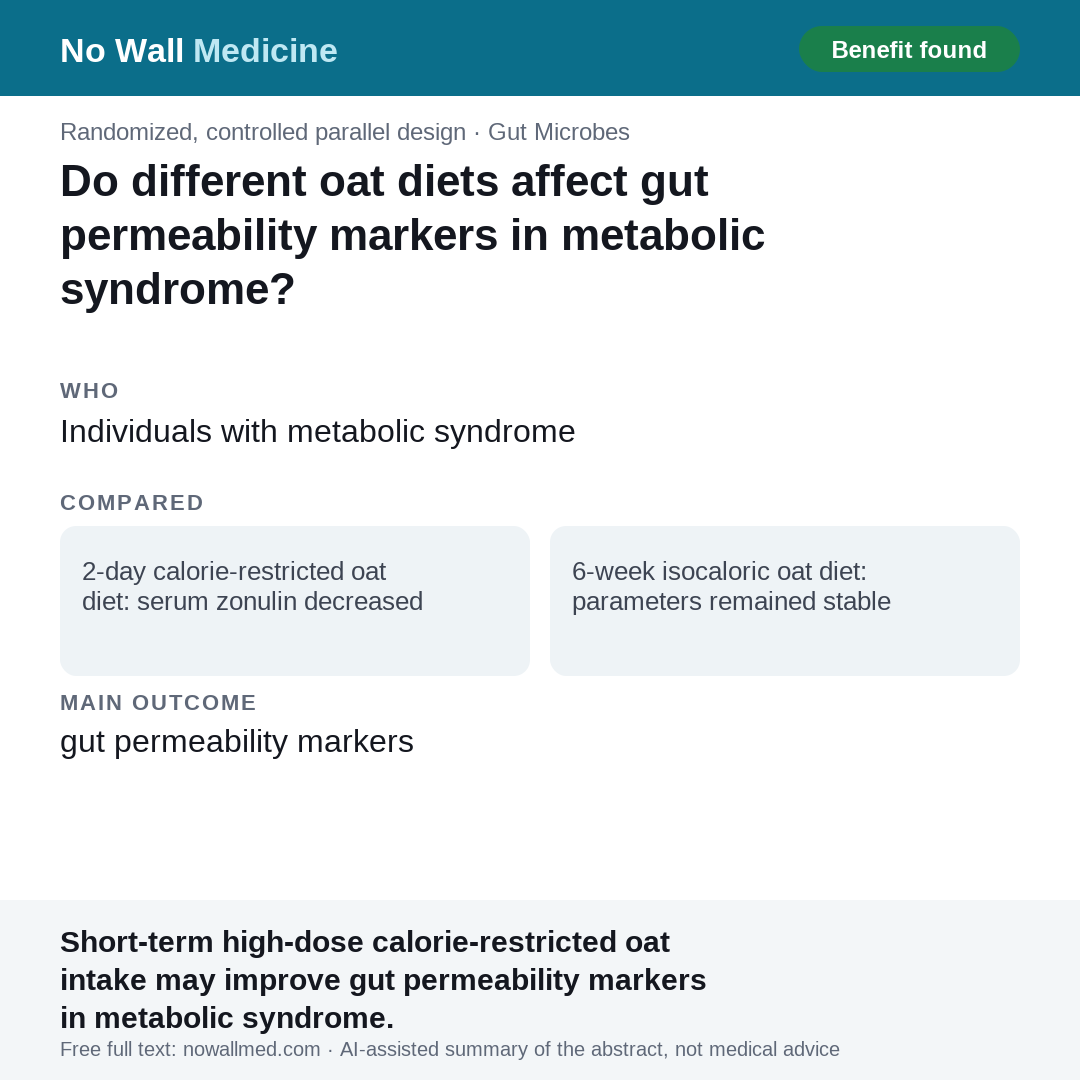
Clinical question: Do different oat diets affect gut permeability markers in metabolic syndrome?
Why it matters: Human studies are largely lacking regarding how different oat diets affect gut health markers in individuals with metabolic syndrome.
Key points
- Researchers studied 27 individuals with metabolic syndrome receiving either 3 × 100 g of oatmeal per day for 2 days or an adapted control diet.
- The 2-day calorie-restricted oat diet decreased serum zonulin, a marker of gut permeability, and increased plasma butyric acid compared to the control.
- In a separate group of 22 participants, these same gut health parameters remained stable during a 6-week isocaloric oat diet.
Headline and key points written with AI from the paper’s abstract, with every number checked against it. Read the paper before relying on them.
Topics
Cite this article
Klümpen L, Mantri A, Donkers A, Seel W, Stoffel-Wagner B, Coenen M. Calorie-restricted oat diet is associated with zonulin and short-chain fatty acid response in metabolic syndrome: a randomized controlled trial. Gut Microbes. 2026. doi:10.1080/19490976.2026.2662687
Spotted a mistake? Suggest a correction