Modified ketogenic diet increased maximal exercise capacity and fat oxidation in McArdle disease patients
Can a modified ketogenic diet be a nutritional strategy for patients with McArdle disease? Results from a randomized, single-blind, placebo-controlled, cross-over study
Randomized, single-blind, placebo-controlled, cross-over studyMixed results
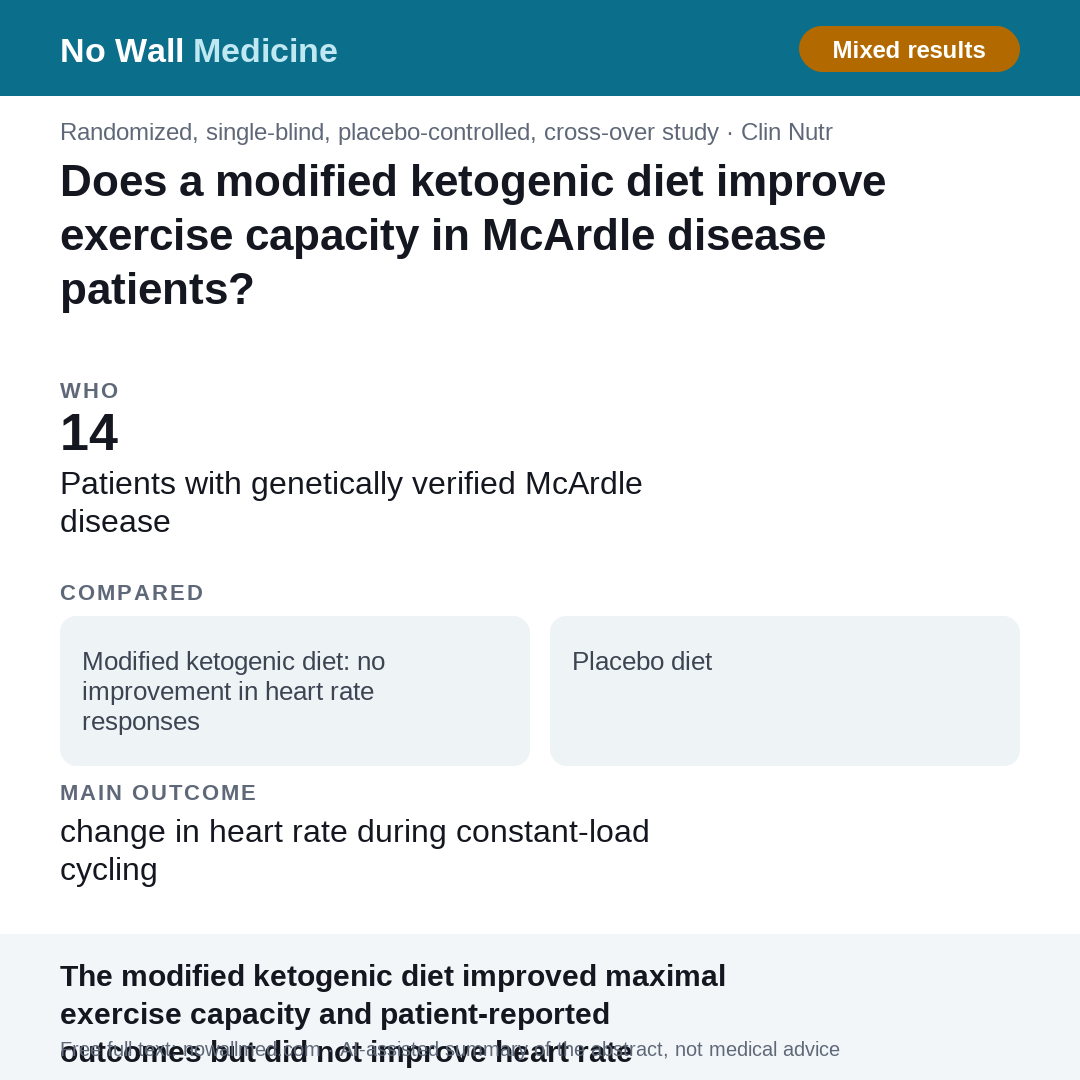
Does a modified ketogenic diet improve exercise capacity in McArdle disease patients?
Who
14
Patients with genetically verified McArdle disease
Compared
Modified ketogenic diet: no improvement in heart rate responses
Placebo diet
Main outcome
change in heart rate during constant-load cycling
Bottom line: The modified ketogenic diet improved maximal exercise capacity and patient-reported outcomes but did not improve heart rate responses.
Clin Nutr · 2023-09-20Download image
Clinical question: Does a modified ketogenic diet improve exercise capacity in McArdle disease patients?
Why it matters: It is unknown if a modified ketogenic diet can provide alternative fuels to improve exercise capacity in individuals with McArdle disease.
Key points
- Researchers studied 14 patients with genetically verified McArdle disease using a randomized, single-blind, placebo-controlled, cross-over design comparing a modified ketogenic diet to a placebo diet.
- The modified ketogenic diet was associated with a ~60% increase in fat oxidation, a 19-fold increase in plasma β-hydroxybutyrate, and a ~20% increase in maximal exercise capacity.
- The modified ketogenic diet was not associated with improved heart rate responses during constant-load cycling compared to the placebo diet.
Headline and key points written with AI from the paper’s abstract, with every number checked against it. Read the paper before relying on them.
Was this summary helpful?
Subject terms
Cite this article
Løkken N, Nielsen MR, Stemmerik MG, Ellerton C, Revsbech KL, Macrae M. Can a modified ketogenic diet be a nutritional strategy for patients with McArdle disease? Results from a randomized, single-blind, placebo-controlled, cross-over study. Clin Nutr. 2023. doi:10.1016/j.clnu.2023.09.006
Spotted a mistake? Suggest a correction
Top studies every Monday
The week’s key trials and guidelines in your specialties, plus any topics you follow. By email, free.
Get the weekly digest