Can changes in social contact (frequency and mode) mitigate low mood before and during the COVID-19 pandemic? The I-CONECT project
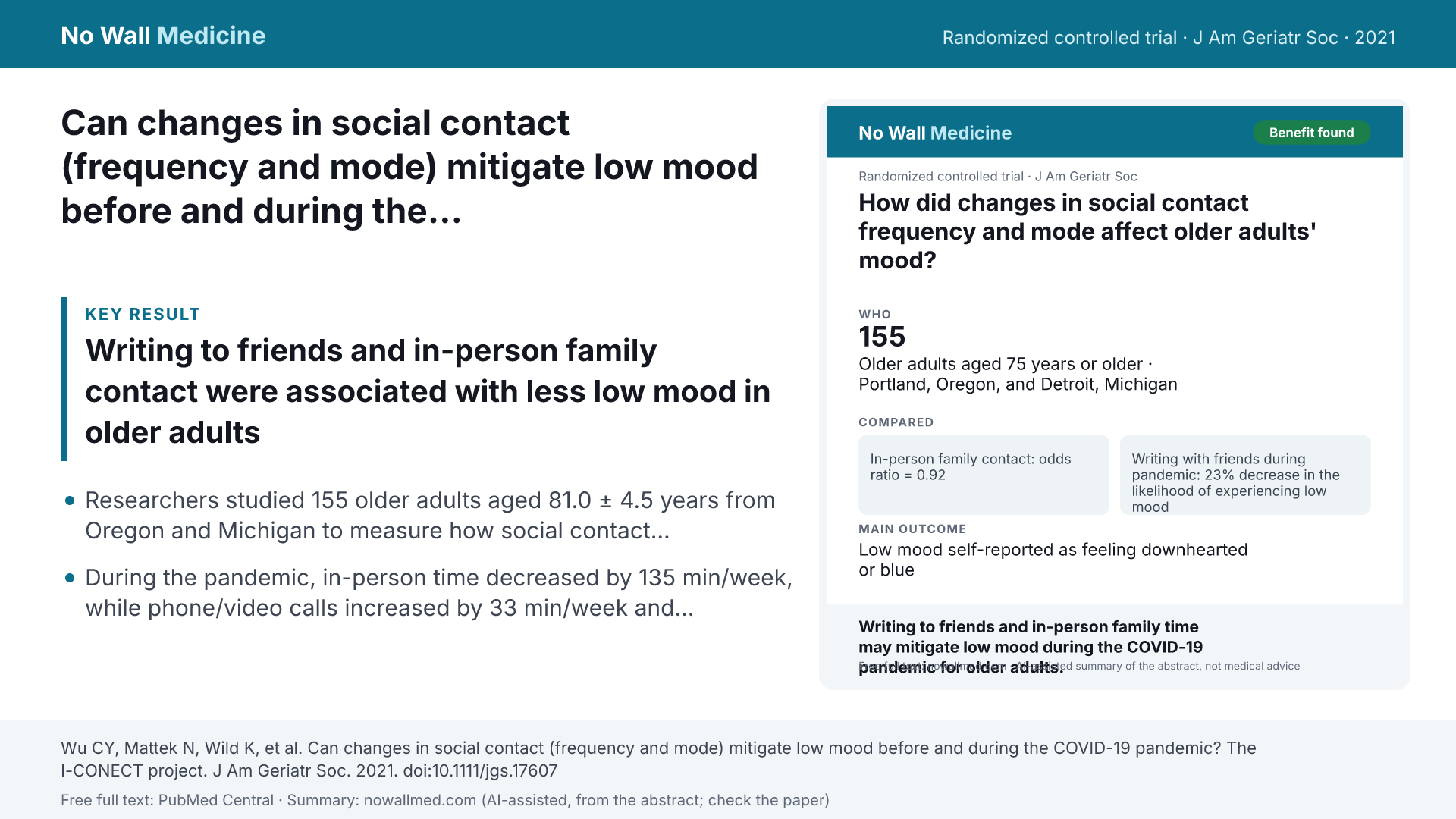
Key result: Writing to friends and in-person family contact were associated with less low mood in older adults
Randomized controlled trialBenefit found
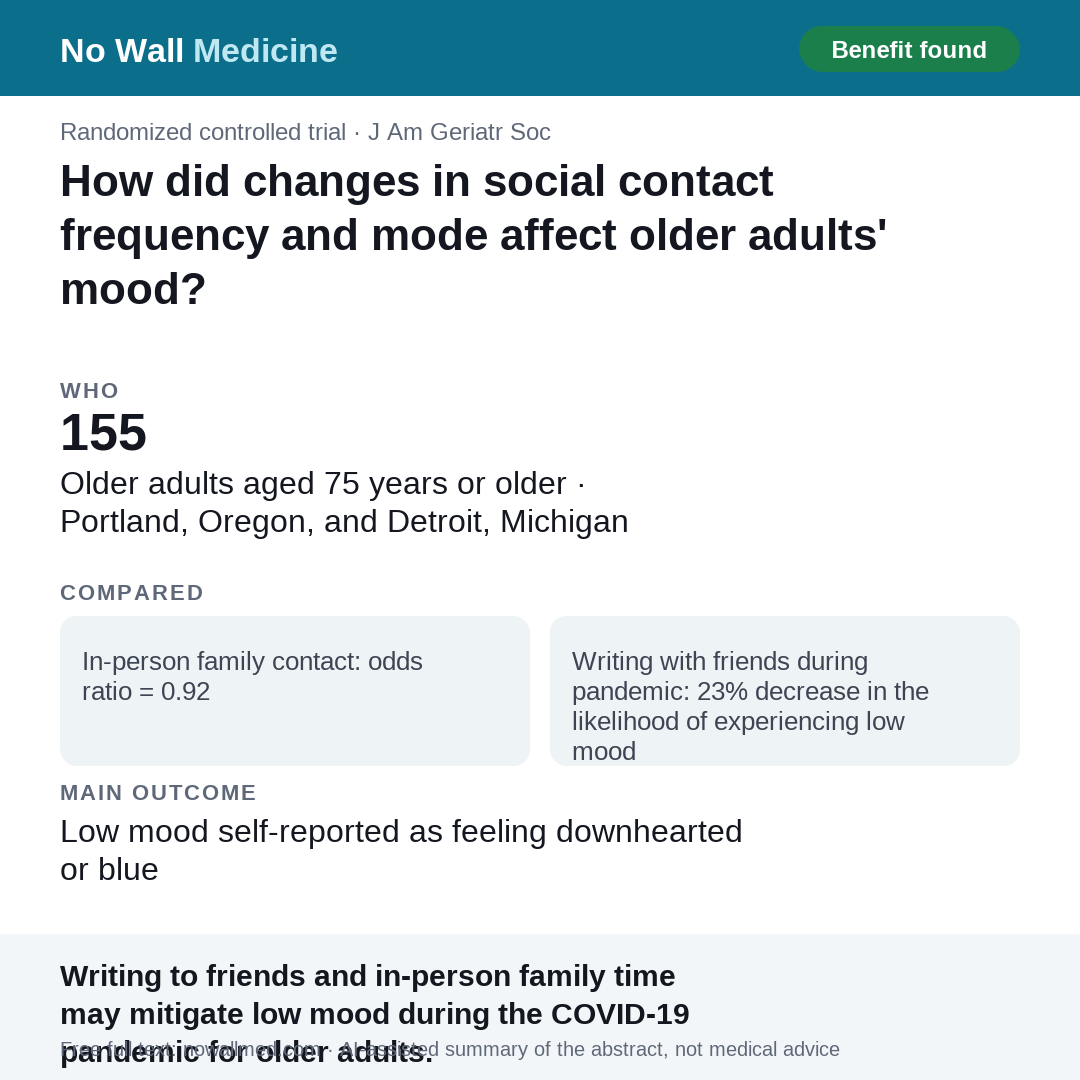
How did changes in social contact frequency and mode affect older adults' mood?
Who
155
Older adults aged 75 years or older · Portland, Oregon, and Detroit, Michigan
Compared
In-person family contact: odds ratio = 0.92
Writing with friends during pandemic: 23% decrease in the likelihood of experiencing low mood
Main outcome
Low mood self-reported as feeling downhearted or blue
Result: odds ratio = 0.92, p < 0.05
Bottom line: Writing to friends and in-person family time may mitigate low mood during the COVID-19 pandemic for older adults.
J Am Geriatr Soc · 2021-12-13Download image
Key points
- Researchers studied 155 older adults aged 81.0 ± 4.5 years from Oregon and Michigan to measure how social contact patterns affected mood.
- During the pandemic, in-person time decreased by 135 min/week, while phone/video calls increased by 33 min/week and writing increased by 26 min/week.
- An increase of 1 h of writing with friends per week during the pandemic was associated with a 23% decrease in the likelihood of low mood.
Why it matters: It was unknown how changes in the frequency and modes of social contact affected the emotional well-being of older adults during the COVID-19 pandemic.
Discussion prompts
- Would these patients look like yours? Who was left out?
- Is the main outcome one that matters to patients?
- Is the difference large enough to change what you do?
Cite: Wu CY, Mattek N, Wild K, Miller LM, Kaye JA, Silbert LC. Can changes in social contact (frequency and mode) mitigate low mood before and during the COVID-19 pandemic? The I-CONECT project. J Am Geriatr Soc. 2021. doi:10.1111/jgs.17607
Free full text: PubMed Central · Summary and visual abstract: nowallmed.com/a/can-changes-in-social-contact-frequency-and-mode-mitigate-low-mood-1rgqjv4/ (AI-assisted from the abstract; check the paper before relying on it).