Animation and images helped adults intend to use ChatGPT less for high risk health questions
Can co-designed educational interventions help consumers think critically about asking ChatGPT health questions? Results from a randomised-controlled trial
Randomised controlled trialBenefit found
Do co-designed educational interventions help consumers critically reflect on asking ChatGPT health questions?
Who
592
Australian adults with ChatGPT experience and without university education · Online panel
Compared
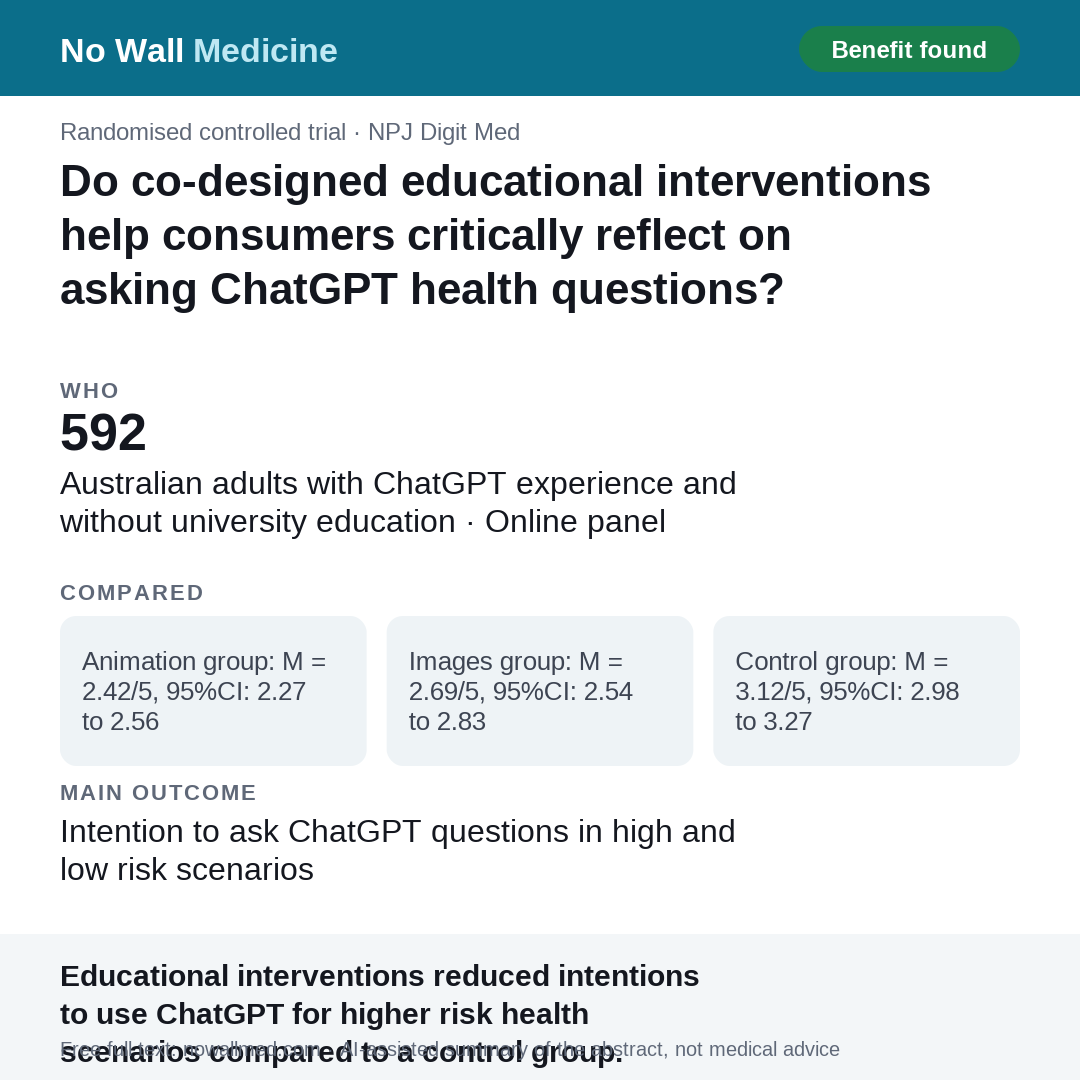
Animation group: M = 2.42/5, 95%CI: 2.27 to 2.56
Images group: M = 2.69/5, 95%CI: 2.54 to 2.83
Control group: M = 3.12/5, 95%CI: 2.98 to 3.27
Main outcome
Intention to ask ChatGPT questions in high and low risk scenarios
Bottom line: Educational interventions reduced intentions to use ChatGPT for higher risk health scenarios compared to a control group.
NPJ Digit Med · 2025-11-17Download image
Clinical question: Do co-designed educational interventions help consumers critically reflect on asking ChatGPT health questions?
Why it matters: It is unclear if co-designed educational interventions can help people critically reflect on the risks of using artificial intelligence tools for health information.
Key points
- Researchers studied 592 Australian adults without university education to see if educational animations or images helped them think critically about using ChatGPT for health information.
- The animation group (n=191) reported a lower intention to use ChatGPT for high risk scenarios (M=2.42/5) compared to the images group (n=203, M=2.69/5).
- Both educational groups showed lower intentions for high risk scenarios than the control group (n=205, M=3.12/5), but there was no effect on intentions for lower risk scenarios (p=0.800).
Headline and key points written with AI from the paper’s abstract, with every number checked against it. Read the paper before relying on them.
Cite this article
Ayre J, Taba M, Nickel B, Edlund G, Vu T, Yan J. Can co-designed educational interventions help consumers think critically about asking ChatGPT health questions? Results from a randomised-controlled trial. NPJ Digit Med. 2025. doi:10.1038/s41746-025-02056-5
Spotted a mistake? Suggest a correction