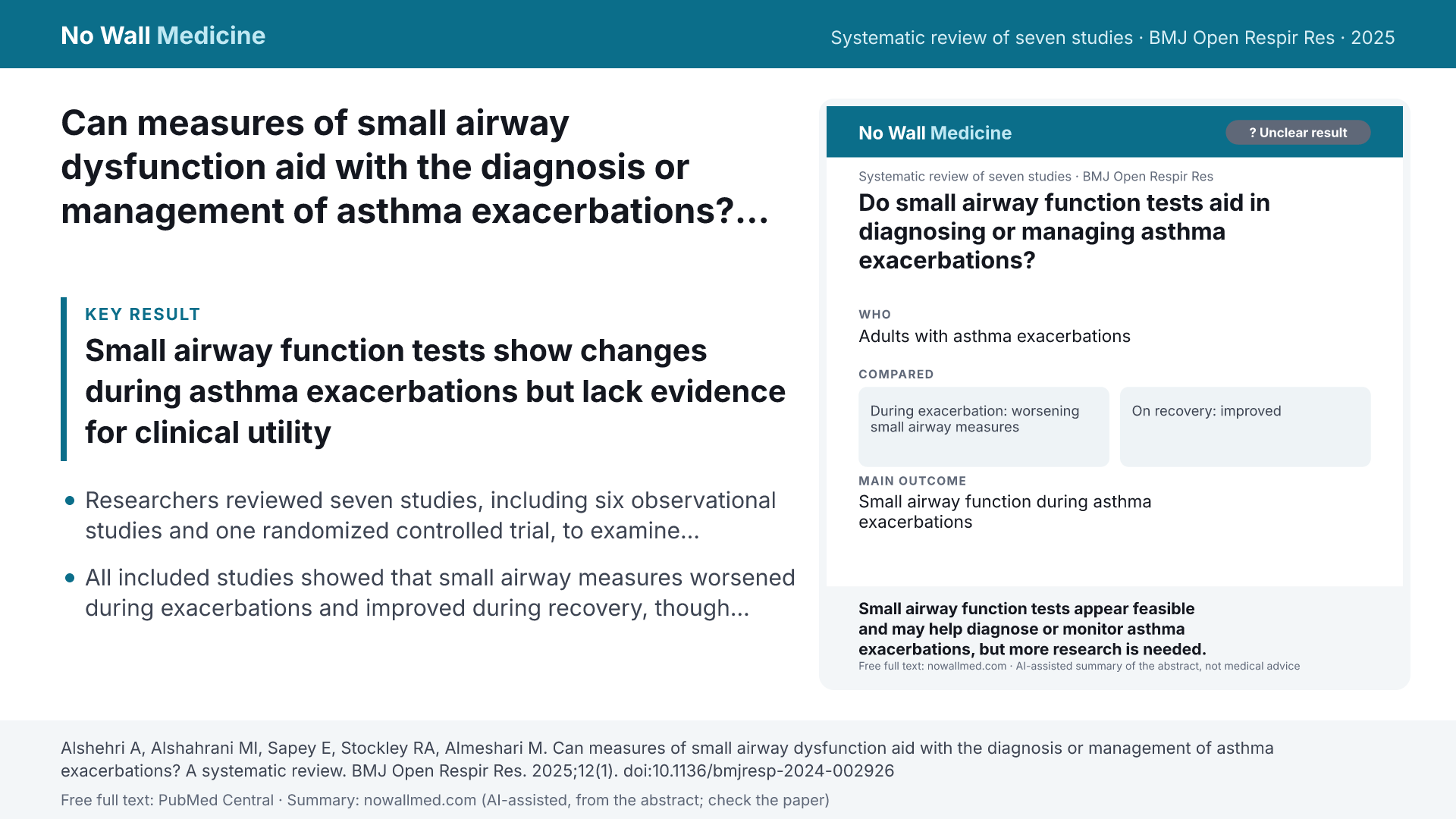
Small airway function tests show changes during asthma exacerbations but lack evidence for clinical utility
Can measures of small airway dysfunction aid with the diagnosis or management of asthma exacerbations? A systematic review
Systematic review of seven studiesUnclear result
Do small airway function tests aid in diagnosing or managing asthma exacerbations?
Who
Adults with asthma exacerbations
Compared
During exacerbation: worsening small airway measures
On recovery: improved
Main outcome
Small airway function during asthma exacerbations
Bottom line: Small airway function tests appear feasible and may help diagnose or monitor asthma exacerbations, but more research is needed.
Limitation: Existing studies are heterogeneous and no study specifically tested improved diagnosis or monitoring.
BMJ Open Respir Res · 2025-06-26 · Save PNG
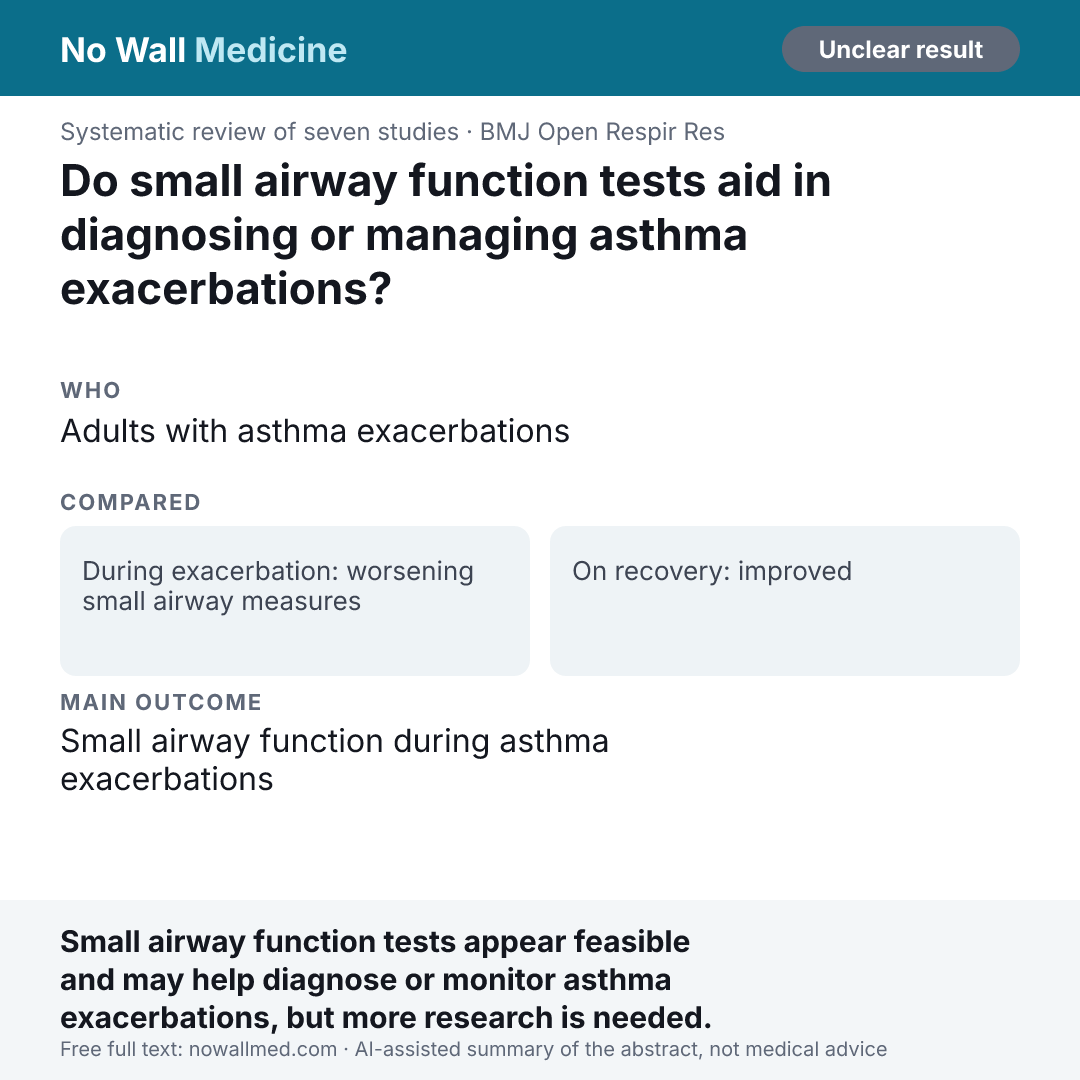
Clinical question: Do small airway function tests aid in diagnosing or managing asthma exacerbations?
Why it matters: Current diagnosis of asthma exacerbations relies on clinical assessment and spirometry, which lacks a gold standard test for identifying treatable traits.
Key points
- Researchers reviewed seven studies, including six observational studies and one randomized controlled trial, to examine small airway tests in adults with asthma exacerbations.
- All included studies showed that small airway measures worsened during exacerbations and improved during recovery, though no study tested if these tests improved diagnosis or monitoring.
- In one study, forced expiratory flow between 25% and 75% of forced vital capacity showed a greater percentage change than forced expiratory volume in one second after recovery.
Limitation the authors note: Existing studies are heterogeneous and no study specifically tested whether small airway function tests improved the diagnosis or monitoring of exacerbations.
Headline and key points written with AI from the paper’s abstract, with every number checked against it. Read the paper before relying on them.
Was this summary helpful?
Abstract
Background
Asthma exacerbations are acute episodes with worsened symptoms and decreased lung function. Current diagnosis relies on clinical assessment and spirometry, lacking a gold standard test. Interest in small airways tests suggests they may identify treatable traits. This review examines evidence for using small airways tests in diagnosing and managing exacerbations. Methods
The protocol was prospectively registered on PROSPERO, and the systematic review followed standard methodology. Multiple electronic databases were searched, including MEDLINE (Ovid), EMBASE (Ovid), CINAHL (EBSCOhost) and Cochrane Central Register of Controlled Trials (Cochrane Library). The search strategy combined subject headings and keywords related to asthma exacerbations and small airway function tests. Observational studies and randomised controlled trials (RCTs) assessing these tests for detecting or monitoring exacerbations in adults (≥18 years) were included, without language or date restrictions. Risk of bias was evaluated using the Newcastle-Ottawa Scale (NOS) for observational studies and the Cochrane Risk of Bias 2 tool for RCTs. Results
Seven studies (six observational, one RCT) met the inclusion criteria. Five included forced expiratory flow between 25% and 75% of forced vital capacity (FEF25-75), also referred to as maximal mid-expiratory flow; one used isolated forced expiratory flow measures (FEF25, FEF50 and FEF75); and one included multiple breath washout (MBW). No study specifically tested whether small airway function tests improved the diagnosis or monitoring of exacerbations. However, all showed worsening small airway measures during exacerbations, which improved on recovery. FEF25-75 showed greater percentage change than forced expiratory volume in one second postrecovery. The MBW study reported increased acinar ventilation heterogeneity (Sacin) and conductive ventilation heterogeneity (Scond), suggesting small airway involvement. Conclusion
Conducting physiological tests for small airway function appears feasible during an exacerbation. These tests may have utility in the diagnosis or monitoring of acute asthma exacerbations. However, existing studies are heterogeneous and further research is needed. Prospero registration number
CRD42024494994.
Abstract reproduced under the article’s CC BY NC licence.
Subject terms
Headline, design, result, key points, caveat and citation as plain text.
Cite this article
Alshehri A, Alshahrani MI, Sapey E, Stockley RA, Almeshari M. Can measures of small airway dysfunction aid with the diagnosis or management of asthma exacerbations? A systematic review. BMJ Open Respir Res. 2025;12(1). doi:10.1136/bmjresp-2024-002926
Spotted a mistake? Suggest a correction