Can motion capture improve task-based fMRI studies of motor function post-stroke? A systematic review
Systematic literature reviewBenefit found
Can motion capture improve task-based functional magnetic resonance imaging studies of motor function post-stroke?
Who
23
Post-stroke individuals
Compared
Studies using kinematic information
Studies without kinematic coupling
Main outcome
Understanding of motor function and cortico-kinematic relationships
Bottom line: Coupling functional magnetic resonance imaging and kinematics may provide valuable insight into cortico-kinematic relationships post-stroke.
J Neuroeng Rehabil · 2025-04-03Download image
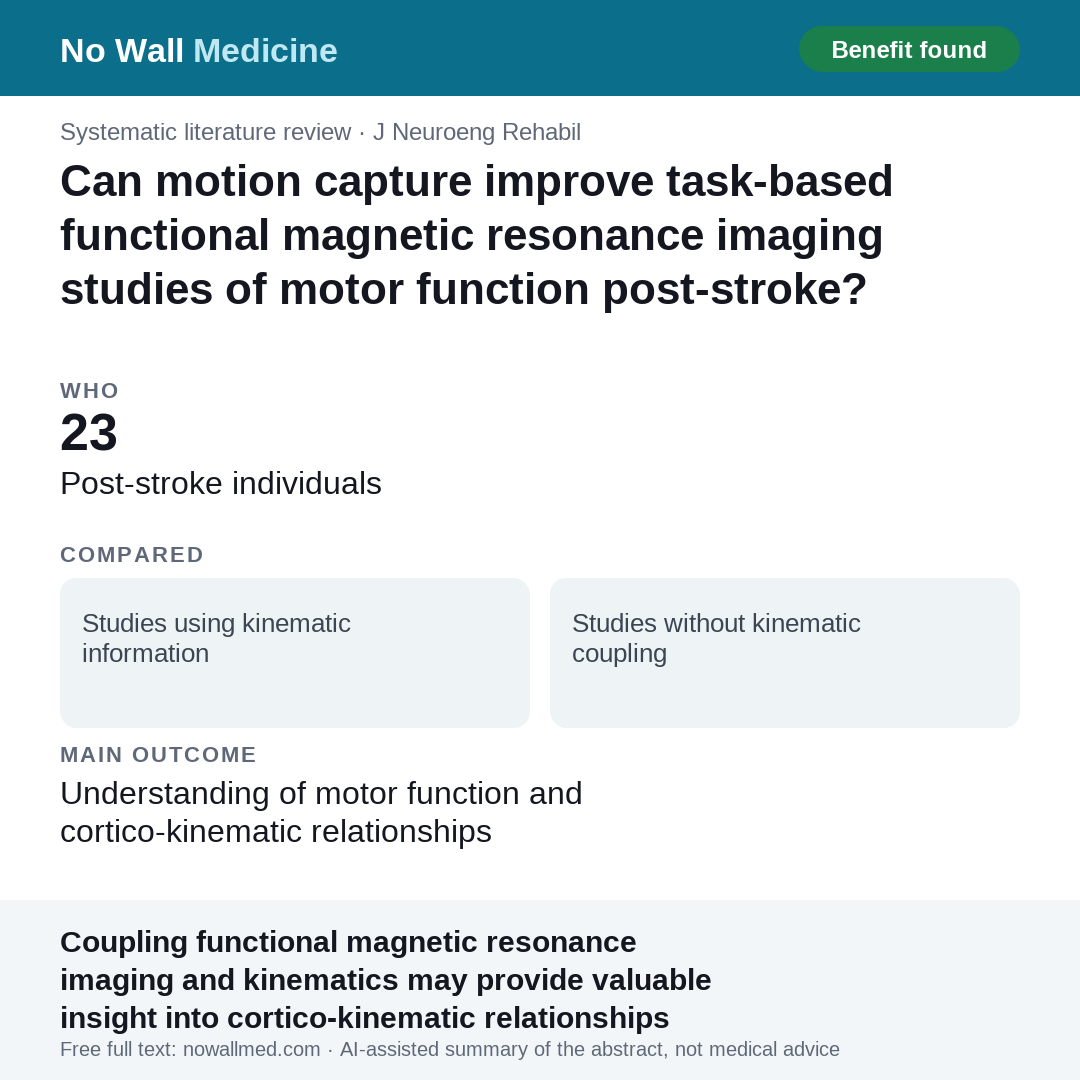
Clinical question: Can motion capture improve task-based functional magnetic resonance imaging studies of motor function post-stroke?
Abstract
Background
Variability in motor recovery after stroke represents a major challenge in its understanding and management. While functional MRI has been used to unravel interactions between stroke motor function and clinical outcome, fMRI alone cannot clarify any relation between brain activation and movement characteristics. Objectives
We aimed to identify fMRI and kinematic coupling approaches and to evaluate their potential contribution to the understanding of motor function post-stroke. Method
A systematic literature review was performed according to PRISMA guidelines on studies using fMRI and kinematics in post-stroke individuals. We assessed the internal, external, statistical, and technological validity of each study. Data extraction included study design and analysis procedures used to couple brain activity with movement characteristics. Results
Of the 404 studies found, 23 were included in the final review. The overall study quality was moderate (0.6/1). Thirteen studies used kinematic information either parallel to the fMRI results, or as a real-time input to external devices, for instance to provide feedback to the patient. Ten studies performed a statistical analysis between movement and brain activity by either using kinematics as variables during group or individual level regression or correlation. This permitted establishing links between movement characteristics and brain activity, unraveling cortico-kinematic relationships. For instance, increased activity in the ipsilesional Premotor Cortex was related to less smooth movements, whereas trunk compensation was expressed by increased activity in the contralesional Primary Motor Cortex. Conclusion
Our review suggests that the coupling of fMRI and kinematics may provide valuable insight into cortico-kinematic relationships. The optimization and standardization of both data measurement and treatment procedures may help the field to move forward and to fully use the potential of multimodal cortico-kinematic integration to unravel the complexity of post-stroke motor function and recovery.
Topics
Cite this article
Belkacemi Z, van Dokkum LEH, Tchechmedjiev A, Lepetit-Coiffe M, Mottet D, Le Bars E. Can motion capture improve task-based fMRI studies of motor function post-stroke? A systematic review. J Neuroeng Rehabil. 2025. doi:10.1186/s12984-025-01611-1
Spotted a mistake? Suggest a correction