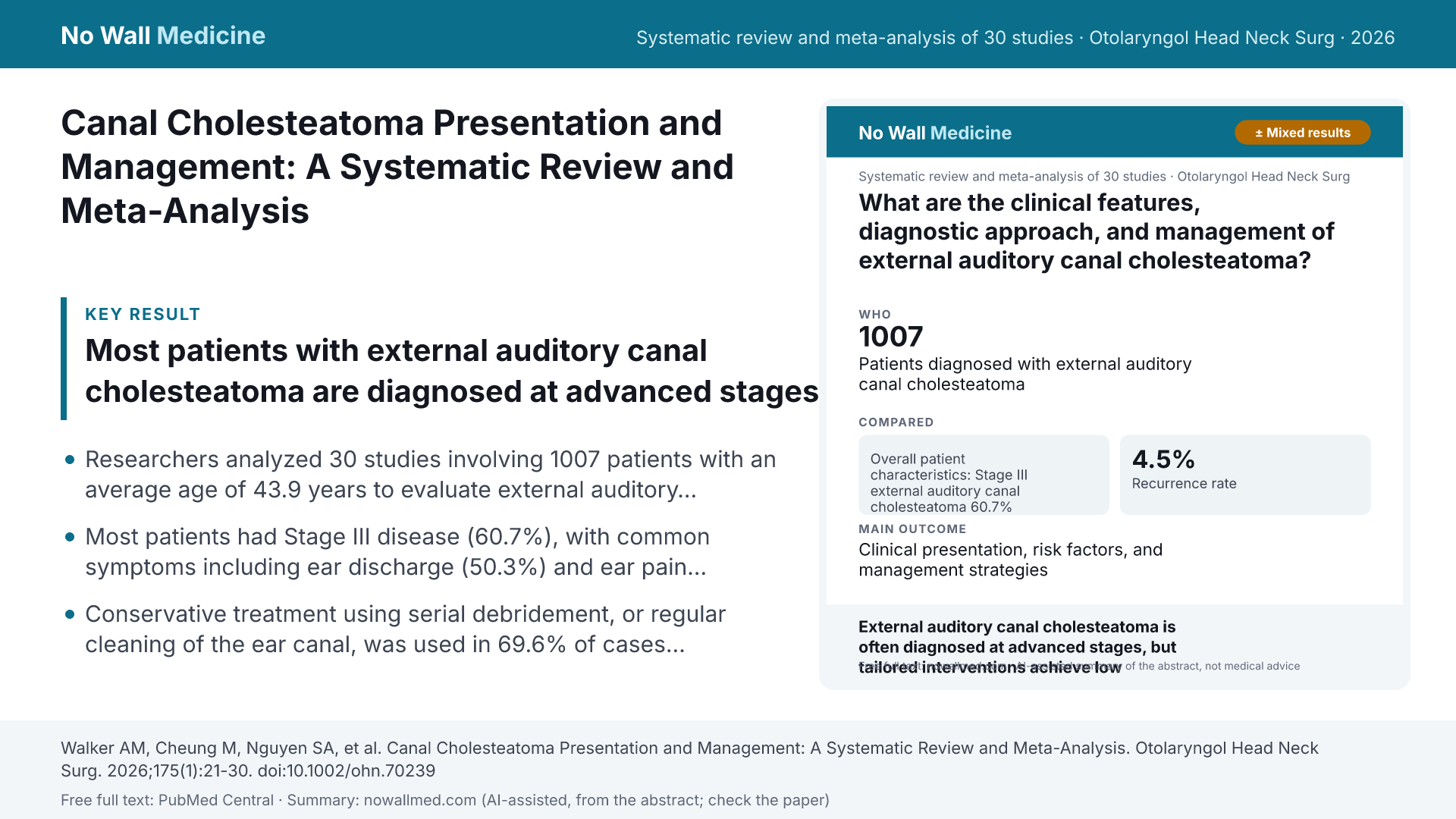
Most patients with external auditory canal cholesteatoma are diagnosed at advanced stages
Canal Cholesteatoma Presentation and Management: A Systematic Review and Meta-Analysis
Systematic review and meta-analysis of 30 studiesMixed results
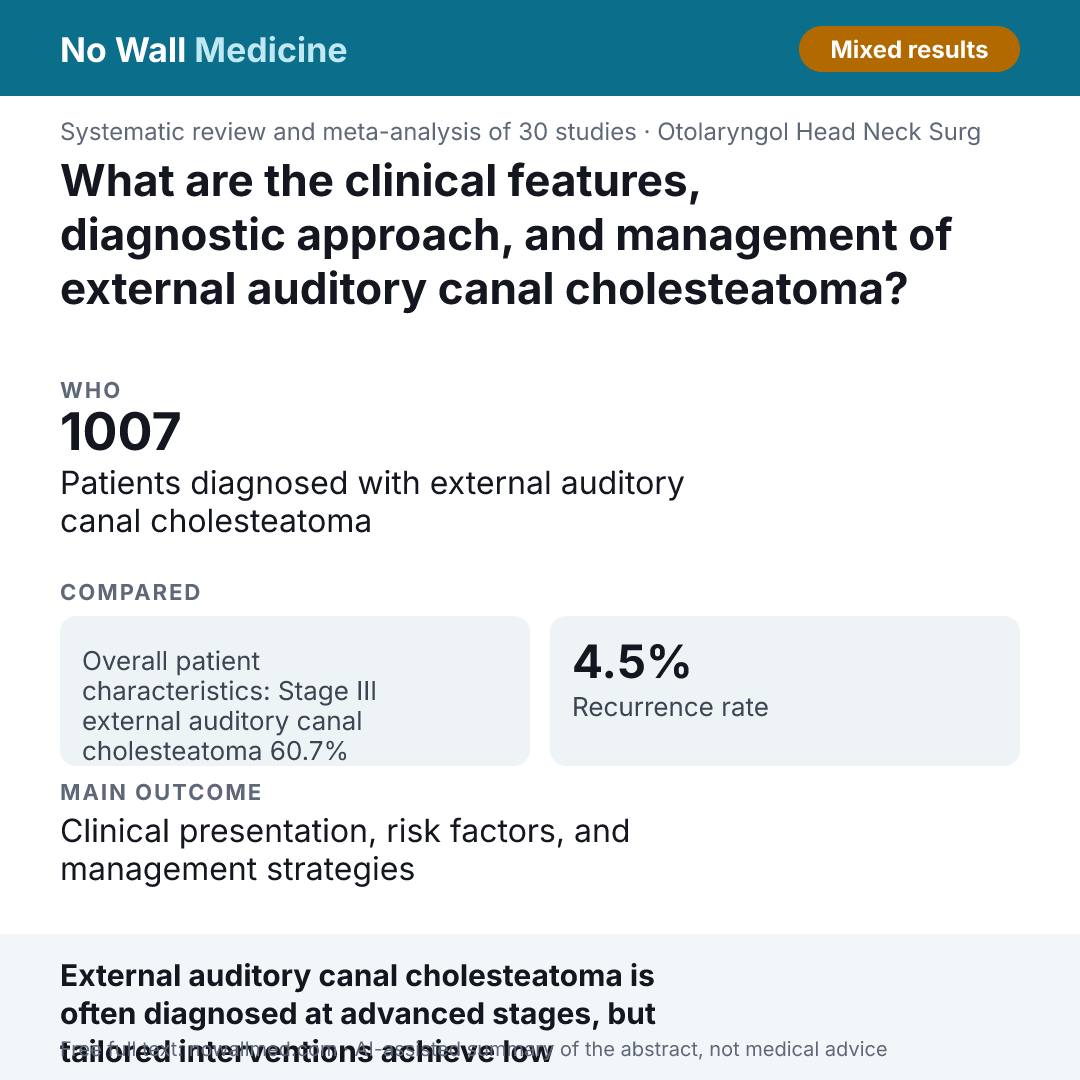
What are the clinical features, diagnostic approach, and management of external auditory canal cholesteatoma?
Who
1007
Patients diagnosed with external auditory canal cholesteatoma
Compared
Overall patient characteristics: Stage III external auditory canal cholesteatoma 60.7%
4.5%Recurrence rate
Main outcome
Clinical presentation, risk factors, and management strategies
Bottom line: External auditory canal cholesteatoma is often diagnosed at advanced stages, but tailored interventions achieve low recurrence rates.
Otolaryngol Head Neck Surg · 2026-04-14 · Save PNG
Clinical question: What are the clinical features, diagnostic approach, and management of external auditory canal cholesteatoma?
Key points
- Researchers analyzed 30 studies involving 1007 patients with an average age of 43.9 years to evaluate external auditory canal cholesteatoma, a skin growth in the ear canal.
- Most patients had Stage III disease (60.7%), with common symptoms including ear discharge (50.3%) and ear pain (39.9%), while 15.7% had no symptoms.
- Conservative treatment using serial debridement, or regular cleaning of the ear canal, was used in 69.6% of cases and resulted in a low recurrence rate of 4.5%.
Headline and key points written with AI from the paper’s abstract, with every number checked against it. Read the paper before relying on them.
Was this summary helpful?
Subject terms
Headline, design, result, key points, caveat and citation as plain text.
Cite this article
Walker AM, Cheung M, Nguyen SA, et al. Canal Cholesteatoma Presentation and Management: A Systematic Review and Meta-Analysis. Otolaryngol Head Neck Surg. 2026;175(1):21-30. doi:10.1002/ohn.70239
Spotted a mistake? Suggest a correction