Cancer detection in the European Randomised Study of Screening for Prostate Cancer (ERSPC)
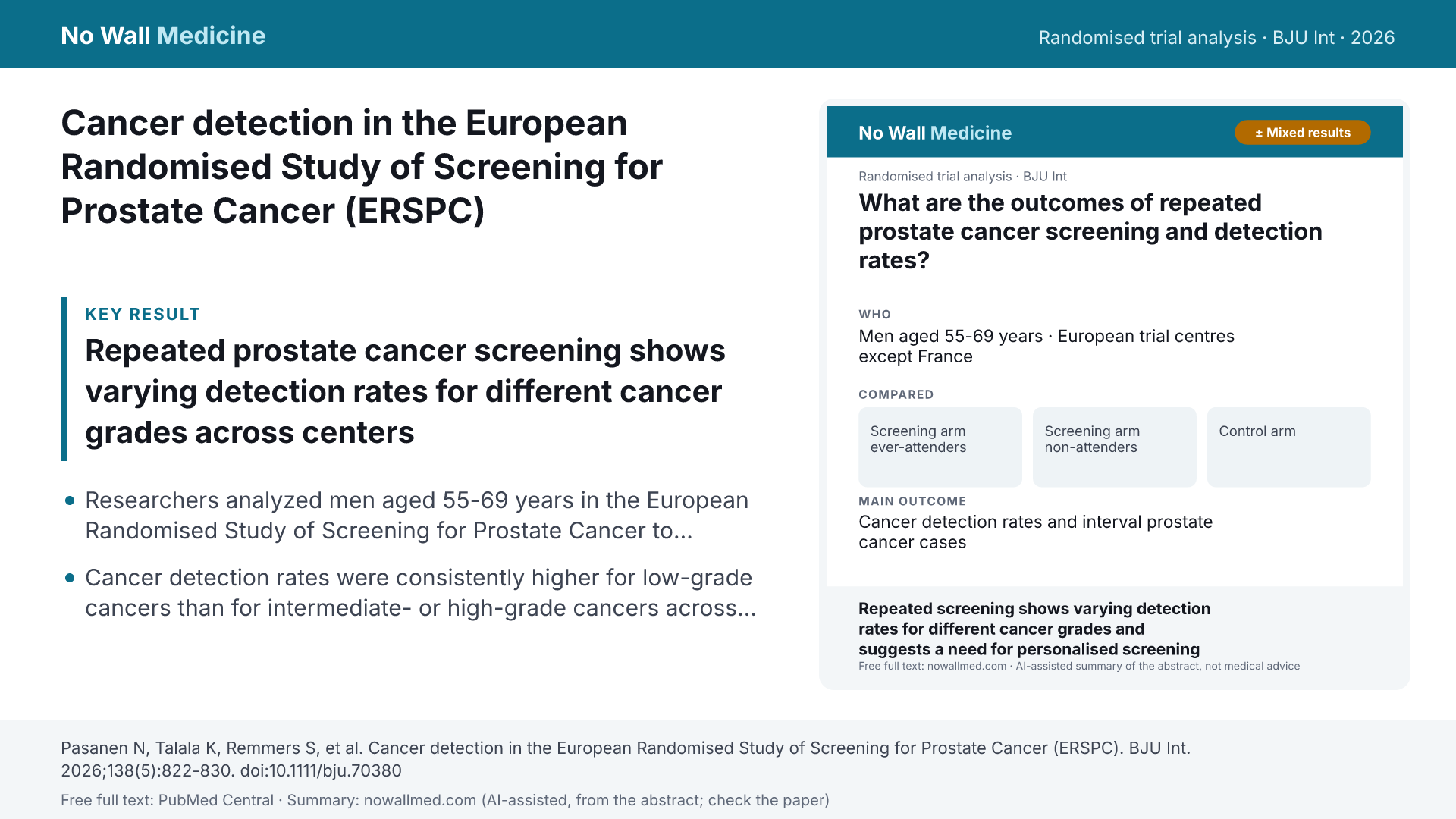
Key result: Repeated prostate cancer screening shows varying detection rates for different cancer grades across centers
Randomised trial analysisMixed results
What are the outcomes of repeated prostate cancer screening and detection rates?
Who
Men aged 55-69 years · European trial centres except France
Compared
Screening arm ever-attenders
Screening arm non-attenders
Control arm
Main outcome
Cancer detection rates and interval prostate cancer cases
Bottom line: Repeated screening shows varying detection rates for different cancer grades and suggests a need for personalised screening approaches.
BJU Int · 2026-07-04
Key points
- Researchers analyzed men aged 55-69 years in the European Randomised Study of Screening for Prostate Cancer to compare cancer detection rates across three screening cycles.
- Cancer detection rates were consistently higher for low-grade cancers than for intermediate- or high-grade cancers across all centers and screening cycles.
- High-grade cancer detection rates varied by center, decreasing from the first to second cycle before increasing in the third cycle in most locations.
Why it matters: Current uniform screening schedules may have diminishing effectiveness as interval cancers and cancers in non-attenders increase.
Discussion prompts
- Would these patients look like yours? Who was left out?
- Is the main outcome one that matters to patients?
- Is the difference large enough to change what you do?
Cite: Pasanen N, Talala K, Remmers S, et al. Cancer detection in the European Randomised Study of Screening for Prostate Cancer (ERSPC). BJU Int. 2026;138(5):822-830. doi:10.1111/bju.70380
Free full text: PubMed Central · Summary and visual abstract: nowallmed.com/a/cancer-detection-in-the-european-randomised-study-of-screening-for-17osspg/ (AI-assisted from the abstract; check the paper before relying on it).