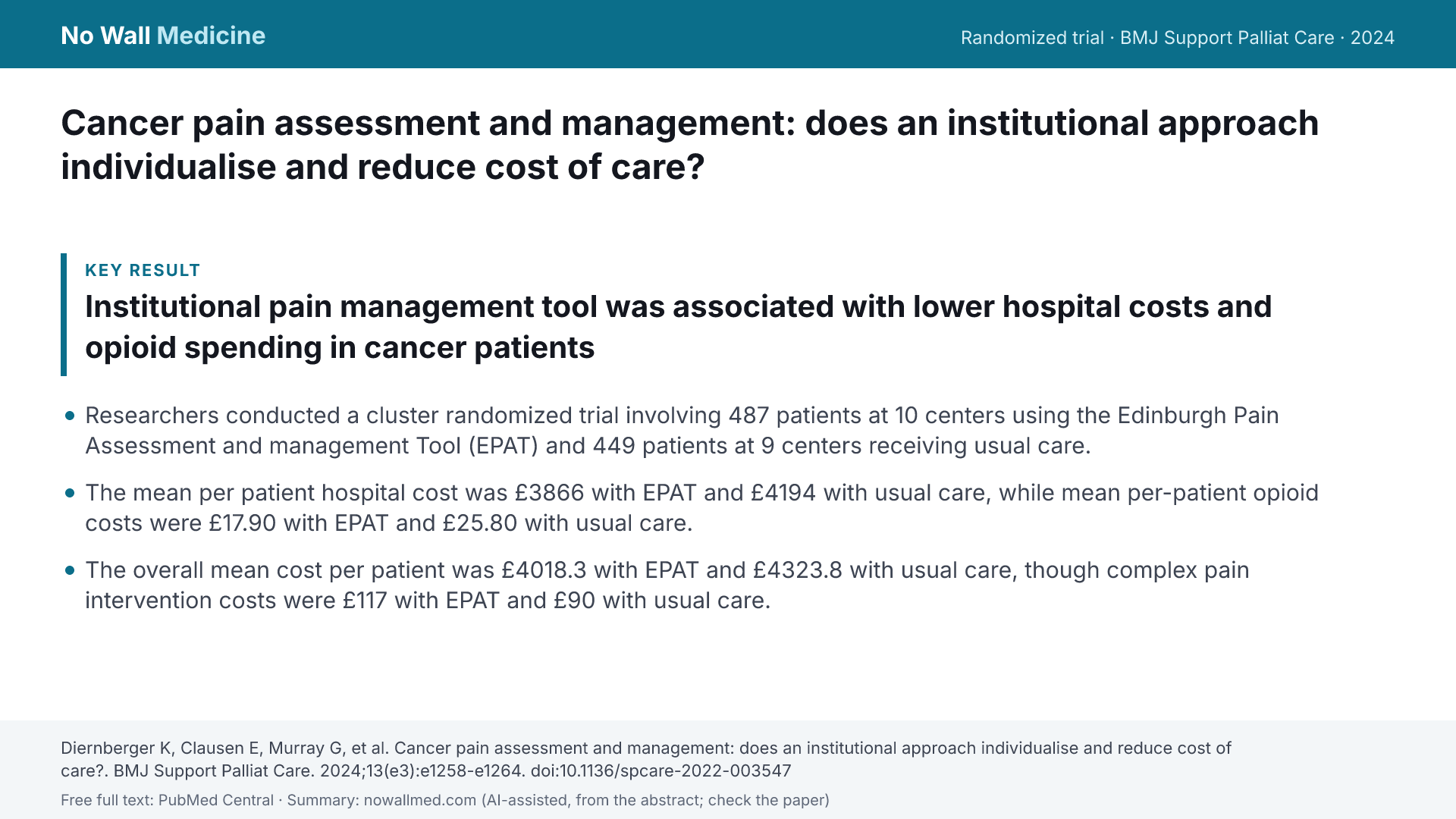
Institutional pain management tool was associated with lower hospital costs and opioid spending in cancer patients
Cancer pain assessment and management: does an institutional approach individualise and reduce cost of care?
Key points
- Researchers conducted a cluster randomized trial involving 487 patients at 10 centers using the Edinburgh Pain Assessment and management Tool (EPAT) and 449 patients at 9 centers receiving usual care.
- The mean per patient hospital cost was £3866 with EPAT and £4194 with usual care, while mean per-patient opioid costs were £17.90 with EPAT and £25.80 with usual care.
- The overall mean cost per patient was £4018.3 with EPAT and £4323.8 with usual care, though complex pain intervention costs were £117 with EPAT and £90 with usual care.
Headline and key points written with AI from the paper’s abstract, with every number checked against it. Read the paper before relying on them.
Was this summary helpful?
Abstract
Objectives
To understand individual prescribing and associated costs in patients managed with the Edinburgh Pain Assessment and management Tool (EPAT). Methods
The EPAT study was a two-arm parallel group cluster randomised (1:1) trial, including 19 UK cancer centres. Study outcome assessments, including pain levels, analgesia and non-pharmacological and anaesthetic interventions, collected at baseline, 3-5 days and, if applicable, 7-10 days after admission. Costs calculated for inpatient length of stay (LoS), medications and complex pain interventions. Analysis accounted for the clustered nature of the trial design. In this post-hoc analysis, healthcare utilisation and costs are presented descriptively. Participants
10 centres randomised to EPAT (487 patients) and 9 (449 patients) to usual care (UC). Main outcome measures
Pharmacological and non-pharmacological management, complex pain interventions, length of hospital stay and costs related to these outcomes. Results
The mean per patient hospital cost was £3866 with EPAT and £4194 with UC, reflecting a mean LoS of 2.9 days and 3.1 days, respectively. Costs were lower for non-opioids, Non-steroidal anti-inflammatories (NSAIDs) and opioids but slightly higher for adjuvants with EPAT than with UC. The mean per-patient opioid costs were £17.90 (EPAT) and £25.80 (UC). Mean per patient costs of all medication were £36 (EPAT) and £40 (UC).Complex pain intervention costs were £117 with EPAT per patient and £90 with UC. Overall mean cost per patient was £4018.3 (95% CI 3698.9 to 4337.8) with EPAT and £4323.8 (95% CI 4060.0 to 4587.7) with UC. Conclusions
EPAT facilitated personalised medicine and may result in less opioids, more specific treatments, improved pain outcomes and cost savings.
Abstract reproduced under the article’s CC BY licence.
Subject terms
Headline, design, result, key points, caveat and citation as plain text.
Cite this article
Diernberger K, Clausen E, Murray G, et al. Cancer pain assessment and management: does an institutional approach individualise and reduce cost of care?. BMJ Support Palliat Care. 2024;13(e3):e1258-e1264. doi:10.1136/spcare-2022-003547
Spotted a mistake? Suggest a correction