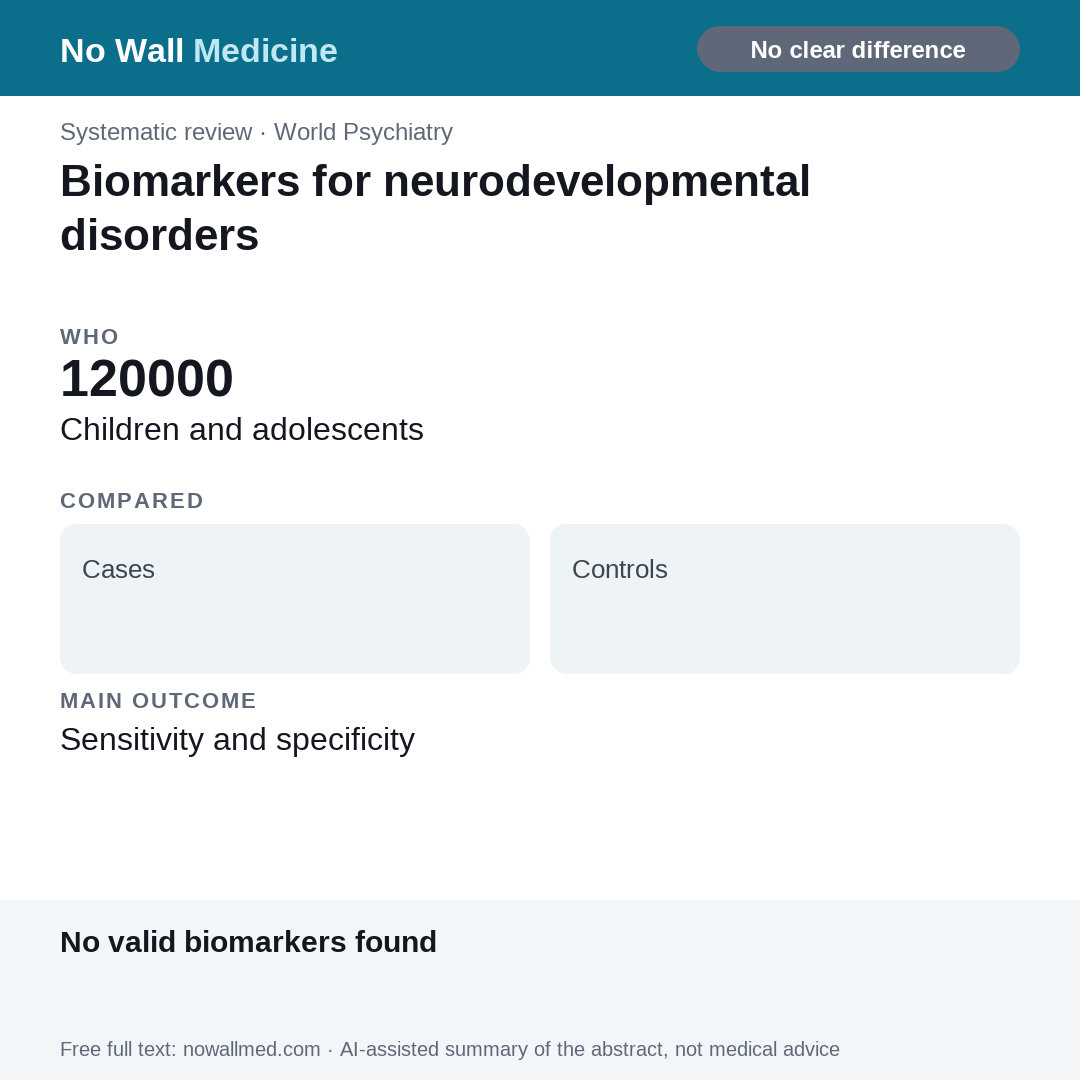
No single biomarker met the required accuracy standards for diagnosing neurodevelopmental disorders in children
Candidate diagnostic biomarkers for neurodevelopmental disorders in children and adolescents: a systematic review
Systematic reviewNo clear difference
Biomarkers for neurodevelopmental disorders
Who
120000
Children and adolescents
Compared
Cases
Controls
Main outcome
Sensitivity and specificity
Bottom line: No valid biomarkers found
Limitation: Small sample sizes, heterogeneous approaches
World Psychiatry · 2023-01-14Download image
Why it matters: Clinicians lack valid, reliable, and broadly usable biomarkers to support the timely diagnosis of neurodevelopmental disorders in children and adolescents.
Key points
- Researchers reviewed 780 studies involving approximately 120,000 cases and 176,000 controls to identify promising biomarkers for neurodevelopmental disorders.
- No biomarker was found to have at least 80% sensitivity and 80% specificity across two or more independent studies.
- Metrics such as positive predictive value and negative predictive value were infrequently reported in the available research.
Limitation the authors note: Existing studies often used small sample sizes, heterogeneous approaches, focused on single rather than joint signatures, and did not fully account for confounding factors.
Headline and key points written with AI from the paper’s abstract, with every number checked against it. Read the paper before relying on them.
Was this summary helpful?
Cite this article
Cortese S, Solmi M, Michelini G, Bellato A, Blanner C, Canozzi A. Candidate diagnostic biomarkers for neurodevelopmental disorders in children and adolescents: a systematic review. World Psychiatry. 2023. doi:10.1002/wps.21037
Spotted a mistake? Suggest a correction
Top studies every Monday
The week’s key trials and guidelines in your specialties, plus any topics you follow. By email, free.
Get the weekly digest