Cannabis Use During Adolescence and Young Adulthood and Academic Achievement: A Systematic Review and Meta-Analysis
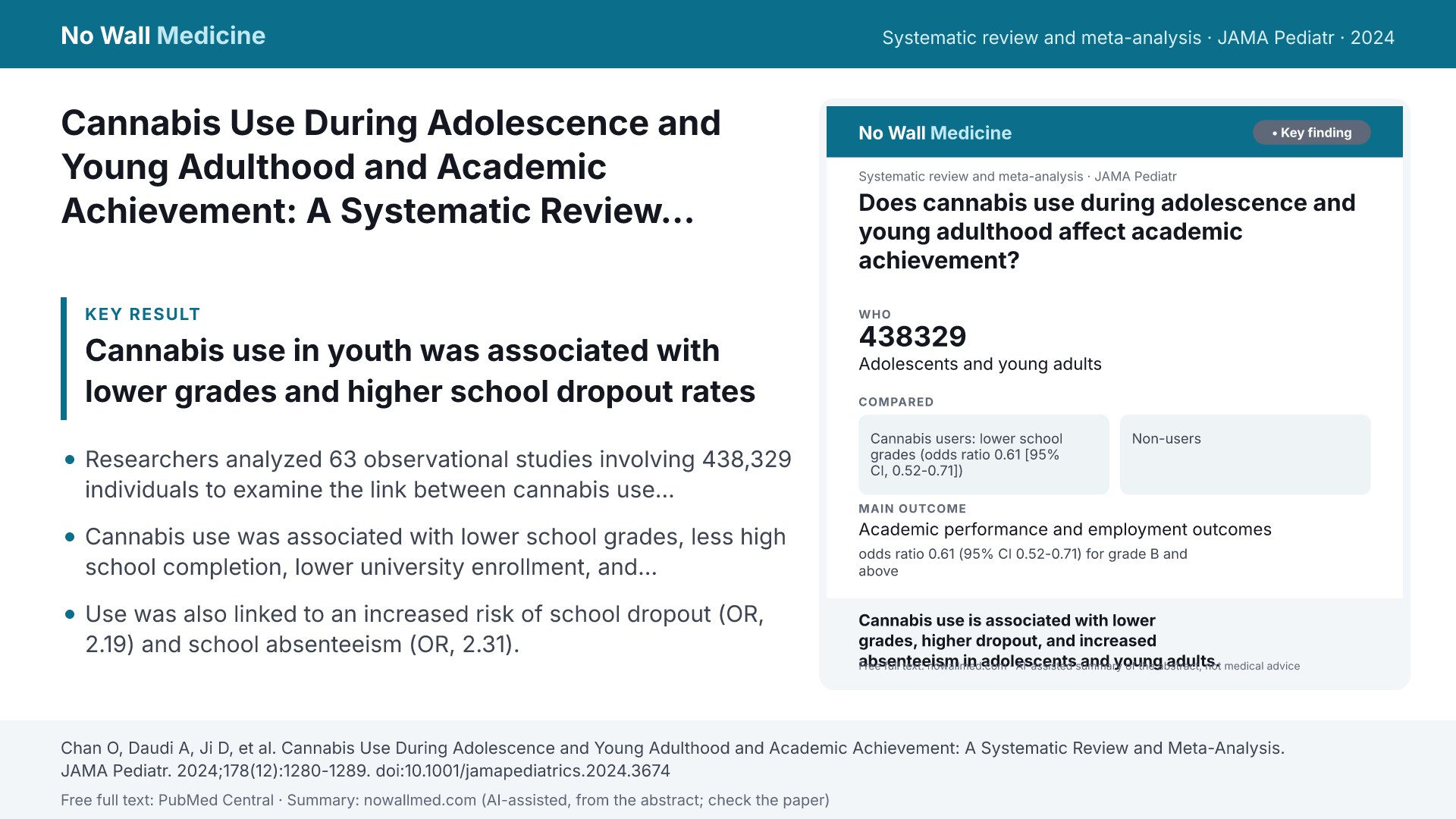
Key result: Cannabis use in youth was associated with lower grades and higher school dropout rates
Systematic review and meta-analysisKey finding
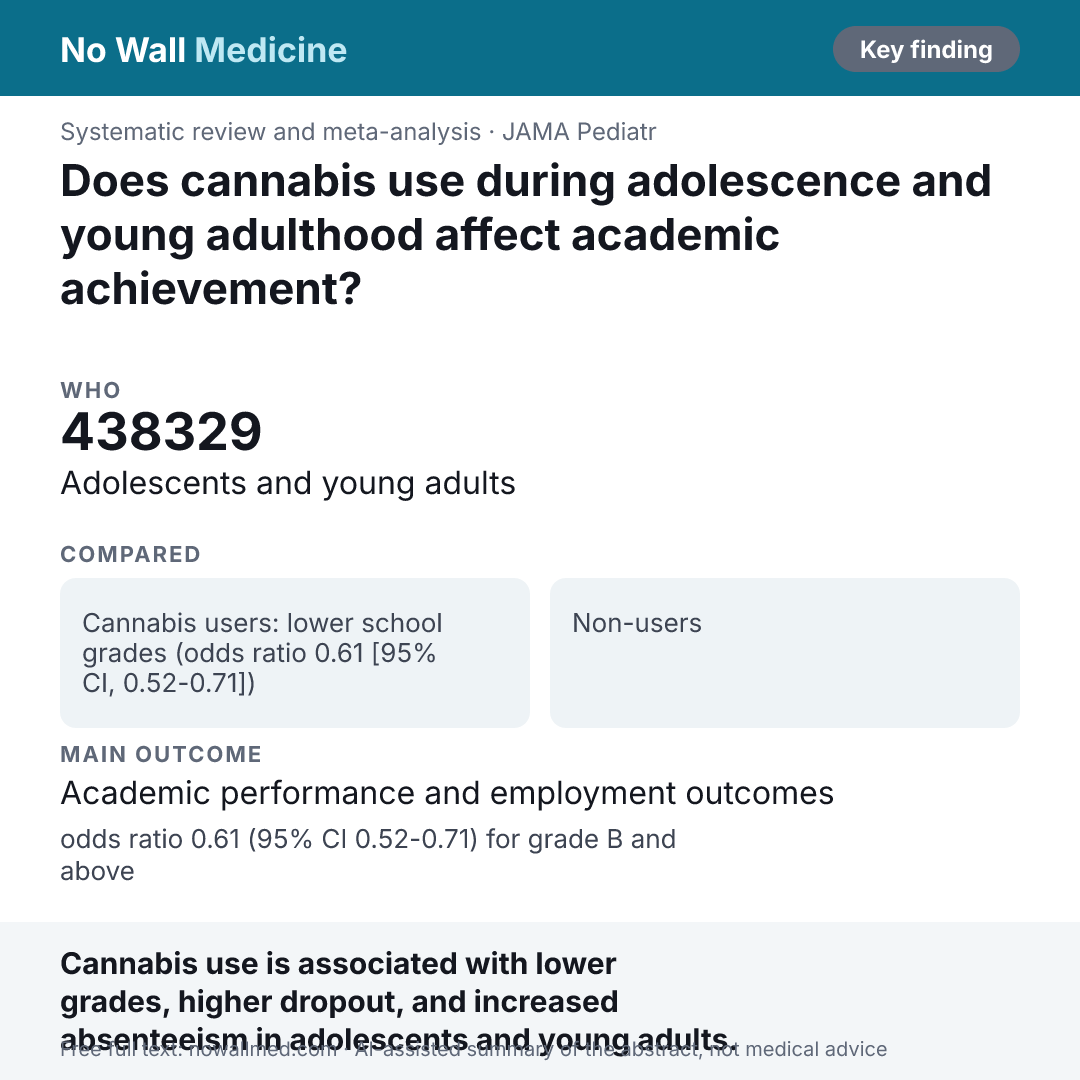
Does cannabis use during adolescence and young adulthood affect academic achievement?
Who
438329
Adolescents and young adults
Compared
Cannabis users: lower school grades (odds ratio 0.61 [95% CI, 0.52-0.71])
Non-users
Main outcome
Academic performance and employment outcomes
Result: odds ratio 0.61 (95% CI 0.52-0.71) for grade B and above
Bottom line: Cannabis use is associated with lower grades, higher dropout, and increased absenteeism in adolescents and young adults.
Limitation: Certainty of evidence varied from low to moderate across different outcomes.
JAMA Pediatr · 2024-10-07 · Save PNG
Key points
- Researchers analyzed 63 observational studies involving 438,329 individuals to examine the link between cannabis use and academic outcomes.
- Cannabis use was associated with lower school grades, less high school completion, lower university enrollment, and lower postsecondary degree attainment.
- Use was also linked to an increased risk of school dropout (OR, 2.19) and school absenteeism (OR, 2.31).
Discussion prompts
- Would these patients look like yours? Who was left out?
- Is the main outcome one that matters to patients?
- Is the difference large enough to change what you do?
Cite: Chan O, Daudi A, Ji D, et al. Cannabis Use During Adolescence and Young Adulthood and Academic Achievement: A Systematic Review and Meta-Analysis. JAMA Pediatr. 2024;178(12):1280-1289. doi:10.1001/jamapediatrics.2024.3674
Free full text: PubMed Central · Summary and visual abstract: nowallmed.com/a/cannabis-use-during-adolescence-and-young-adulthood-and-academic-3yuej2/ (AI-assisted from the abstract; check the paper before relying on it).