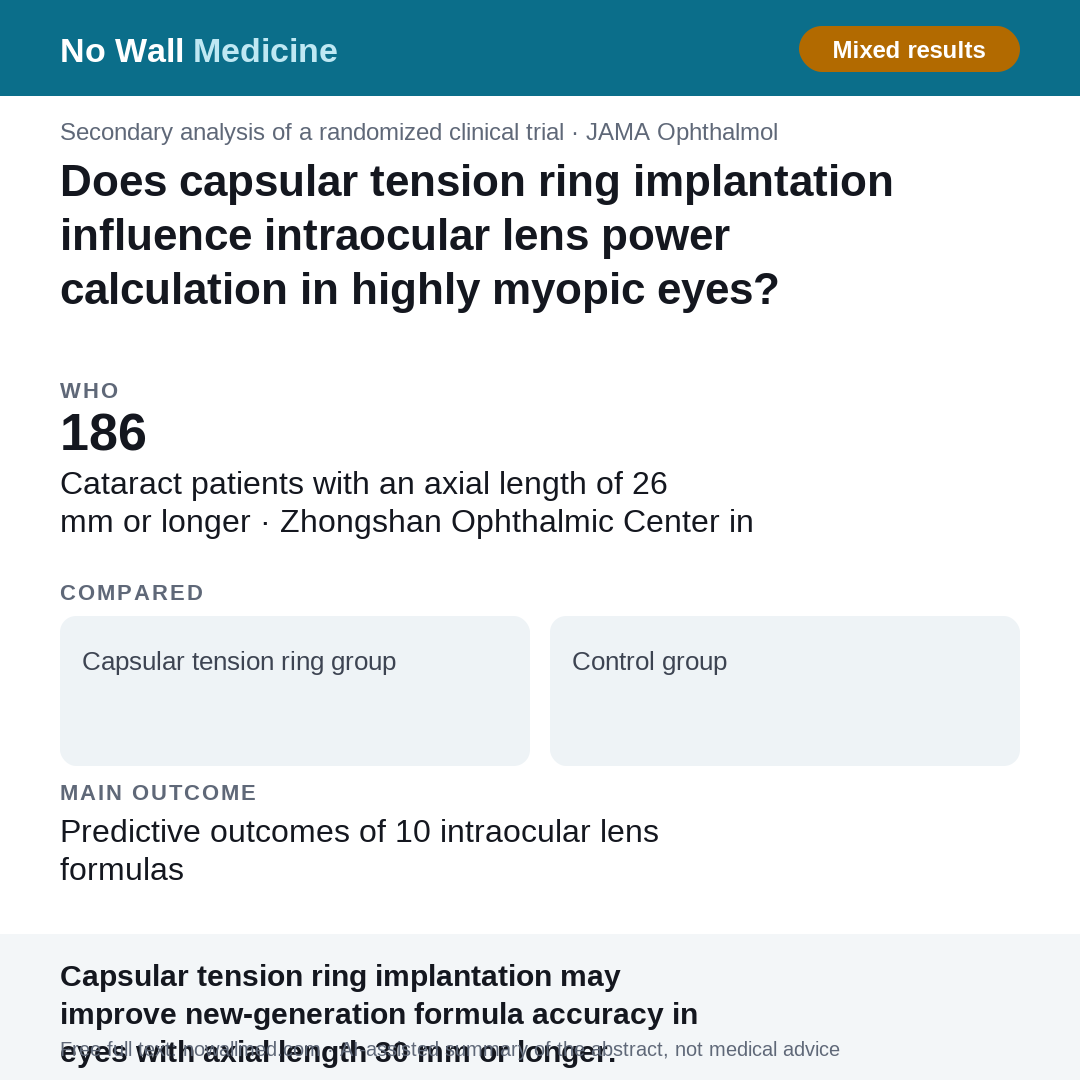
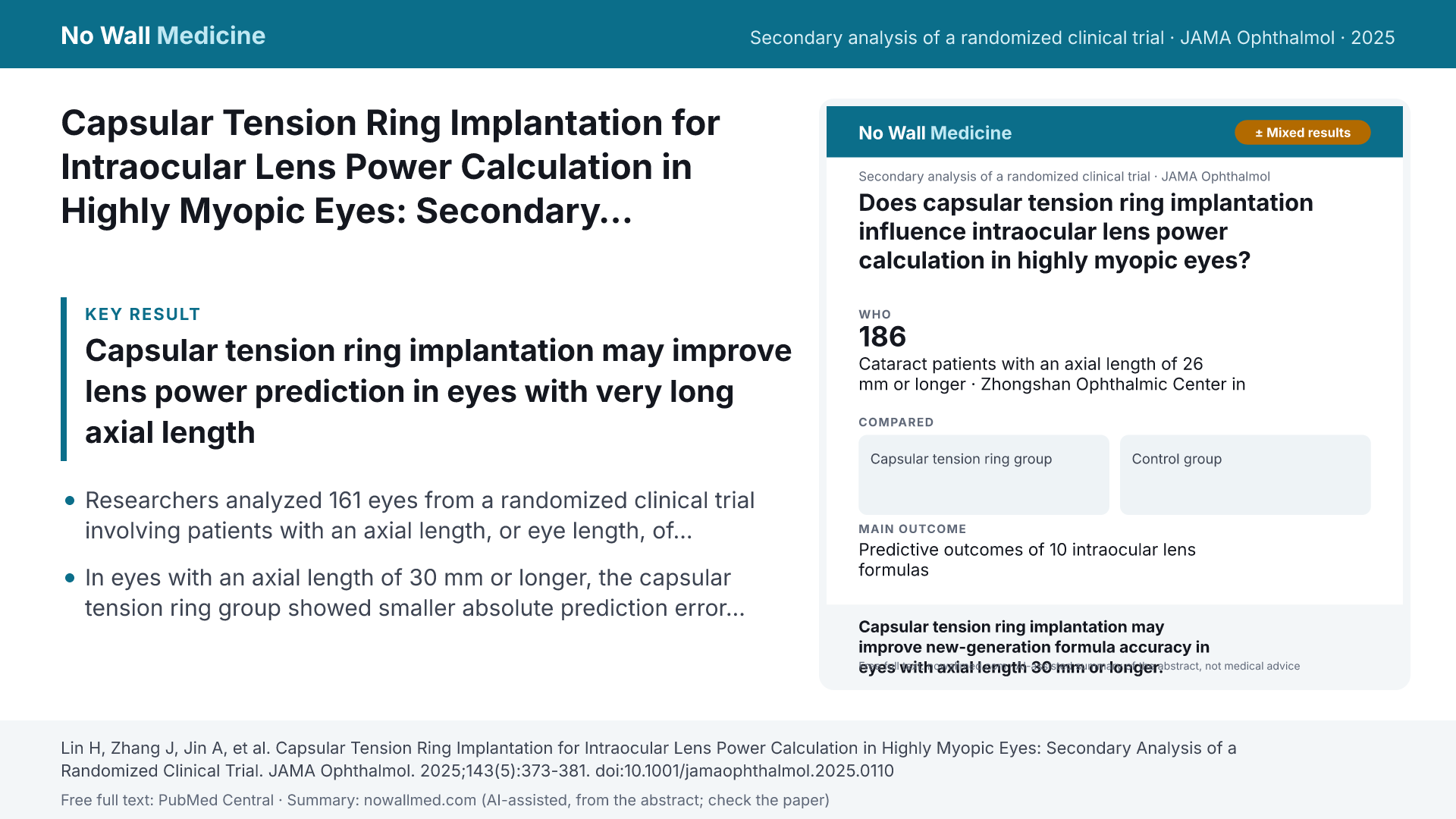
Capsular tension ring implantation may improve lens power prediction in eyes with very long axial length
Capsular Tension Ring Implantation for Intraocular Lens Power Calculation in Highly Myopic Eyes: Secondary Analysis of a Randomized Clinical Trial
Secondary analysis of a randomized clinical trialMixed results
Does capsular tension ring implantation influence intraocular lens power calculation in highly myopic eyes?
Who
186
Cataract patients with an axial length of 26 mm or longer · Zhongshan Ophthalmic Center in Guangzhou, China
Compared
Capsular tension ring group
Control group
Main outcome
Predictive outcomes of 10 intraocular lens formulas
Bottom line: Capsular tension ring implantation may improve new-generation formula accuracy in eyes with axial length 30 mm or longer.
Limitation: This is a prespecified secondary analysis of outcomes from a randomized clinical trial.
JAMA Ophthalmol · 2025-03-20Download image
Clinical question: Does capsular tension ring implantation influence intraocular lens power calculation in highly myopic eyes?
Key points
- Researchers analyzed 161 eyes from a randomized clinical trial involving patients with an axial length, or eye length, of 26 mm or longer.
- In eyes with an axial length of 30 mm or longer, the capsular tension ring group showed smaller absolute prediction error in all new-generation formulas.
- No differences were observed in arithmetic prediction error between the groups in any strata, and no differences were found in traditional formulas.
Headline and key points written with AI from the paper’s abstract, with every number checked against it. Read the paper before relying on them.
Was this summary helpful?
Subject terms
Cite this article
Lin H, Zhang J, Jin A, et al. Capsular Tension Ring Implantation for Intraocular Lens Power Calculation in Highly Myopic Eyes: Secondary Analysis of a Randomized Clinical Trial. JAMA Ophthalmol. 2025. doi:10.1001/jamaophthalmol.2025.0110
Spotted a mistake? Suggest a correction