Cardiac resynchronization therapy benefits patients with specific conduction delays but not right bundle branch block
Cardiac Resynchronization Therapy Improves Outcomes in Patients With Intraventricular Conduction Delay But Not Right Bundle Branch Block: A Patient-Level Meta-Analysis of Randomized Controlled Trials
Meta-analysis of trialsBenefit found
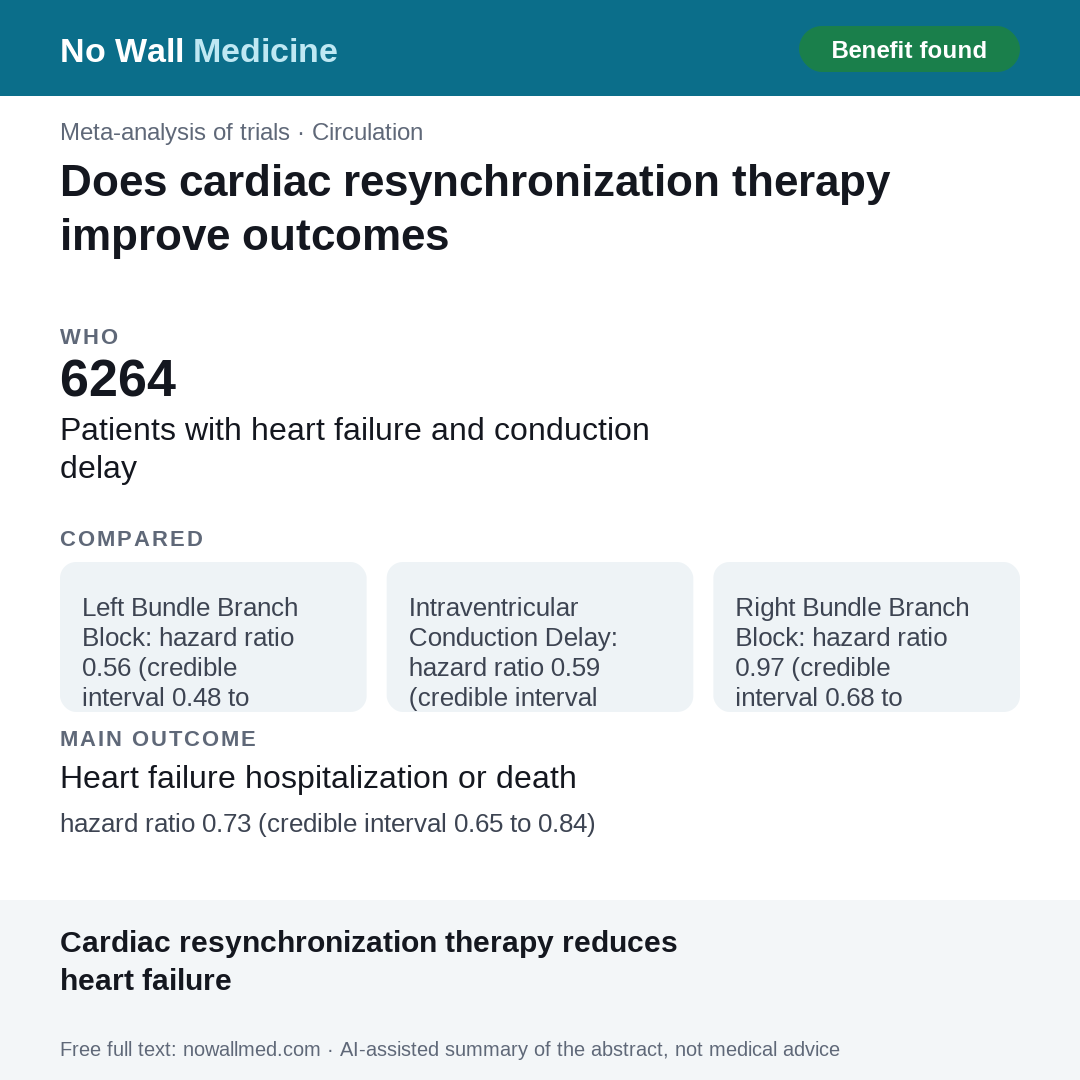
Does cardiac resynchronization therapy improve outcomes
Who
6264
Patients with heart failure and conduction delay
Compared
Left Bundle Branch Block: hazard ratio 0.56 (credible interval 0.48 to 0.66)
Intraventricular Conduction Delay: hazard ratio 0.59 (credible interval 0.39 to 0.89)
Right Bundle Branch Block: hazard ratio 0.97 (credible interval 0.68 to 1.34)
Main outcome
Heart failure hospitalization or death
Result: hazard ratio 0.73 (credible interval 0.65 to 0.84)
Bottom line: Cardiac resynchronization therapy reduces heart failure
Circulation · 2023-01-26Download image
Why it matters: It is unknown how different types of electrical conduction delays in the heart affect the benefits of cardiac resynchronization therapy.
Key points
- Researchers analyzed patient-level data from 6264 people across eight randomized controlled trials to evaluate the effects of cardiac resynchronization therapy.
- In patients with a QRS duration of 150 ms or more, cardiac resynchronization therapy was associated with a lower risk of heart failure hospitalization or death for those with left bundle branch block (HR, 0.56) or intraventricular conduction delay (HR, 0.59).
- No significant association was observed for heart failure hospitalization or death when the QRS duration was less than 150 ms or in patients with right bundle branch block (HR, 0.97).
Headline and key points written with AI from the paper’s abstract, with every number checked against it. Read the paper before relying on them.
Was this summary helpful?
Subject terms
Cite this article
Friedman DJ, Al-Khatib SM, Dalgaard F, Fudim M, Abraham WT, Cleland JGF. Cardiac Resynchronization Therapy Improves Outcomes in Patients With Intraventricular Conduction Delay But Not Right Bundle Branch Block: A Patient-Level Meta-Analysis of Randomized Controlled Trials. Circulation. 2023. doi:10.1161/CIRCULATIONAHA.122.062124
Spotted a mistake? Suggest a correction
Top studies every Monday
The week’s key trials and guidelines in your specialties, plus any topics you follow. By email, free.
Get the weekly digest