Implanted microcurrent device improved heart pumping function and symptoms in heart failure patients
Cardio-microcurrent device treatment for heart failure with reduced ejection fraction: Results from the C-MIC II open-label randomized controlled trial
Open-label randomized controlled trialBenefit found
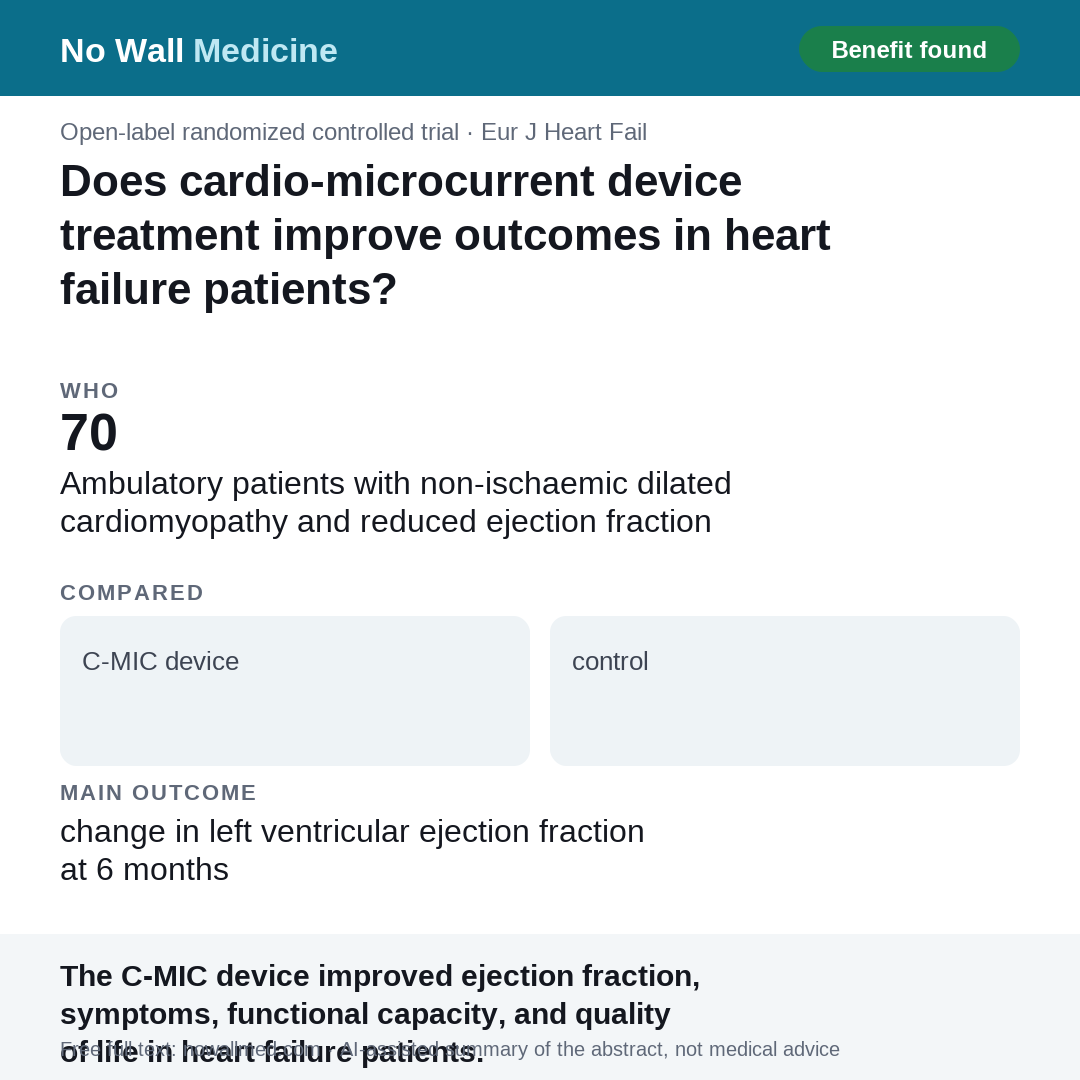
Does cardio-microcurrent device treatment improve outcomes in heart failure patients?
Who
70
Ambulatory patients with non-ischaemic dilated cardiomyopathy and reduced ejection fraction
Compared
C-MIC device
control
Main outcome
change in left ventricular ejection fraction at 6 months
Result: mean difference: 5.1% (95% confidence interval 3.1-7.1%)
Bottom line: The C-MIC device improved ejection fraction, symptoms, functional capacity, and quality of life in heart failure patients.
Eur J Heart Fail · 2025-07-15Download image
Clinical question: Does cardio-microcurrent device treatment improve outcomes in heart failure patients?
Why it matters: The safety and efficacy of direct microcurrent therapy using an implanted generator remain uncertain for patients with heart failure.
Key points
- Researchers studied 65 patients with non-ischaemic dilated cardiomyopathy and low ejection fraction, comparing an implanted microcurrent device to a control group receiving standard medical therapy.
- At 6 months, the device group showed a 5.1% mean difference in left ventricular ejection fraction, which is the percentage of blood pumped out of the heart with each beat.
- The device was associated with higher rates of improvement in functional class, quality of life scores, and walking distance compared to the control group.
Headline and key points written with AI from the paper’s abstract, with every number checked against it. Read the paper before relying on them.
Topics
Cite this article
Rame JE, Schmitto JD, Kosevic DN, Kovacevic-Preradovic T, Jovev S, Zdravkovic M. Cardio-microcurrent device treatment for heart failure with reduced ejection fraction: Results from the C-MIC II open-label randomized controlled trial. Eur J Heart Fail. 2025. doi:10.1002/ejhf.3763
Spotted a mistake? Suggest a correction
Top studies every Monday
The week’s key trials and guidelines in your specialties, plus any topics you follow. By email, free.
Get the weekly digest