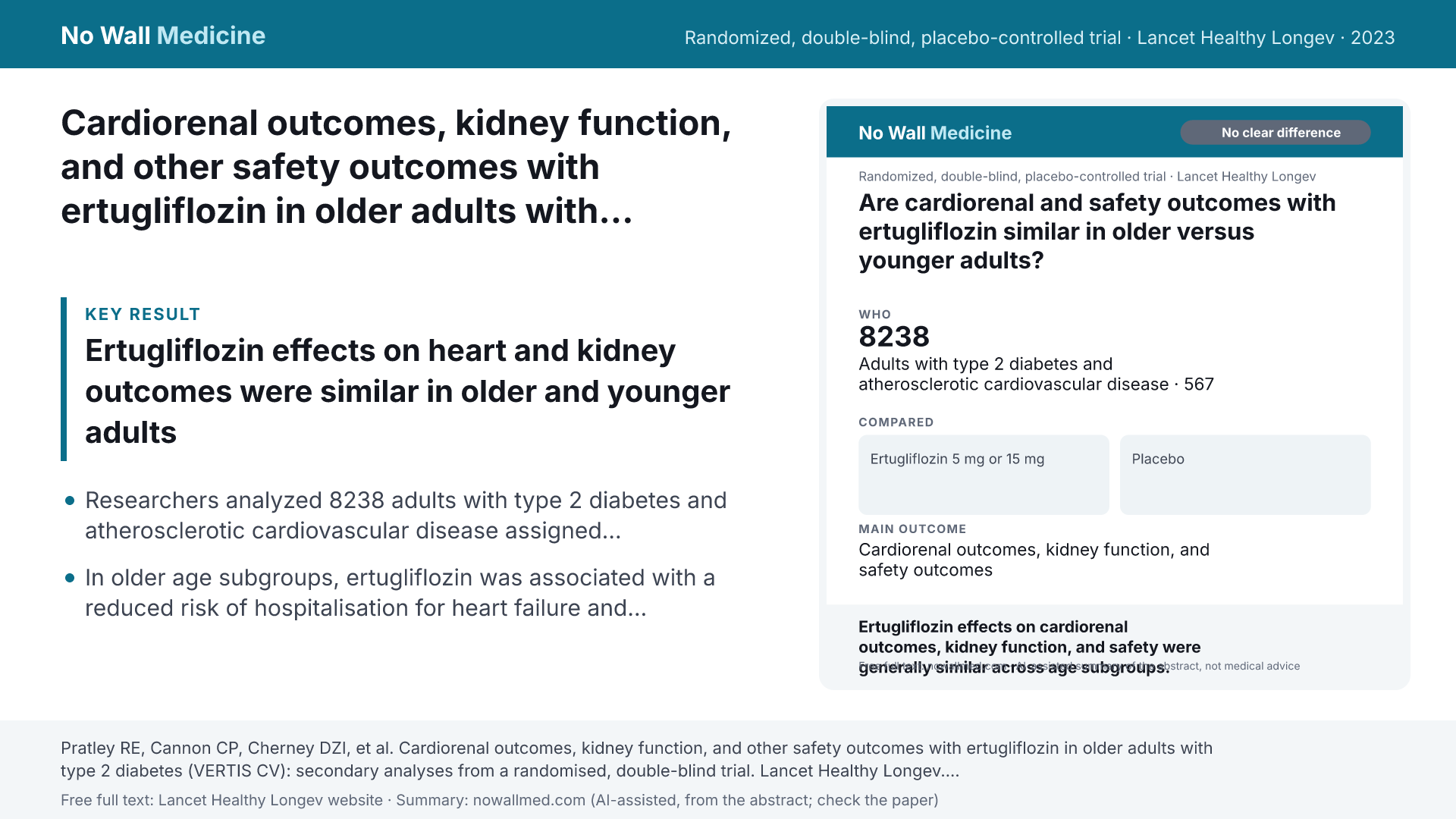
Ertugliflozin effects on heart and kidney outcomes were similar in older and younger adults
Cardiorenal outcomes, kidney function, and other safety outcomes with ertugliflozin in older adults with type 2 diabetes (VERTIS CV): secondary analyses from a randomised, double-blind trial
Randomized, double-blind, placebo-controlled trialNo clear difference
Are cardiorenal and safety outcomes with ertugliflozin similar in older versus younger adults?
Who
8238
Adults with type 2 diabetes and atherosclerotic cardiovascular disease · 567 centres in 34 countries
Compared
Ertugliflozin 5 mg or 15 mg
Placebo
Main outcome
Cardiorenal outcomes, kidney function, and safety outcomes
Bottom line: Ertugliflozin effects on cardiorenal outcomes, kidney function, and safety were generally similar across age subgroups.
Lancet Healthy Longev · 2023-04-01Download image
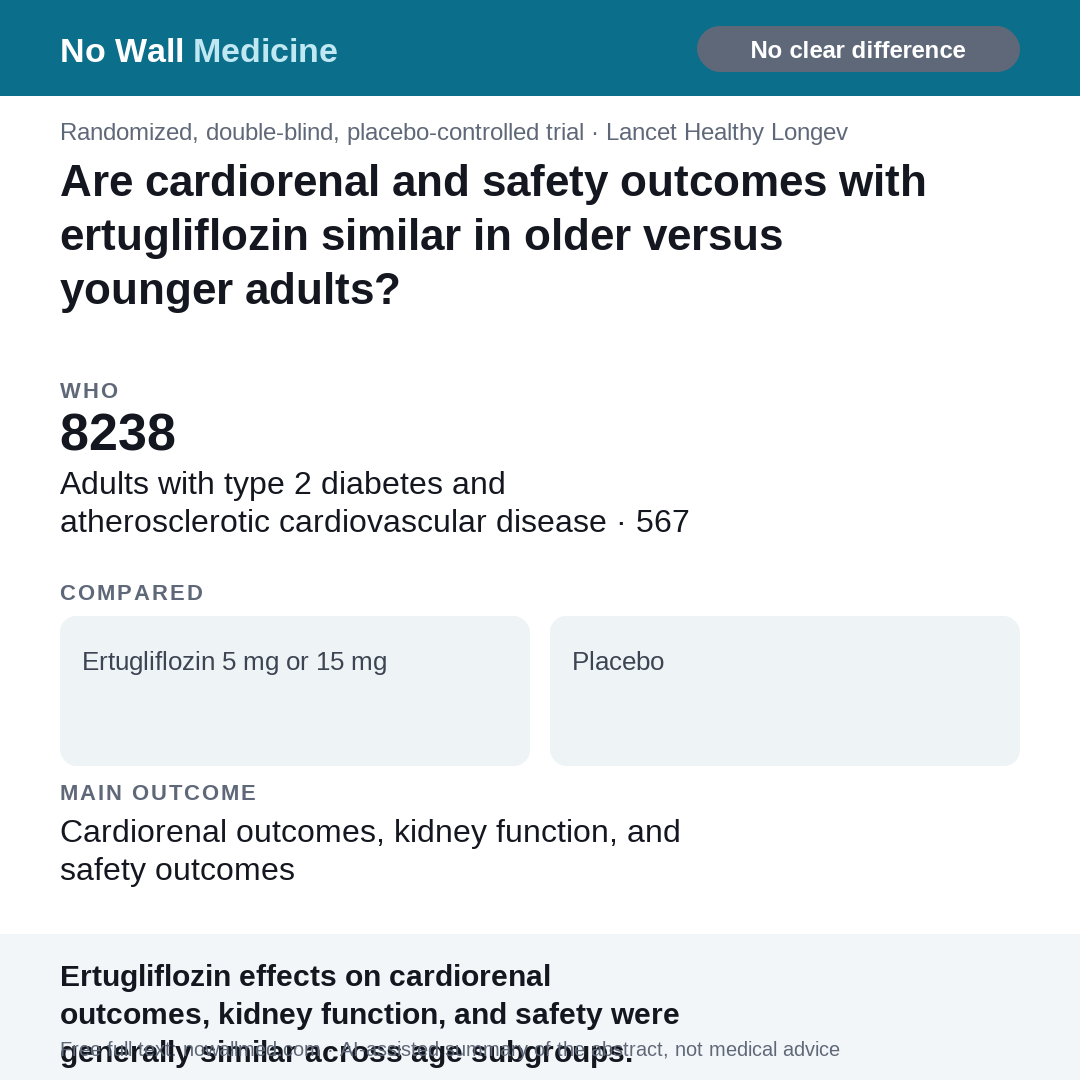
Clinical question: Are cardiorenal and safety outcomes with ertugliflozin similar in older versus younger adults?
Why it matters: It was unknown if the cardiorenal and safety effects of ertugliflozin were consistent in older adults compared to younger participants.
Key points
- Researchers analyzed 8238 adults with type 2 diabetes and atherosclerotic cardiovascular disease assigned to ertugliflozin 5 mg, 15 mg, or placebo.
- In older age subgroups, ertugliflozin was associated with a reduced risk of hospitalisation for heart failure and an exploratory kidney composite outcome.
- Ertugliflozin was associated with a slower decline in estimated glomerular filtration rate, a measure of kidney function, across all age subgroups.
Headline and key points written with AI from the paper’s abstract, with every number checked against it. Read the paper before relying on them.
Was this summary helpful?
Abstract
Background
VERTIS CV was a randomised, double-blind, placebo-controlled, parallel-group, multicentre cardiovascular outcomes trial that evaluated the cardiovascular efficacy and safety of ertugliflozin in adults with type 2 diabetes and atherosclerotic cardiovascular disease. The primary objective of VERTIS CV was to show non-inferiority of ertugliflozin to placebo with respect to the primary outcome, major adverse cardiovascular events (a composite of death from cardiovascular causes, non-fatal myocardial infarction, or non-fatal stroke). The analyses reported here aimed to assess cardiorenal outcomes, kidney function, and other safety outcomes with ertugliflozin in older adults with type 2 diabetes and atherosclerotic cardiovascular disease compared with younger participants. Methods
VERTIS CV was done at 567 centres in 34 countries. Participants (aged ≥40 years) with type 2 diabetes and atherosclerotic cardiovascular disease were randomly assigned (1:1:1) to once-daily ertugliflozin 5 mg, ertugliflozin 15 mg, or placebo in addition to background standard-of-care treatment. Random assignment was done with the use of an interactive voice-response system. The study outcomes were major adverse cardiovascular events, hospitalisation for heart failure or cardiovascular death, cardiovascular death, hospitalisation for heart failure, prespecified kidney composite outcomes, kidney function, and other assessments of safety. Cardiorenal outcomes, kidney function, and safety outcomes were evaluated by baseline age (≥65 years and <65 years [prespecified] and ≥75 years and <75 years [post hoc]). The study is registered with ClinicalTrials.gov, NCT01986881. Findings
Between Dec 13, 2013, and July 31, 2015, and between June 1, 2016, and April 14, 2017, 8246 adults with type 2 diabetes and atherosclerotic cardiovascular disease were recruited to the study and randomly assigned. 2752 patients were assigned to ertugliflozin 5 mg, 2747 patients to ertugliflozin 15 mg, and 2747 patients to placebo. 8238 participants received at least one dose of ertugliflozin 5 mg, ertugliflozin 15 mg, or placebo. 4145 (50·3%) of 8238 participants were aged 65 years and older, including 903 (11·0%) participants aged 75 years and older. 5764 (70·0%) of 8238 participants were male and 2474 (30·0%) were female, and 7233 (87·8%) of 8238 participants were White, 497 (6·0%) were Asian, 235 (2·9%) were Black, and 273 (3·3%) were classified as other. The mean estimated glomerular filtration rate (eGFR) was lower and the type 2 diabetes duration longer for those aged 65 years and older versus those younger than 65 years, and for those aged 75 years and older versus those younger than 75 years. Cardiovascular outcomes were more common in the older age subgroups than in the younger age subgroups. Similar to the overall VERTIS CV cohort, ertugliflozin did not increase the risk of major adverse cardiovascular events, cardiovascular death or hospitalisation for heart failure, cardiovascular death alone, or the kidney composite outcome (using doubling of serum creatinine, dialysis or transplantation, or kidney death), and reduced the risk of hospitalisation for heart failure and the exploratory kidney composite outcome (using a 40% sustained eGFR decrease, dialysis or transplantation, or kidney death) in the older age subgroups (pinteraction>0·05 for outcomes assessed). A slower decline in eGFR and a smaller increase in the urine albumin-to-creatinine ratio were observed over time in all age subgroups taking ertugliflozin compared with placebo. Across age subgroups, safety outcomes were consistent with the known profile of ertugliflozin. Interpretation
The effects of ertugliflozin on cardiorenal outcomes, kidney function, and safety outcomes were generally similar across age subgroups. These results have the potential to help clinical decision making by providing a longer-term evaluation of the cardiorenal safety and overall tolerability of ertugliflozin in a large population of older adults. Funding
Merck Sharp & Dohme LLC, a subsidiary of Merck & Co, Inc, Rahway, NJ, USA in collaboration with Pfizer Inc, New York, NY, USA.
Abstract reproduced under the article’s CC BY NC ND licence.
Subject terms
Cite this article
Pratley RE, Cannon CP, Cherney DZI, et al. Cardiorenal outcomes, kidney function, and other safety outcomes with ertugliflozin in older adults with type 2 diabetes (VERTIS CV): secondary analyses from a randomised, double-blind trial. Lancet Healthy Longev. 2023. doi:10.1016/S2666-7568(23)00032-6
Spotted a mistake? Suggest a correction