Blood pressure management and lifestyle improvements reduced cardiovascular risk in a large rural Chinese study
Cardiovascular Health Change Patterns After Multifaceted Antihypertensive Intervention and Cardiovascular Outcomes: A Post Hoc Analysis of CRHCP Trial
Post hoc analysis of a randomized trialBenefit found
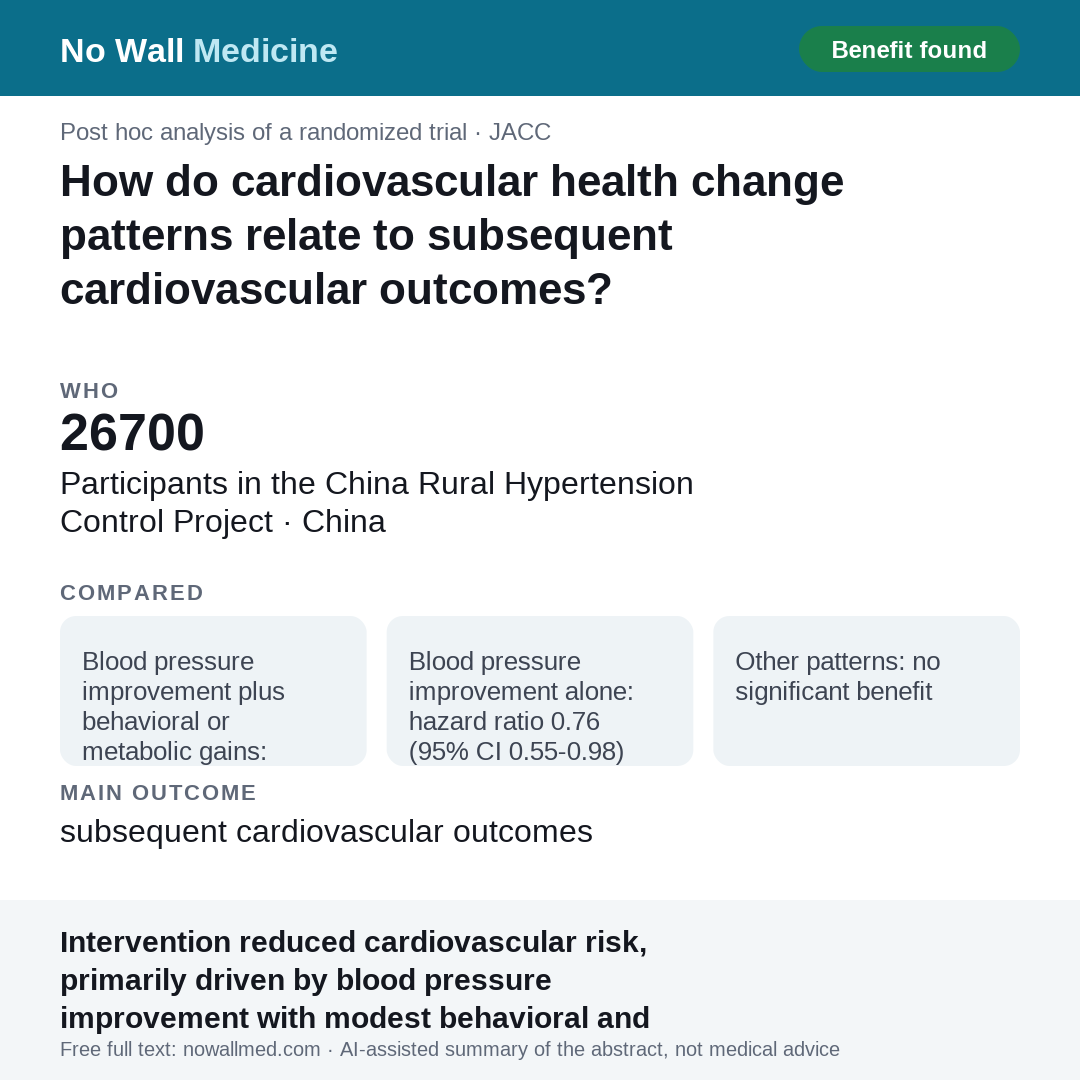
How do cardiovascular health change patterns relate to subsequent cardiovascular outcomes?
Who
26700
Participants in the China Rural Hypertension Control Project · China
Compared
Blood pressure improvement plus behavioral or metabolic gains: hazard ratio 0.57 (95% CI 0.30-0.84)
Blood pressure improvement alone: hazard ratio 0.76 (95% CI 0.55-0.98)
Other patterns: no significant benefit
Main outcome
subsequent cardiovascular outcomes
Result: hazard ratio 0.71 (95% CI 0.54-0.89)
Bottom line: Intervention reduced cardiovascular risk, primarily driven by blood pressure improvement with modest behavioral and metabolic contributions.
JACC · 2026-07-08Download image
Clinical question: How do cardiovascular health change patterns relate to subsequent cardiovascular outcomes?
Why it matters: The multidimensional health change patterns resulting from multifaceted interventions and their relationship with clinical outcomes remain unclear.
Key points
- Researchers analyzed 26,700 participants, aged 62.5 ± 9.0 years, who received intensive blood pressure management from nonphysician community health care providers.
- Participants with improved cardiovascular health metrics saw a reduction in cardiovascular risk, with the greatest reduction seen in those with blood pressure, behavioral, or metabolic improvements (HR: 0.57; 95% CI: 0.30-0.84).
- Blood pressure changes accounted for 67.5% of the observed effect, while behavioral factors contributed 8.0% and metabolic domains contributed a minimal amount.
Headline and key points written with AI from the paper’s abstract, with every number checked against it. Read the paper before relying on them.
Topics
Spotted a mistake? Suggest a correction
More in Cardiology
Clonal hematopoiesis mutations linked to higher atrial fibrillation risk in cancer populations
Association of Clonal Hematopoiesis Mutations With Incident Atrial Fibrillation: A Systematic Review and Meta-Analysis
Deep learning model detects aortic stenosis from finger-cuff pressure waveforms accurately
Aortic Valve Stenosis Screening Using Deep Learning on Noninvasive Arterial Pressure Waveforms
Spontaneous coronary artery dissection affects younger women more often than expected
Spontaneous coronary artery dissection: implications for women's health, clinical care, and future research
Early lipid-lowering strategies may reduce atherosclerotic cardiovascular disease risk
Lipid-Lowering Strategies in the Era of Early Atherosclerosis Detection: 2026 ACC Scientific Statement: A Report of the American College of Cardiology