Cardiovascular magnetic resonance accurately detects blocked coronary arteries in patients with suspected heart attacks
Cardiovascular magnetic resonance accurately detects obstructive coronary artery disease in suspected non-ST elevation myocardial infarction: a sub-analysis of the CARMENTA Trial
Sub-analysis of a randomized controlled trialBenefit found
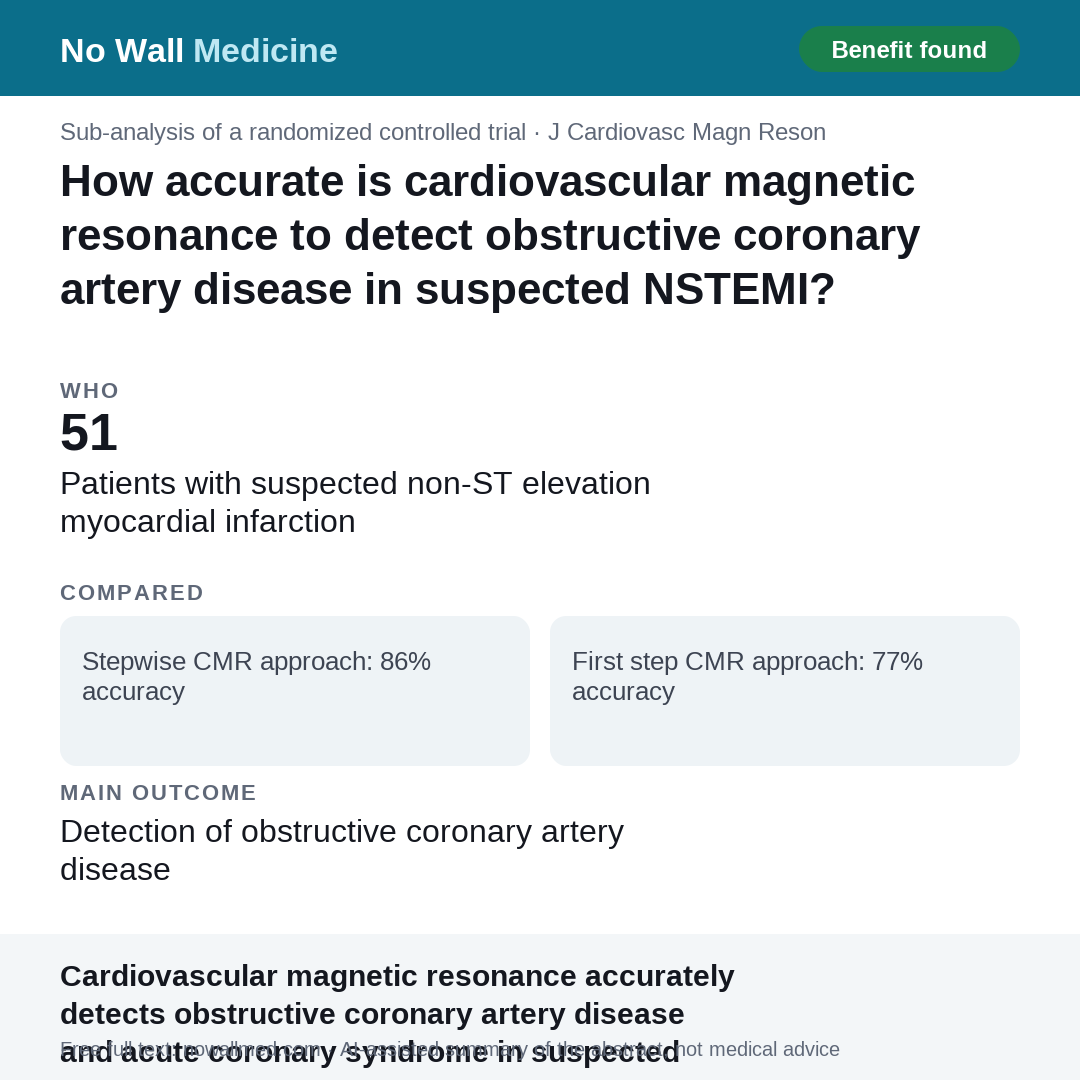
How accurate is cardiovascular magnetic resonance to detect obstructive coronary artery disease in suspected NSTEMI?
Who
51
Patients with suspected non-ST elevation myocardial infarction
Compared
Stepwise CMR approach: 86% accuracy
First step CMR approach: 77% accuracy
Main outcome
Detection of obstructive coronary artery disease
Bottom line: Cardiovascular magnetic resonance accurately detects obstructive coronary artery disease and acute coronary syndrome in suspected non-ST elevation myocardial infarction.
J Cardiovasc Magn Reson · 2021-03-22Download image
Clinical question: How accurate is cardiovascular magnetic resonance to detect obstructive coronary artery disease in suspected NSTEMI?
Why it matters: It is unknown if cardiovascular magnetic resonance imaging can accurately identify blocked coronary arteries to serve as a gatekeeper before invasive coronary angiography.
Key points
- Researchers analyzed 51 patients with suspected non-ST elevation myocardial infarction to compare cardiovascular magnetic resonance imaging against invasive coronary angiography.
- The first step of imaging had 79% sensitivity, 71% specificity, and 77% accuracy for detecting obstructive coronary artery disease.
- Adding vasodilator stress-perfusion imaging increased overall sensitivity to 97%, specificity to 65%, and accuracy to 86%.
Headline and key points written with AI from the paper’s abstract, with every number checked against it. Read the paper before relying on them.
Was this summary helpful?
Subject terms
Cite this article
van Cauteren YJM, Smulders MW, Theunissen RALJ, Gerretsen SC, Adriaans BP, Bijvoet GP. Cardiovascular magnetic resonance accurately detects obstructive coronary artery disease in suspected non-ST elevation myocardial infarction: a sub-analysis of the CARMENTA Trial. J Cardiovasc Magn Reson. 2021. doi:10.1186/s12968-021-00723-6
Spotted a mistake? Suggest a correction
Top studies every Monday
The week’s key trials and guidelines in your specialties, plus any topics you follow. By email, free.
Get the weekly digest