Deferred heart procedure based on pressure measurements linked to better cardiovascular outcomes in patients
Cardiovascular Outcomes in Patients With Deferred and Performed Coronary Revascularization Based on Intracoronary Physiology: A Systematic Review and Meta-Analysis
Systematic review and meta-analysis of 24 studiesBenefit found
What are the cardiovascular outcomes of deferred versus performed coronary revascularization based on intracoronary physiology?
Who
24285
Patients undergoing coronary revascularization based on intracoronary physiology
Compared
Deferred revascularization: all-cause death incidence rate ratio 1.14 (95% CI 1.00-1.30)
Performed revascularization
Main outcome
Major adverse cardiovascular events and mortality
Result: incidence rate ratio 1.15 (95% CI 0.99-1.34) for major adverse cardiovascular events
Bottom line: Deferred revascularization based on intracoronary physiology shows lower risk of adverse cardiovascular events compared to performed revascularization.
J Am Heart Assoc · 2026-04-22Download image
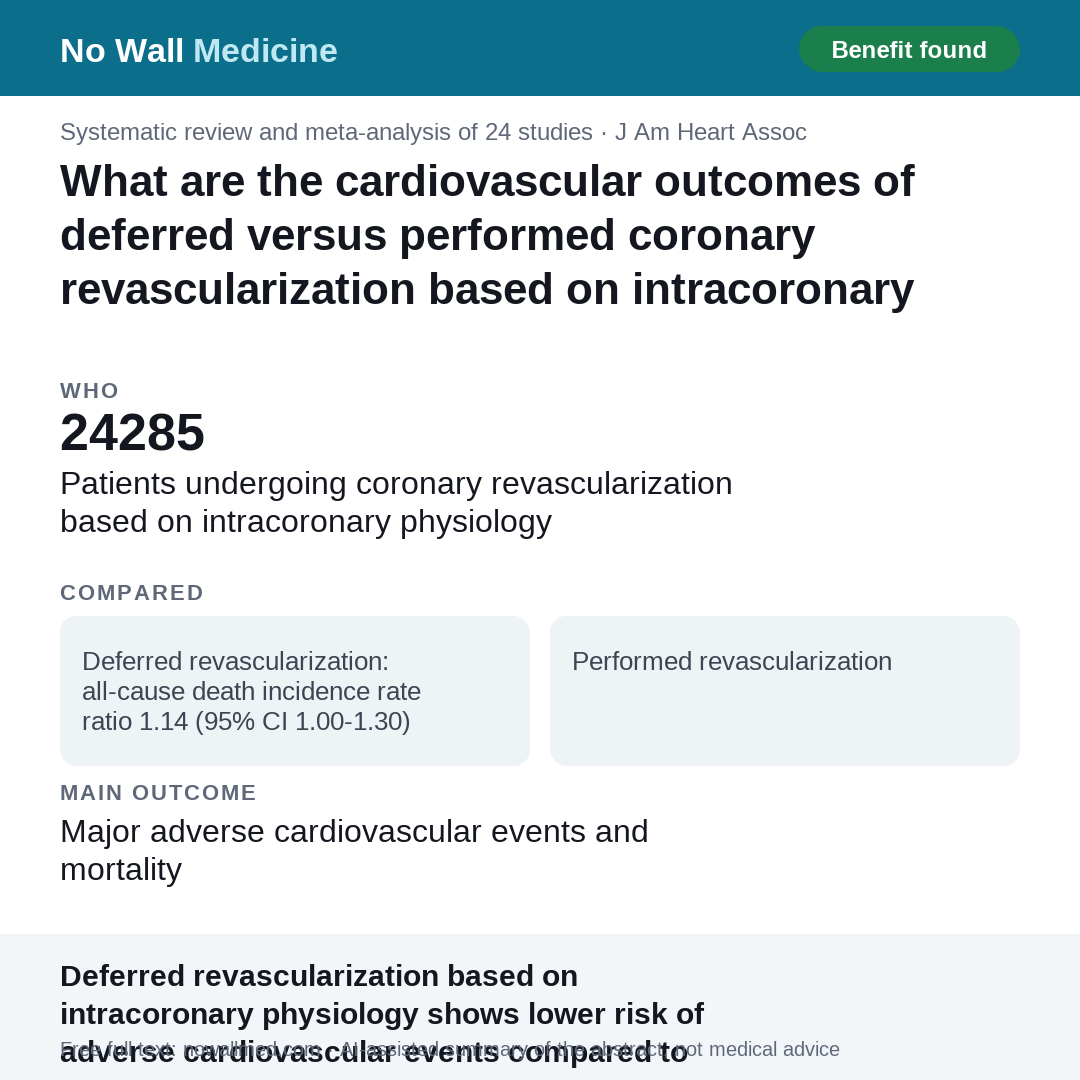
Clinical question: What are the cardiovascular outcomes of deferred versus performed coronary revascularization based on intracoronary physiology?
Why it matters: Conflicting findings have emerged regarding the safety of deferring heart procedures in specific patient subsets and varying follow-up periods.
Key points
- Researchers analyzed 24 studies involving 24,285 patients to compare outcomes of deferred versus performed coronary revascularization using intracoronary physiology.
- Patients with deferred revascularization had lower risks for cardiovascular death and unplanned revascularization after a mean follow-up of 2.6±1.6 years.
- No statistically significant differences were found for major adverse cardiovascular events or myocardial infarction, which is a heart attack.
Headline and key points written with AI from the paper’s abstract, with every number checked against it. Read the paper before relying on them.
Topics
Cite this article
Lombardi M, Travieso A, Cerrato E, Mohammad MA, Götberg M, Davies J. Cardiovascular Outcomes in Patients With Deferred and Performed Coronary Revascularization Based on Intracoronary Physiology: A Systematic Review and Meta-Analysis. J Am Heart Assoc. 2026. doi:10.1161/JAHA.125.042044
Spotted a mistake? Suggest a correction