Exenatide effects on heart failure hospitalizations varied based on baseline left ventricular ejection fraction
Cardiovascular outcomes with exenatide in type 2 diabetes according to ejection fraction: The EXSCEL trial
Post-hoc analysis of a randomized trialMixed results
How does exenatide affect cardiovascular outcomes according to left ventricular ejection fraction?
Who
4749
People with type 2 diabetes
Compared
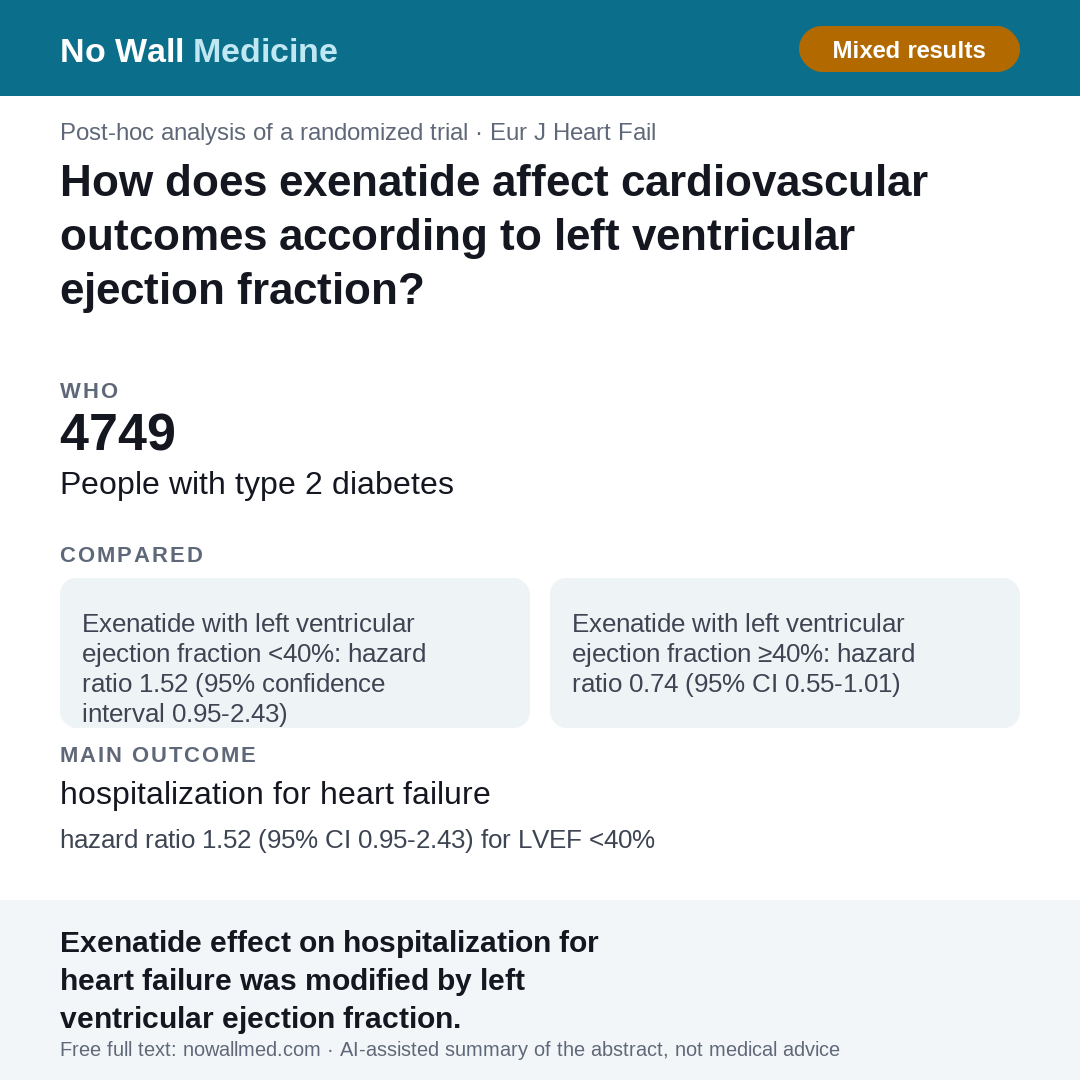
Exenatide with left ventricular ejection fraction <40%: hazard ratio 1.52 (95% confidence interval 0.95-2.43)
Exenatide with left ventricular ejection fraction ≥40%: hazard ratio 0.74 (95% CI 0.55-1.01)
Main outcome
hospitalization for heart failure
Result: hazard ratio 1.52 (95% CI 0.95-2.43) for LVEF <40%
Bottom line: Exenatide effect on hospitalization for heart failure was modified by left ventricular ejection fraction.
Limitation: This was a post-hoc analysis of the EXSCEL trial.
Eur J Heart Fail · 2024-10-09Download image
Clinical question: How does exenatide affect cardiovascular outcomes according to left ventricular ejection fraction?
Why it matters: It was unknown if the effects of glucagon-like peptide-1 receptor agonists on heart failure outcomes vary depending on a patient's baseline left ventricular ejection fraction.
Key points
- Researchers analyzed 4,749 participants from the EXSCEL trial to compare once-weekly exenatide against a placebo based on left ventricular ejection fraction, which is a measure of heart pumping strength.
- In participants with left ventricular ejection fraction <40%, the hazard ratio for hospitalization for heart failure was 1.52, while the hazard ratio was 0.74 for those with left ventricular ejection fraction ≥40%.
- No significant interactions between treatment and left ventricular ejection fraction were observed for major adverse cardiovascular events, cardiovascular death, or all-cause mortality.
Headline and key points written with AI from the paper’s abstract, with every number checked against it. Read the paper before relying on them.
Was this summary helpful?
Subject terms
Cite this article
Neves JS, Leite AR, Mentz RJ, Holman RR, Zannad F, Butler J. Cardiovascular outcomes with exenatide in type 2 diabetes according to ejection fraction: The EXSCEL trial. Eur J Heart Fail. 2024. doi:10.1002/ejhf.3478
Spotted a mistake? Suggest a correction
Top studies every Monday
The week’s key trials and guidelines in your specialties, plus any topics you follow. By email, free.
Get the weekly digest