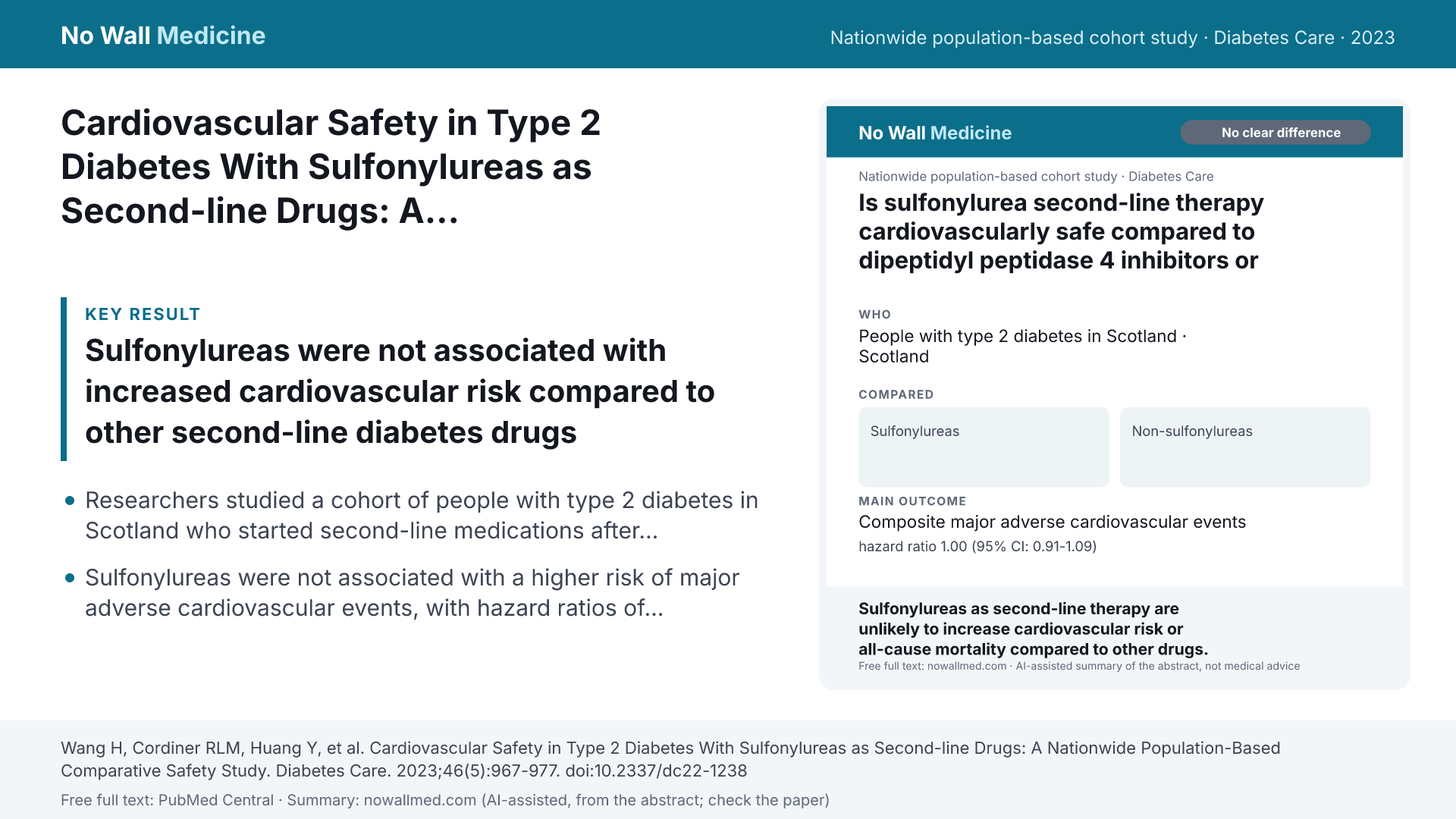
Sulfonylureas were not associated with increased cardiovascular risk compared to other second-line diabetes drugs
Cardiovascular Safety in Type 2 Diabetes With Sulfonylureas as Second-line Drugs: A Nationwide Population-Based Comparative Safety Study
Nationwide population-based cohort studyNo clear difference
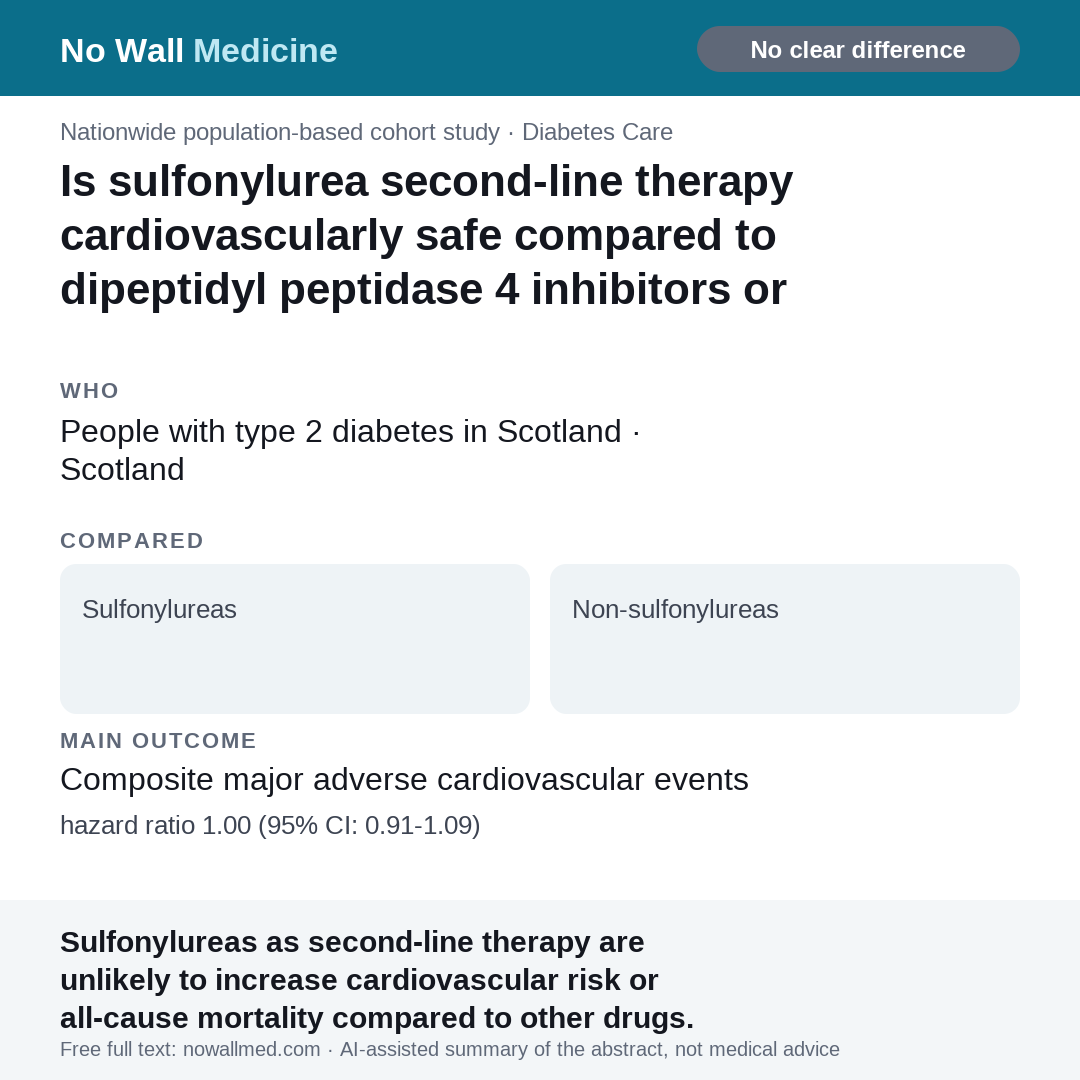
Is sulfonylurea second-line therapy cardiovascularly safe compared to dipeptidyl peptidase 4 inhibitors or thiazolidinediones?
Who
People with type 2 diabetes in Scotland · Scotland
Compared
Sulfonylureas
Non-sulfonylureas
Main outcome
Composite major adverse cardiovascular events
Result: hazard ratio 1.00 (95% CI: 0.91-1.09)
Bottom line: Sulfonylureas as second-line therapy are unlikely to increase cardiovascular risk or all-cause mortality compared to other drugs.
Diabetes Care · 2023-03-22Download image
Clinical question: Is sulfonylurea second-line therapy cardiovascularly safe compared to dipeptidyl peptidase 4 inhibitors or thiazolidinediones?
Why it matters: It was unknown if sulfonylureas, used as a second-line treatment for type 2 diabetes, carried higher cardiovascular risks compared to dipeptidyl peptidase 4 inhibitors or thiazolidinediones.
Key points
- Researchers studied a cohort of people with type 2 diabetes in Scotland who started second-line medications after metformin alone failed to reach an HbA1c of 48 mmol/mol.
- Sulfonylureas were not associated with a higher risk of major adverse cardiovascular events, with hazard ratios of 1.00, 1.02, and 1.03 across different analysis methods.
- The use of sulfonylureas was also not associated with an increased risk of all-cause death, with hazard ratios ranging from 1.03 to 1.04.
Headline and key points written with AI from the paper’s abstract, with every number checked against it. Read the paper before relying on them.
Was this summary helpful?
Subject terms
Cite this article
Wang H, Cordiner RLM, Huang Y, et al. Cardiovascular Safety in Type 2 Diabetes With Sulfonylureas as Second-line Drugs: A Nationwide Population-Based Comparative Safety Study. Diabetes Care. 2023. doi:10.2337/dc22-1238
Spotted a mistake? Suggest a correction