Web-based support program trial to evaluate wellbeing in cardiac arrest survivors
CARDIS (Cardiac ARrest DIgital Support): study protocol for a randomised controlled trial of a web-based support intervention for cardiac arrest survivors
Multicentre, parallel-group, randomised controlled trialUnclear result
Does a web-based support programme improve wellbeing for cardiac arrest survivors?
Who
Cardiac arrest survivors aged over 18 years · Multicentre
Compared
Intervention
Control
Main outcome
Overall wellbeing and health at 3 months
Bottom line: This study protocol describes a trial evaluating a web-based support programme for cardiac arrest survivors.
Resusc Plus · 2026-01-18Download image
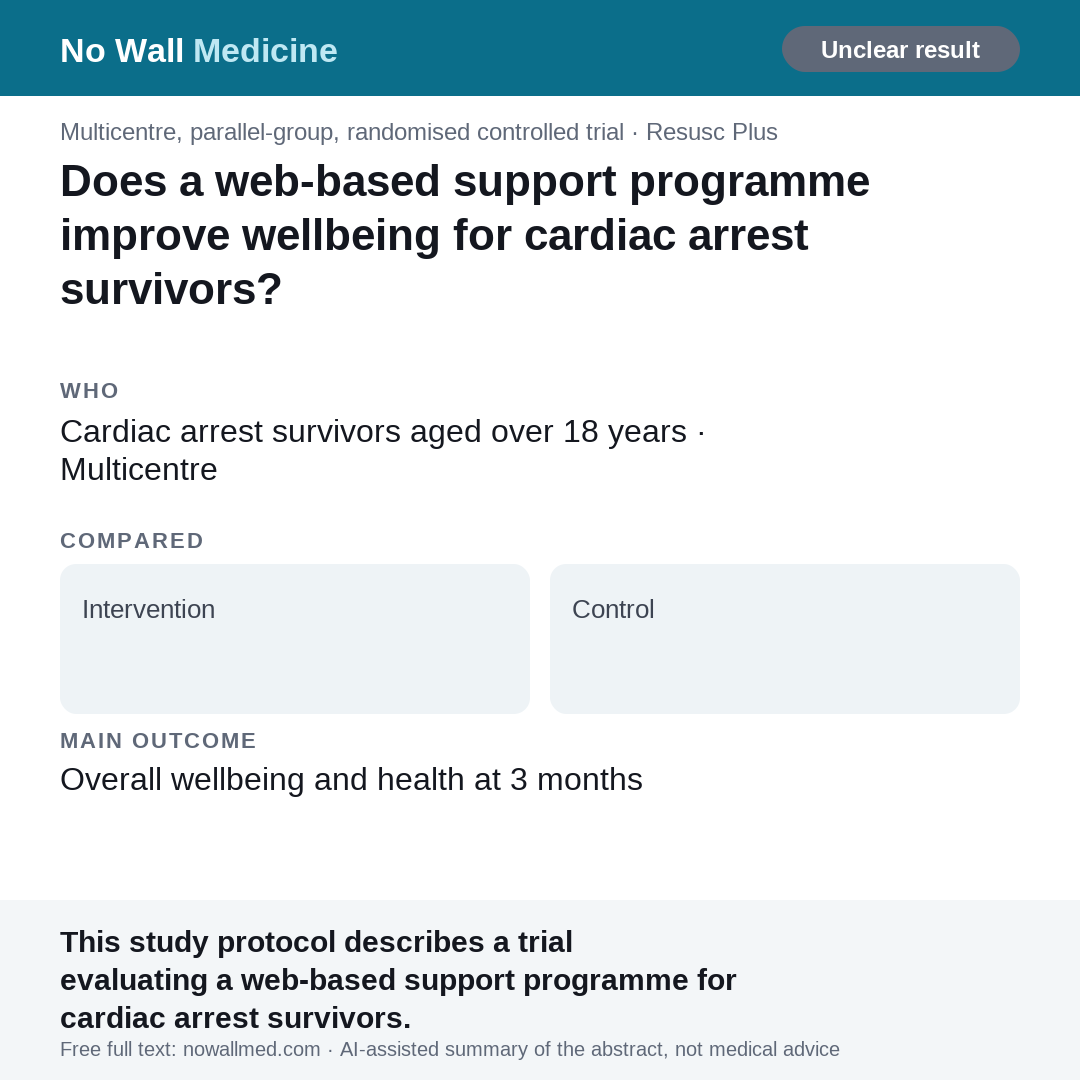
Clinical question: Does a web-based support programme improve wellbeing for cardiac arrest survivors?
Why it matters: Clinical guidelines recommend structured follow-up after cardiac arrest, but such resources are often inconsistent or lacking for survivors.
Key points
- The CARDIS trial will enroll cardiac arrest survivors over 18 years old and randomize them 1:1 to either a control group or a web-based support program.
- The intervention group will receive a 3-month web-based self-guided program in addition to standard care, while the control group receives standard care and a printed booklet.
- Researchers will measure overall wellbeing and health at 3 months, along with secondary outcomes like cognitive problems, depression, anxiety, and sleep disturbances.
Headline and key points written with AI from the paper’s abstract, with every number checked against it. Read the paper before relying on them.
Cite this article
Waldemar A, Israelsson J, Heimburg K, Blennow Nordström E, Nordberg P, Bremer A. CARDIS (Cardiac ARrest DIgital Support): study protocol for a randomised controlled trial of a web-based support intervention for cardiac arrest survivors. Resusc Plus. 2026. doi:10.1016/j.resplu.2026.101235
Spotted a mistake? Suggest a correction