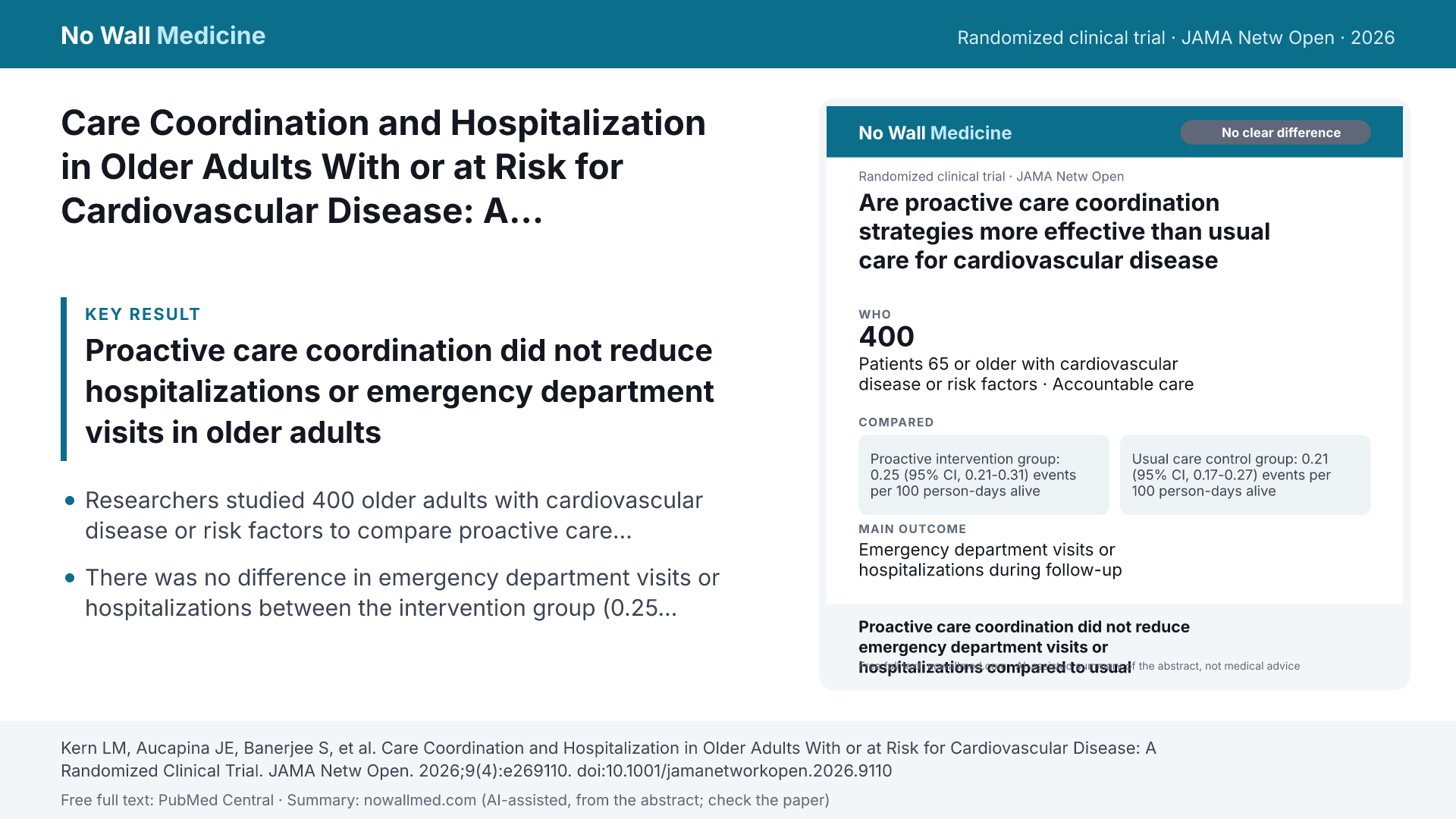
Proactive care coordination did not reduce hospitalizations or emergency department visits in older adults
Care Coordination and Hospitalization in Older Adults With or at Risk for Cardiovascular Disease: A Randomized Clinical Trial
Randomized clinical trialNo clear difference
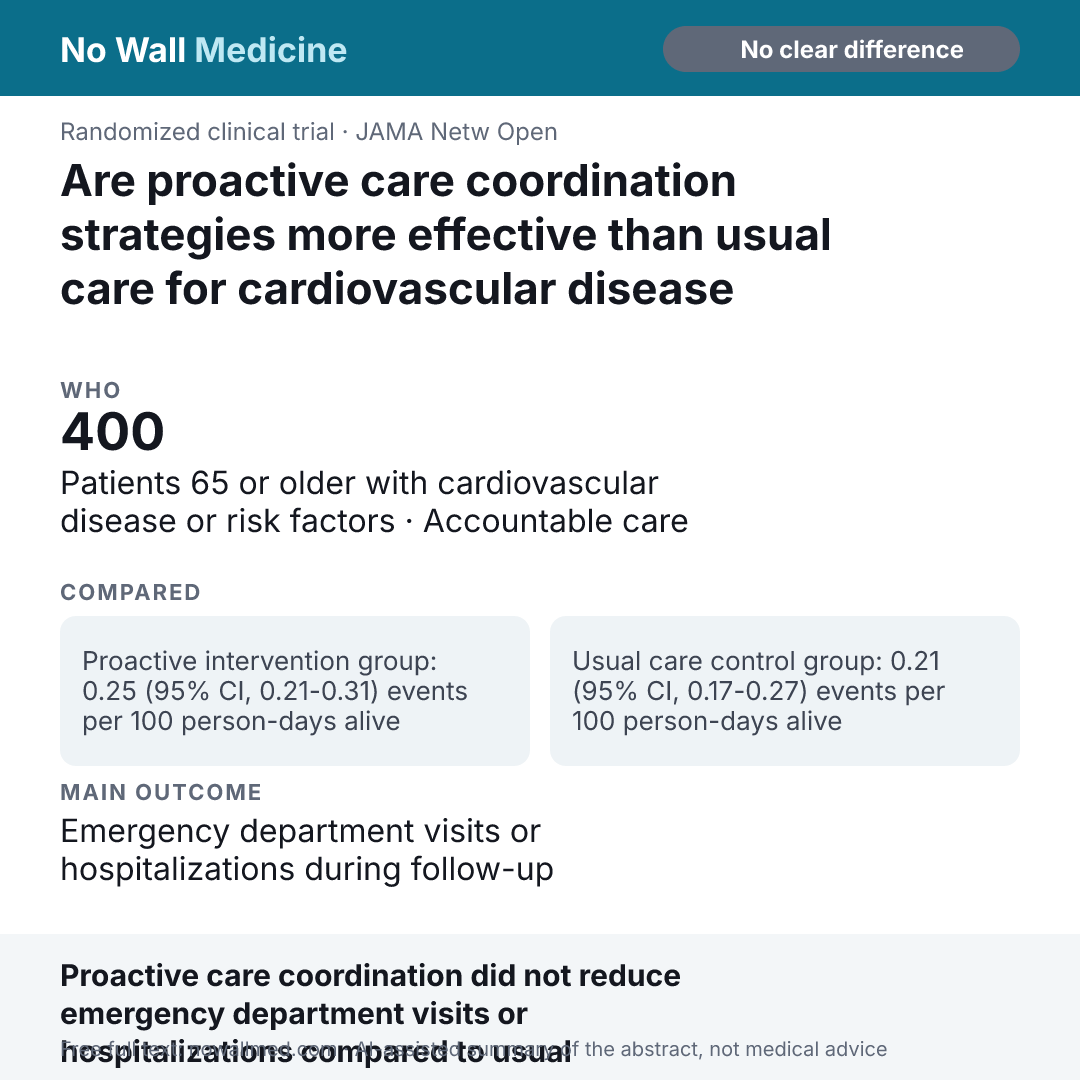
Are proactive care coordination strategies more effective than usual care for cardiovascular disease patients?
Who
400
Patients 65 or older with cardiovascular disease or risk factors · Accountable care organization in New York, New York
Compared
Proactive intervention group: 0.25 (95% CI, 0.21-0.31) events per 100 person-days alive
Usual care control group: 0.21 (95% CI, 0.17-0.27) events per 100 person-days alive
Main outcome
Emergency department visits or hospitalizations during follow-up
Result: 0.25 (95% CI, 0.21-0.31) vs 0.21 (95% CI, 0.17-0.27) events per 100 person-days alive
Bottom line: Proactive care coordination did not reduce emergency department visits or hospitalizations compared to usual post-hospitalization care.
JAMA Netw Open · 2026-04-01 · NCT05820295
Why it matters: Patients with cardiovascular disease often see many different doctors who may not communicate, creating gaps in care coordination.
Headline and visual abstract written with AI from the paper’s abstract, with every number checked against it. Read the paper before relying on them.
Was this summary helpful?
Subject terms
Cite this article
Kern LM, Aucapina JE, Banerjee S, et al. Care Coordination and Hospitalization in Older Adults With or at Risk for Cardiovascular Disease: A Randomized Clinical Trial. JAMA Netw Open. 2026;9(4):e269110. doi:10.1001/jamanetworkopen.2026.9110
Spotted a mistake? Suggest a correction