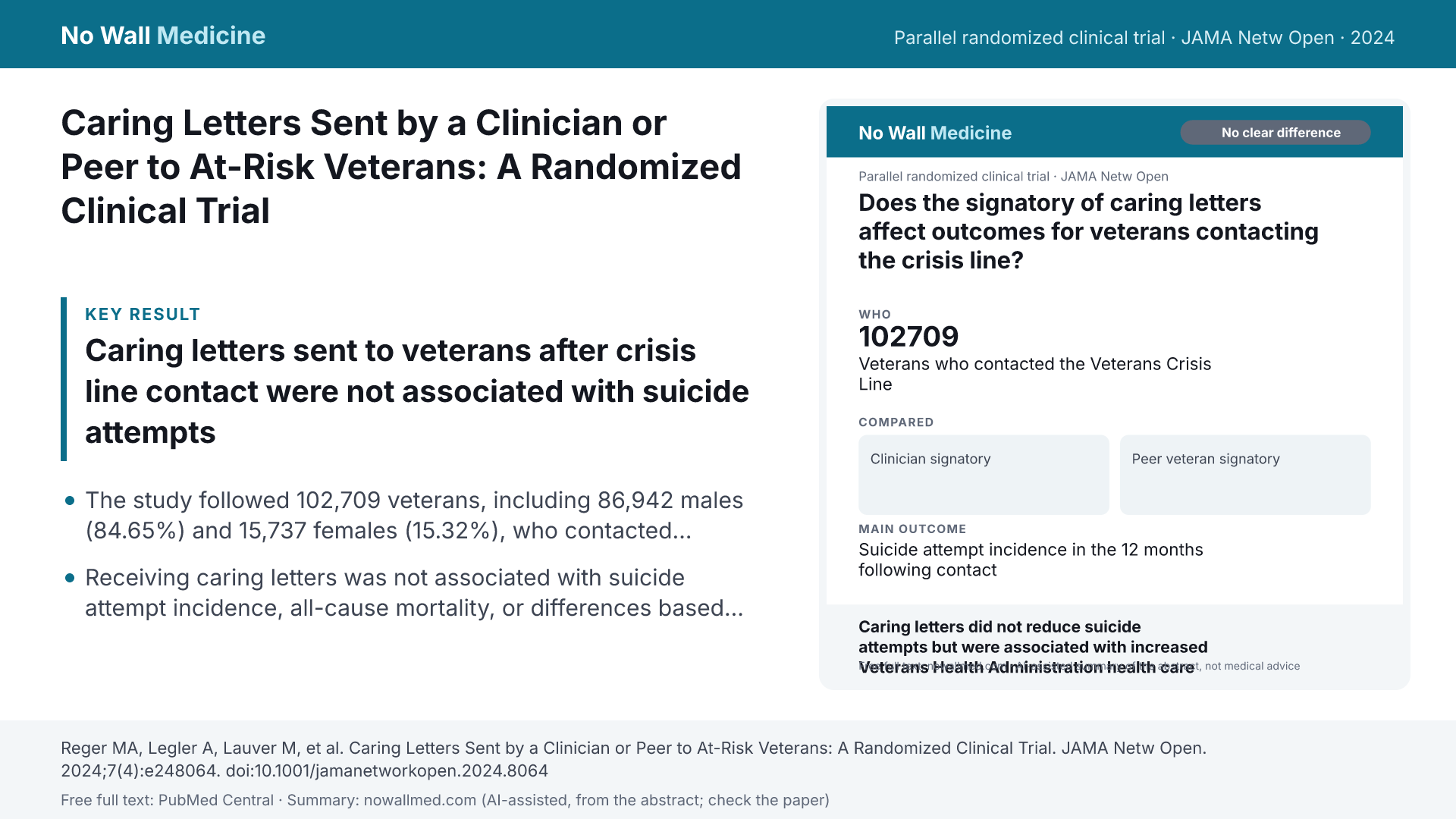
Caring letters sent to veterans after crisis line contact were not associated with suicide attempts
Caring Letters Sent by a Clinician or Peer to At-Risk Veterans: A Randomized Clinical Trial
Parallel randomized clinical trialNo clear difference
Does the signatory of caring letters affect outcomes for veterans contacting the crisis line?
Who
102709
Veterans who contacted the Veterans Crisis Line
Compared
Clinician signatory
Peer veteran signatory
Main outcome
Suicide attempt incidence in the 12 months following contact
Bottom line: Caring letters did not reduce suicide attempts but were associated with increased Veterans Health Administration health care use.
JAMA Netw Open · 2024-04-01 · Save PNG
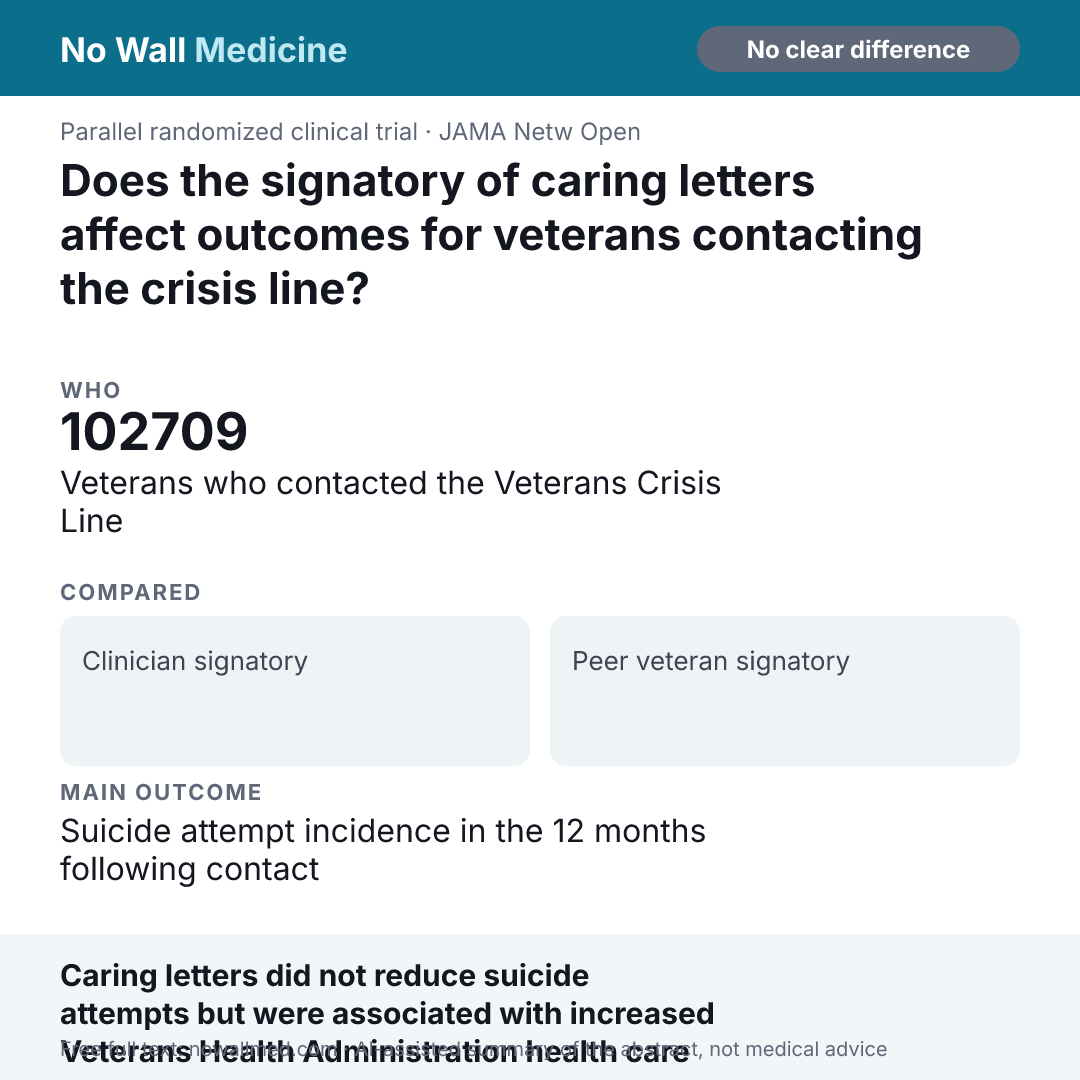
Clinical question: Does the signatory of caring letters affect outcomes for veterans contacting the crisis line?
Key points
- The study followed 102,709 veterans, including 86,942 males (84.65%) and 15,737 females (15.32%), who contacted the Veterans Crisis Line.
- Receiving caring letters was not associated with suicide attempt incidence, all-cause mortality, or differences based on whether a clinician or peer signed the letters.
- Receipt of caring letters was associated with increased Veterans Health Administration health care use, including outpatient mental health (hazard ratio 1.19) and inpatient mental health (hazard ratio 1.14).
Headline and key points written with AI from the paper’s abstract, with every number checked against it. Read the paper before relying on them.
Was this summary helpful?
Subject terms
Headline, design, result, key points, caveat and citation as plain text.
Cite this article
Reger MA, Legler A, Lauver M, et al. Caring Letters Sent by a Clinician or Peer to At-Risk Veterans: A Randomized Clinical Trial. JAMA Netw Open. 2024;7(4):e248064. doi:10.1001/jamanetworkopen.2024.8064
Spotted a mistake? Suggest a correction