Cascade Testing for Hereditary Cancer Syndromes: Should We Move Toward Direct Relative Contact? A Systematic Review and Meta-Analysis
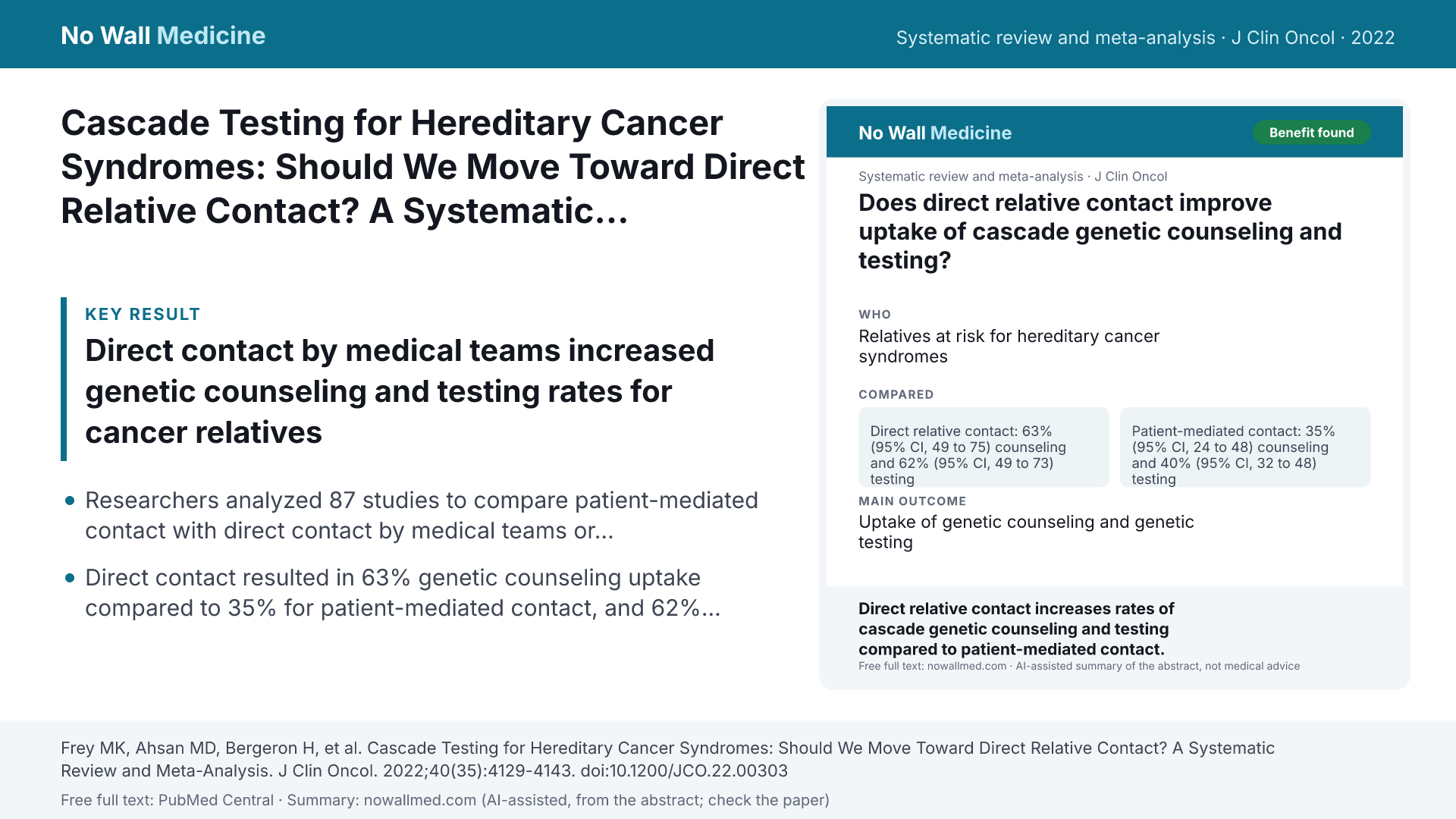
Key result: Direct contact by medical teams increased genetic counseling and testing rates for cancer relatives
Systematic review and meta-analysisBenefit found
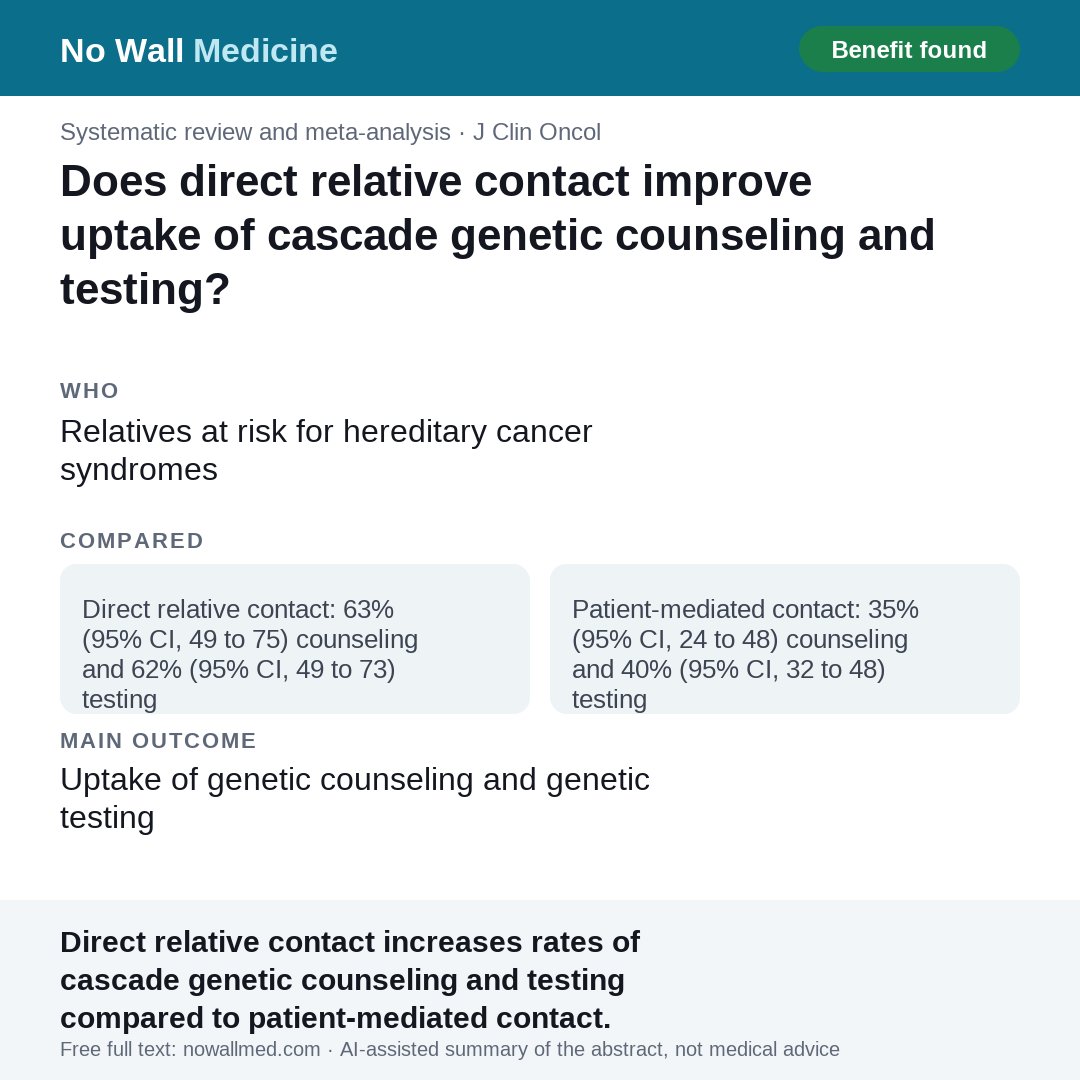
Does direct relative contact improve uptake of cascade genetic counseling and testing?
Who
Relatives at risk for hereditary cancer syndromes
Compared
Direct relative contact: 63% (95% CI, 49 to 75) counseling and 62% (95% CI, 49 to 73) testing
Patient-mediated contact: 35% (95% CI, 24 to 48) counseling and 40% (95% CI, 32 to 48) testing
Main outcome
Uptake of genetic counseling and genetic testing
Bottom line: Direct relative contact increases rates of cascade genetic counseling and testing compared to patient-mediated contact.
J Clin Oncol · 2022-08-12Download image
Key points
- Researchers analyzed 87 studies to compare patient-mediated contact with direct contact by medical teams or laboratories for hereditary cancer testing.
- Direct contact resulted in 63% genetic counseling uptake compared to 35% for patient-mediated contact, and 62% testing for first-degree relatives compared to 40%.
- Among all relatives in the analysis, 48% underwent genetic counseling and 41% underwent genetic testing.
Why it matters: It is unknown whether direct contact by medical teams or laboratories is more effective than having patients contact their own relatives for hereditary cancer testing.
Discussion prompts
- Would these patients look like yours? Who was left out?
- Is the main outcome one that matters to patients?
- Is the difference large enough to change what you do?
Cite: Frey MK, Ahsan MD, Bergeron H, et al. Cascade Testing for Hereditary Cancer Syndromes: Should We Move Toward Direct Relative Contact? A Systematic Review and Meta-Analysis. J Clin Oncol. 2022. doi:10.1200/JCO.22.00303
Free full text: PubMed Central · Summary and visual abstract: nowallmed.com/a/cascade-testing-for-hereditary-cancer-syndromes-should-we-move-toward-5x7t5e/ (AI-assisted from the abstract; check the paper before relying on it).