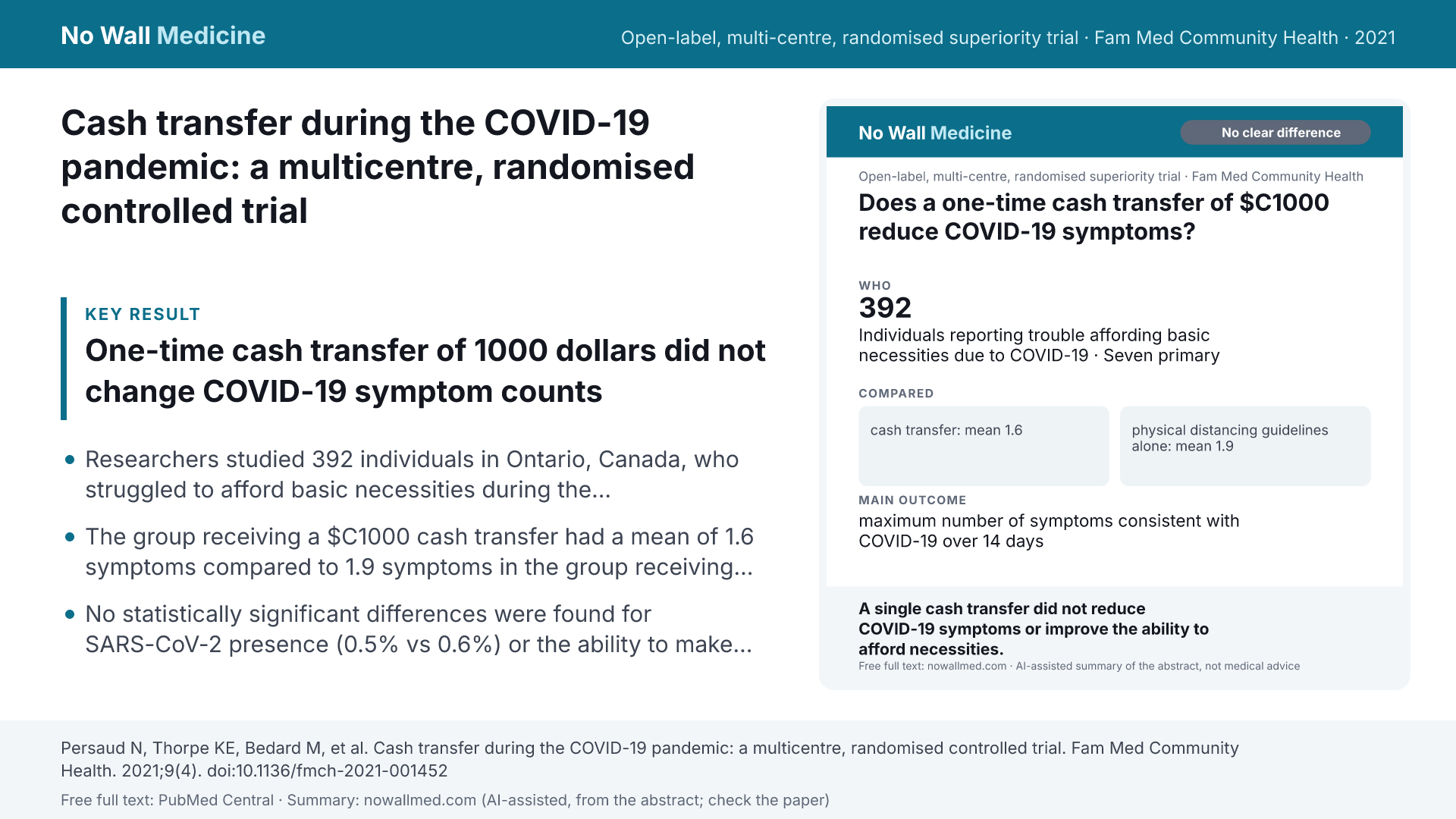
One-time cash transfer of 1000 dollars did not change COVID-19 symptom counts
Cash transfer during the COVID-19 pandemic: a multicentre, randomised controlled trial
Open-label, multi-centre, randomised superiority trialNo clear difference
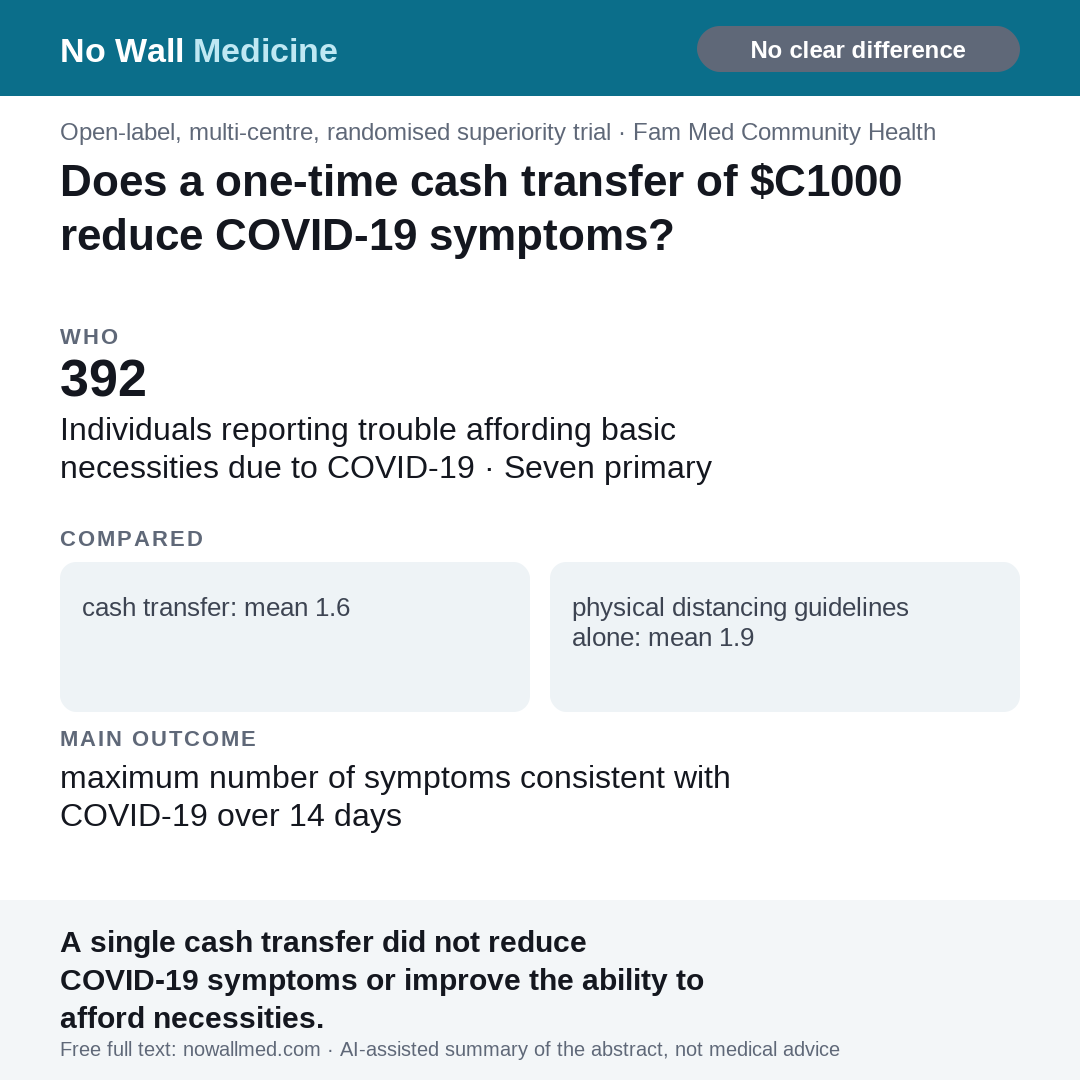
Does a one-time cash transfer of $C1000 reduce COVID-19 symptoms?
Who
392
Individuals reporting trouble affording basic necessities due to COVID-19 · Seven primary care sites in Ontario, Canada
Compared
cash transfer: mean 1.6
physical distancing guidelines alone: mean 1.9
Main outcome
maximum number of symptoms consistent with COVID-19 over 14 days
Result: ratio of means 0.83; 95% CI 0.56 to 1.24
Bottom line: A single cash transfer did not reduce COVID-19 symptoms or improve the ability to afford necessities.
Fam Med Community Health · 2021-12-20Download image
Clinical question: Does a one-time cash transfer of $C1000 reduce COVID-19 symptoms?
Why it matters: It was unknown if a one-time cash transfer would affect COVID-19 symptoms or the ability to afford necessities for people unable to physically distance due to low income.
Key points
- Researchers studied 392 individuals in Ontario, Canada, who struggled to afford basic necessities during the COVID-19 pandemic.
- The group receiving a $C1000 cash transfer had a mean of 1.6 symptoms compared to 1.9 symptoms in the group receiving only distancing guidelines.
- No statistically significant differences were found for SARS-CoV-2 presence (0.5% vs 0.6%) or the ability to make ends meet (52% vs 51%).
Headline and key points written with AI from the paper’s abstract, with every number checked against it. Read the paper before relying on them.
Was this summary helpful?
Abstract
Objective
To evaluate the effect of a one-time cash transfer of $C1000 in people who are unable to physically distance due to insufficient income. Design
Open-label, multi-centre, randomised superiority trial. Setting
Seven primary care sites in Ontario, Canada; six urban sites associated with St. Michael's Hospital in Toronto and one in Manitoulin Island. Participants
392 individuals who reported trouble affording basic necessities due to disruptions related to COVID-19. Intervention
After random allocation, participants either received the cash transfer of $C1000 (n=196) or physical distancing guidelines alone (n=196). Main outcome measures
The primary outcome was the maximum number of symptoms consistent with COVID-19 over 14 days. Secondary outcomes were meeting clinical criteria for COVID-19, SARS-CoV-2 presence, number of close contacts, general health and ability to afford basic necessities. Results
The primary outcome of number of symptoms reported by participants did not differ between groups after 2 weeks (cash transfer, mean 1.6 vs 1.9, ratio of means 0.83; 95% CI 0.56 to 1.24). There were no statistically significant effects on secondary outcomes of the meeting COVID-19 clinical criteria (7.9% vs 12.8%; risk difference -0.05; 95% CI -0.11 to 0.01), SARS-CoV-2 presence (0.5% vs 0.6%; risk difference 0.00 95% CI -0.02 to 0.02), mean number of close contacts (3.5 vs 3.7; rate ratio 1.10; 95% CI 0.83 to 1.46), general health very good or excellent (60% vs 63%; risk difference -0.03 95% CI -0.14 to 0.08) and ability to make ends meet (52% vs 51%; risk difference 0.01 95% CI -0.10 to 0.12). Conclusions
A single cash transfer did not reduce the COVID-19 symptoms or improve the ability to afford necessities. Further studies are needed to determine whether some groups may benefit from financial supports and to determine if a higher level of support is beneficial. Trial registration number
NCT04359264.
Abstract reproduced under the article’s CC BY NC licence.
Subject terms
Cite this article
Persaud N, Thorpe KE, Bedard M, Hwang SW, Pinto A, Jüni P. Cash transfer during the COVID-19 pandemic: a multicentre, randomised controlled trial. Fam Med Community Health. 2021. doi:10.1136/fmch-2021-001452
Spotted a mistake? Suggest a correction
Top studies every Monday
The week’s key trials and guidelines in your specialties, plus any topics you follow. By email, free.
Get the weekly digest