Catheter ablation added to standard therapy did not reduce composite risks in atrial fibrillation patients
Catheter Ablation and Oral Anticoagulation for Secondary Stroke Prevention in Atrial Fibrillation: The STABLED Randomized Clinical Trial
Open-label, parallel-group, randomized clinical trialNo clear difference
Does catheter ablation plus standard therapy reduce recurrent stroke or composite outcomes in atrial fibrillation?
Who
249
Patients with nonvalvular atrial fibrillation and recent ischemic stroke · 45 sites in Japan
Compared
Standard therapy: 4.9% per person-year
Standard therapy plus catheter ablation: 5.6% per person-year
Main outcome
Recurrent ischemic stroke, systemic embolism, all-cause death, or heart failure hospitalization
Result: hazard ratio 1.11 (95% CI 0.62-2.01)
Bottom line: Adding catheter ablation to standard therapy did not significantly reduce the risk of the primary composite end point.
JAMA Neurol · 2026-03-02Download image
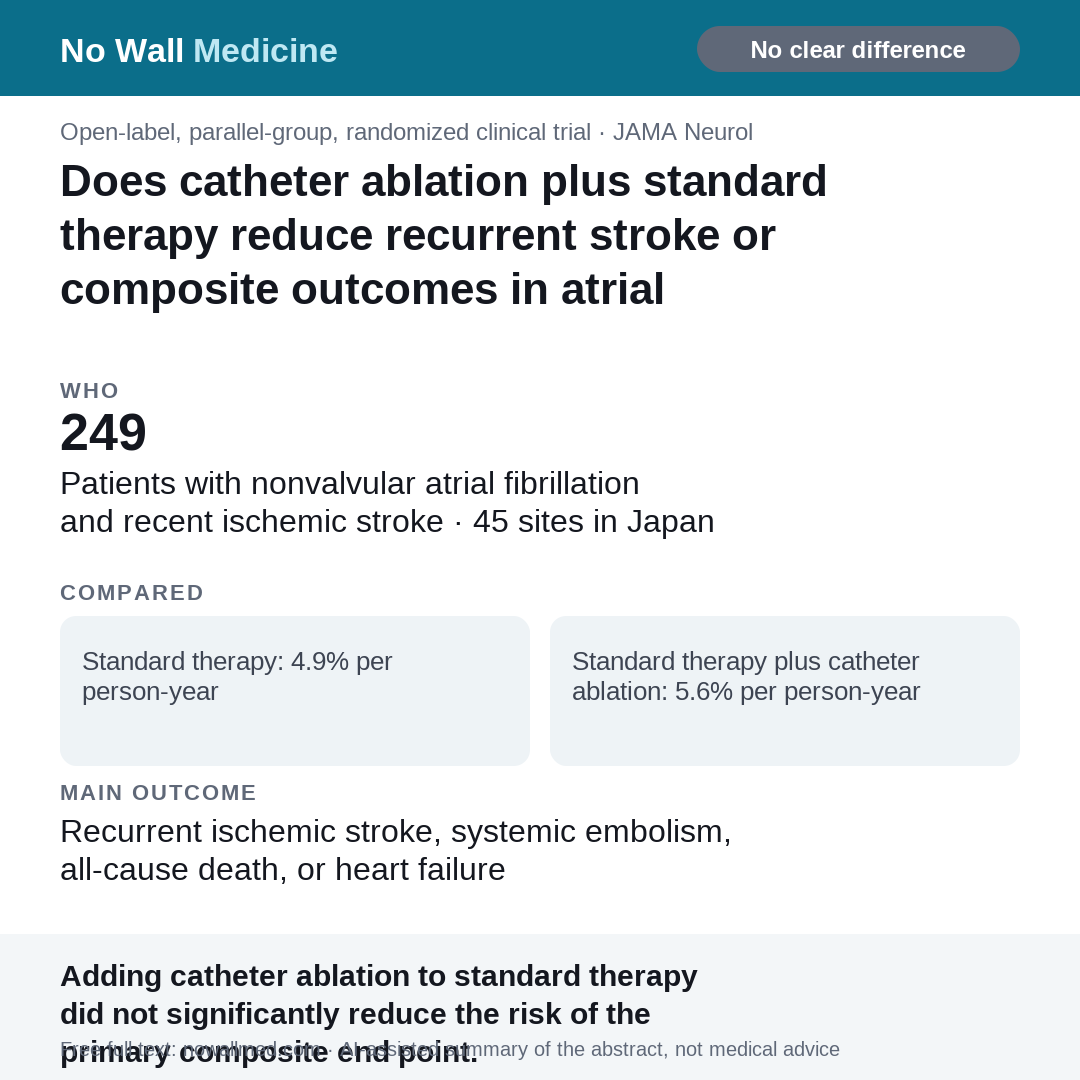
Clinical question: Does catheter ablation plus standard therapy reduce recurrent stroke or composite outcomes in atrial fibrillation?
Why it matters: Patients with atrial fibrillation and a recent stroke face a high risk of recurrence, but the efficacy of adding catheter ablation to standard therapy is unclear.
Key points
- Researchers studied 249 patients with nonvalvular atrial fibrillation and a recent history of ischemic stroke in Japan.
- The primary composite end point occurred at rates of 4.9% and 5.6% per person-year for standard therapy versus catheter ablation.
- Two ablation-related adverse events, including cardiac tamponade and stroke, were reported at 0.8% each.
Headline and key points written with AI from the paper’s abstract, with every number checked against it. Read the paper before relying on them.
Topics
Cite this article
Kimura K, Nishiyama Y, Iwasaki YK, Shimizu W, Toyoda K, Sakamoto Y. Catheter Ablation and Oral Anticoagulation for Secondary Stroke Prevention in Atrial Fibrillation: The STABLED Randomized Clinical Trial. JAMA Neurol. 2026. doi:10.1001/jamaneurol.2026.0155
Spotted a mistake? Suggest a correction