Catheter ablation compared to antiarrhythmic drugs for ventricular tachycardia in patients with prior heart attack
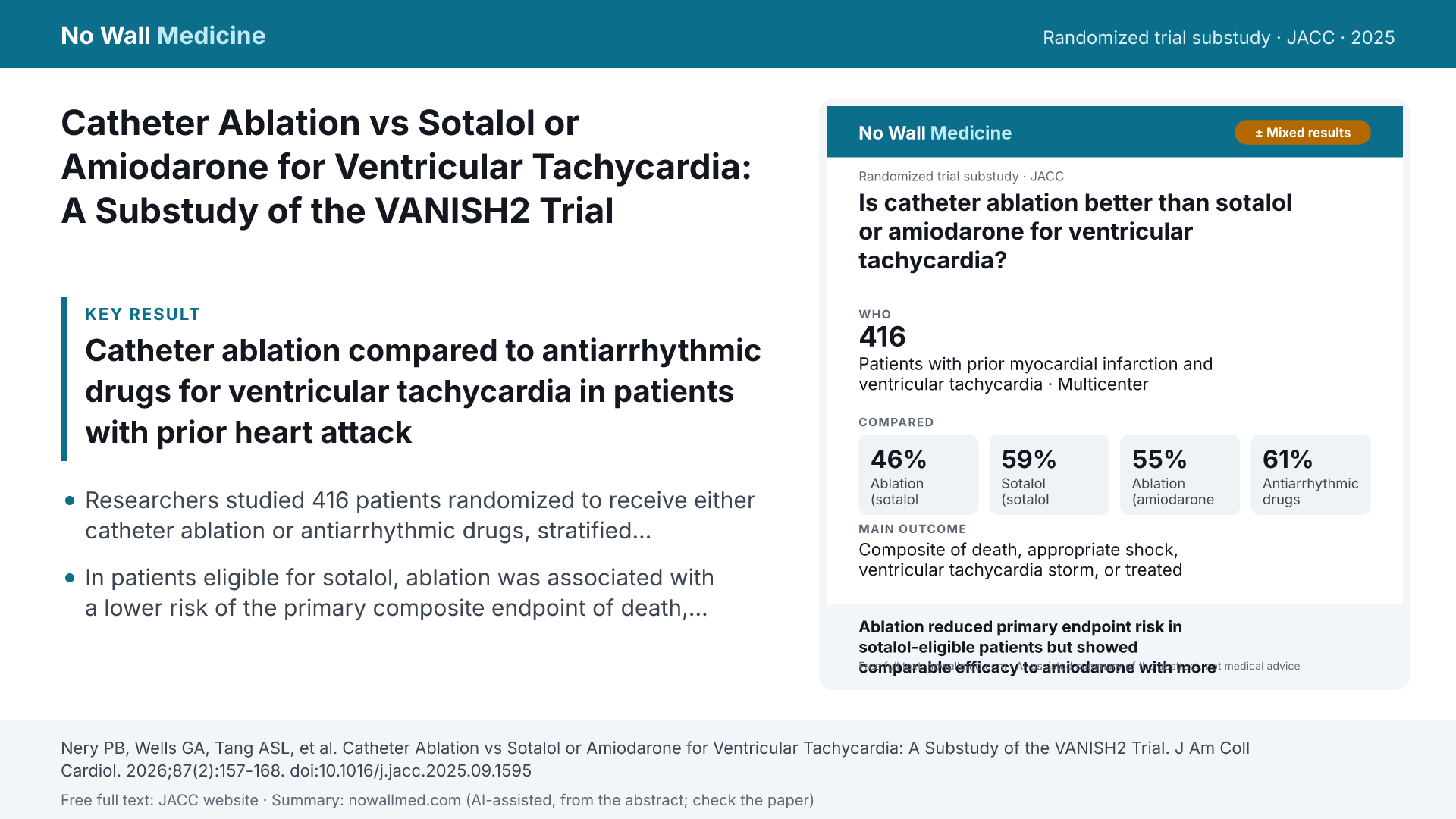
Catheter Ablation vs Sotalol or Amiodarone for Ventricular Tachycardia: A Substudy of the VANISH2 Trial
Randomized trial substudyMixed results
Is catheter ablation better than sotalol or amiodarone for ventricular tachycardia?
Who
416
Patients with prior myocardial infarction and ventricular tachycardia · Multicenter
Compared
46%Ablation (sotalol stratum)
59%Sotalol (sotalol stratum)
55%Ablation (amiodarone stratum)
61%Antiarrhythmic drugs (amiodarone stratum)
Main outcome
Composite of death, appropriate shock, ventricular tachycardia storm, or treated sustained ventricular tachycardia
Result: hazard ratio 0.64 (95% CI 0.43-0.94) for sotalol; hazard ratio 0.86 (95% CI 0.61-1.22) for amiodarone
Bottom line: Ablation reduced primary endpoint risk in sotalol-eligible patients but showed comparable efficacy to amiodarone with more adverse events.
JACC · 2025-10-11Download image
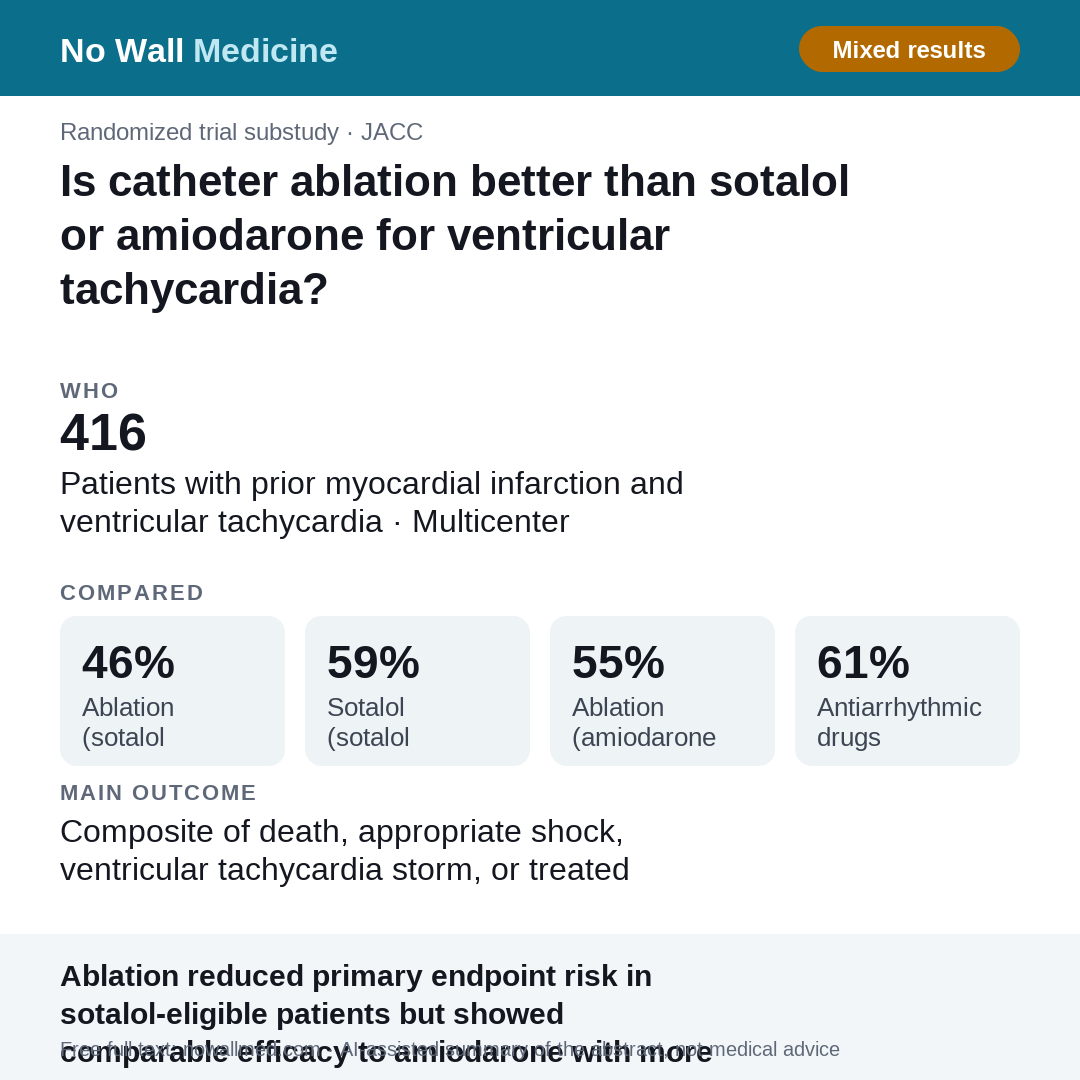
Clinical question: Is catheter ablation better than sotalol or amiodarone for ventricular tachycardia?
Why it matters: Clinicians need to know if catheter ablation is more effective than specific antiarrhythmic drugs for patients with ventricular tachycardia and a history of heart attack.
Key points
- Researchers studied 416 patients randomized to receive either catheter ablation or antiarrhythmic drugs, stratified by whether they were eligible for sotalol or amiodarone.
- In patients eligible for sotalol, ablation was associated with a lower risk of the primary composite endpoint of death, device shock, VT storm, or treated sustained ventricular tachycardia.
- In the amiodarone group, ablation showed no significant difference in the primary composite endpoint compared to amiodarone, though drug therapy was associated with higher rates of noncardiac death and respiratory failure.
Headline and key points written with AI from the paper’s abstract, with every number checked against it. Read the paper before relying on them.
Was this summary helpful?
Subject terms
Cite this article
Nery PB, Wells GA, Tang ASL, et al. Catheter Ablation vs Sotalol or Amiodarone for Ventricular Tachycardia: A Substudy of the VANISH2 Trial. JACC. 2025. doi:10.1016/j.jacc.2025.09.1595
Spotted a mistake? Suggest a correction