Catheter-directed thrombolysis showed no significant difference in primary heart ratio outcome for pulmonary embolism
Catheter-Directed Thrombolysis vs Anticoagulation in Patients With Acute Intermediate-High-risk Pulmonary Embolism: The CANARY Randomized Clinical Trial
Randomized clinical trialBenefit found
Catheter-directed thrombolysis vs anticoagulation
Who
94
Patients with acute intermediate-high-risk pulmonary embolism · Tehran, Iran, 2 centers
Compared
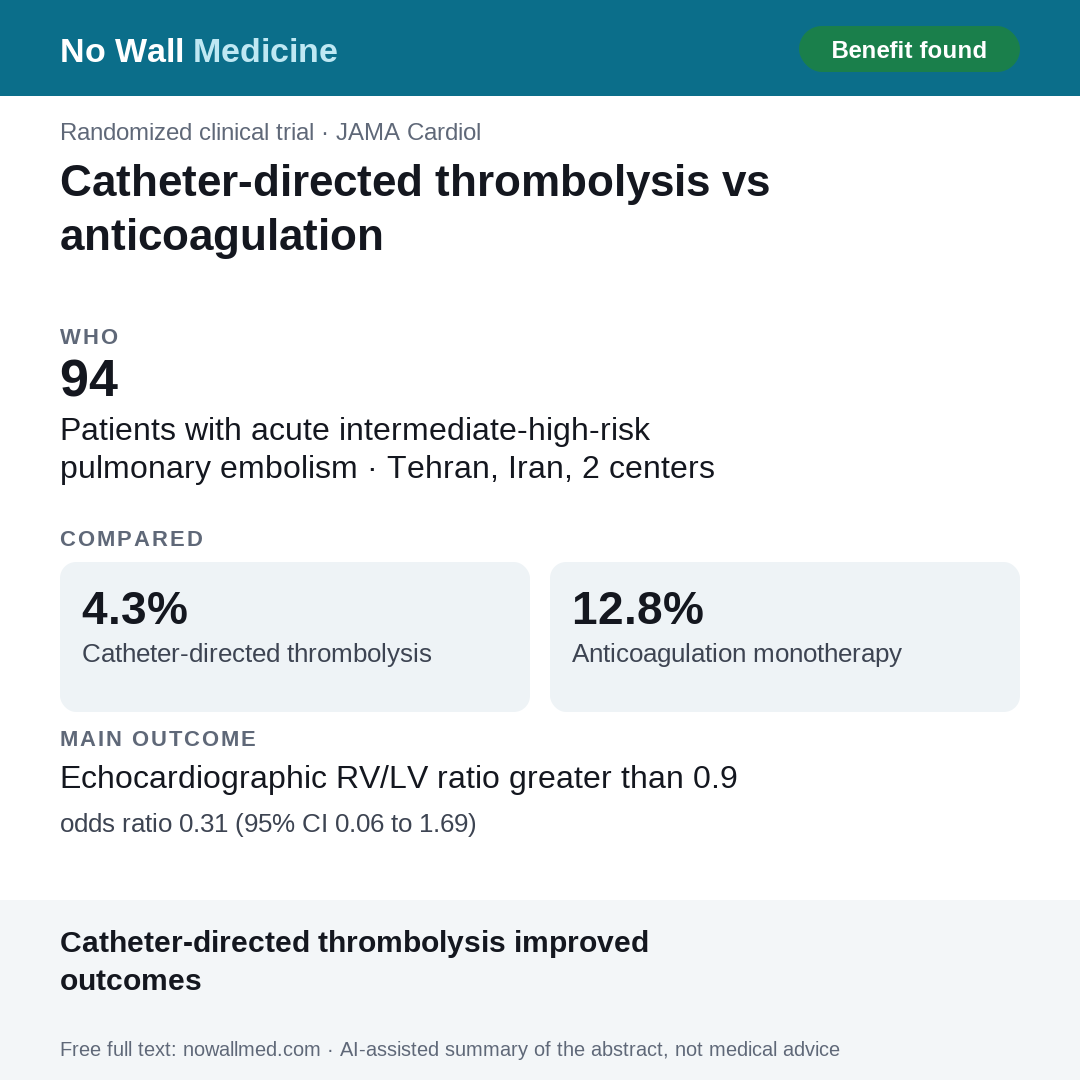
4.3%Catheter-directed thrombolysis (2/46)
12.8%Anticoagulation monotherapy (5/39)
Main outcome
Echocardiographic RV/LV ratio greater than 0.9
Result: odds ratio 0.31 (95% CI 0.06 to 1.69)
Bottom line: Catheter-directed thrombolysis improved outcomes
JAMA Cardiol · 2022-12-01Download image
Why it matters: The optimal treatment for patients with intermediate-high-risk pulmonary embolism remains unknown.
Key points
- The trial randomized 94 patients with intermediate-high-risk pulmonary embolism to receive catheter-directed thrombolysis plus heparin or anticoagulation monotherapy.
- At 3 months, 4.3% of the catheter-directed thrombolysis group and 12.8% of the anticoagulation group met the primary outcome of a right ventricle to left ventricle ratio greater than 0.9.
- The median 3-month right ventricle to left ventricle ratio was 0.7 in the catheter-directed thrombolysis group compared to 0.8 in the anticoagulation group.
Headline and key points written with AI from the paper’s abstract, with every number checked against it. Read the paper before relying on them.
Was this summary helpful?
Subject terms
Cite this article
Sadeghipour P, Jenab Y, Moosavi J, Hosseini K, Mohebbi B, Hosseinsabet A. Catheter-Directed Thrombolysis vs Anticoagulation in Patients With Acute Intermediate-High-risk Pulmonary Embolism: The CANARY Randomized Clinical Trial. JAMA Cardiol. 2022. doi:10.1001/jamacardio.2022.3591
Spotted a mistake? Suggest a correction
Top studies every Monday
The week’s key trials and guidelines in your specialties, plus any topics you follow. By email, free.
Get the weekly digest