Artificial intelligence model helps identify patients who benefit most from immunotherapy with lung cancer radiation
Causal AI-based clinical and radiomic analysis for optimizing patient selection in combined immunotherapy and SABR in early-stage NSCLC: a secondary analysis of the phase II I-SABR trial
Secondary analysis of a randomized trialBenefit found
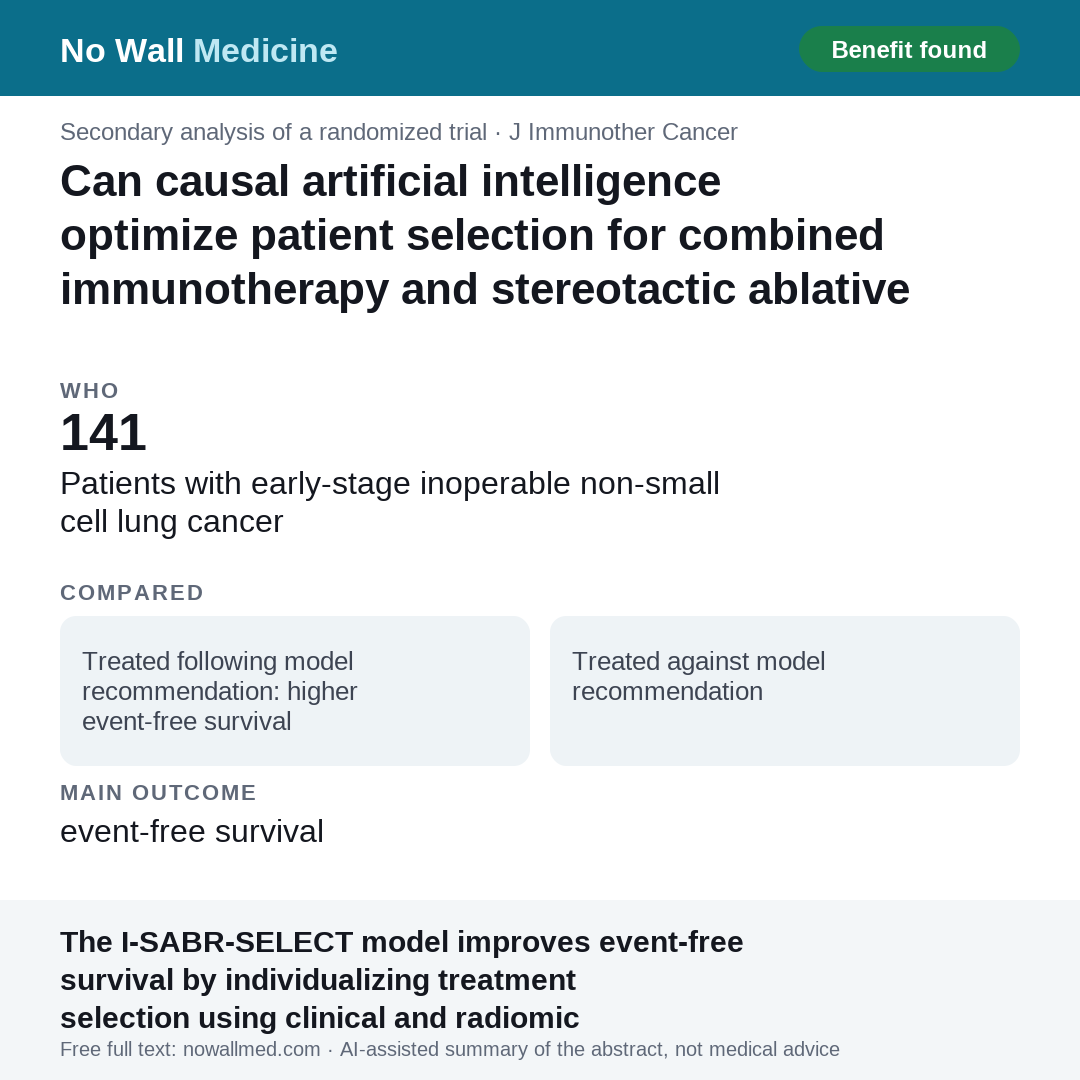
Can causal artificial intelligence optimize patient selection for combined immunotherapy and stereotactic ablative radiotherapy?
Who
141
Patients with early-stage inoperable non-small cell lung cancer
Compared
Treated following model recommendation: higher event-free survival
Treated against model recommendation
Main outcome
event-free survival
Result: hazard ratio 0.06 (p<0.001) in I-SABR arm
Bottom line: The I-SABR-SELECT model improves event-free survival by individualizing treatment selection using clinical and radiomic factors.
Limitation: The model requires further validation to serve as a foundation for digital twins.
J Immunother Cancer · 2025-10-05Download image
Clinical question: Can causal artificial intelligence optimize patient selection for combined immunotherapy and stereotactic ablative radiotherapy?
Why it matters: Not every patient with early-stage inoperable non-small cell lung cancer benefits from adding immunotherapy to stereotactic ablative radiotherapy, making patient selection critical.
Key points
- Researchers used a secondary analysis of the I-SABR trial and the STARS trial to test an artificial intelligence model for selecting lung cancer patients for immunotherapy.
- Patients treated according to the model's recommendations had higher event-free survival, with hazard ratios of 0.06 in the I-SABR arm and 0.38 in the STARS trial.
- Among patients recommended for combined treatment, the restricted mean survival time for event-free survival was prolonged by 1.43 years compared to those receiving radiation alone.
Headline and key points written with AI from the paper’s abstract, with every number checked against it. Read the paper before relying on them.
Abstract
Background
The recent phase II randomized stereotactic ablative radiotherapy with and without immunotherapy (I-SABR) trial has shown improved event-free survival (EFS) when adding immunotherapy to stereotactic ablative radiotherapy (SABR) for early-stage inoperable non-small cell lung cancer (NSCLC). However, optimizing patient selection thereof is critical, because not every patient benefits from immunotherapy. Leveraging the powerful use of artificial intelligence, this secondary analysis of the I-SABR trial developed a modeling system (named "I-SABR-SELECT") based on clinical and radiomic factors to address which patients should receive additional immunotherapy. Methods
The discovery/validation cohorts were from the I-SABR trial, with external validation from the single-arm STARS trial. Individual treatment effect scores, estimating the benefit of adding immunotherapy, were derived from radiomic and clinical predictors using counterfactual reasoning. Dimensionality reduction was applied to mitigate overfitting and enhance model robustness. We also evaluated the average treatment effect between subgroups of patients who were treated following versus against the model's recommendation. Results
The model recommended that 49% (69/141) patients enrolled in the I-SABR trial switch treatments (65% (49/75) in the SABR arm and 30% (20/66) in the I-SABR arm). Patients treated by the model's recommendation had higher EFS, with HRs of 0.06 (in the I-SABR arm, p<0.001) and 0.26 (in the SABR alone arm, p=0.0042) from the I-SABR trial population, and 0.38 (p=0.031) for the STARS trial. Following model stratification, among patients recommended for SABR+immunotherapy, the restricted mean survival time for EFS is prolonged by 1.43 years compared to those who received SABR alone. The absolute risk reduction of the added immunotherapy effect was over twofold greater than that observed in the I-SABR trial without selection. Conclusions
Combining clinical and radiomic parameters, I-SABR-SELECT uses causal reasoning to individualize treatment selection for patients with early-stage inoperable NSCLC. If validated, it could serve as a foundation for a treatment-focused digital twin by integrating real-time adaptive decision-making. Code: https://github.com/WuLabMDA/ISABR-SELECT.
Abstract reproduced under the article’s CC BY NC licence.
Topics
Cite this article
Saad MB, Showkatian E, Verma V, Al-Tashi Q, Aminu M, Xu X. Causal AI-based clinical and radiomic analysis for optimizing patient selection in combined immunotherapy and SABR in early-stage NSCLC: a secondary analysis of the phase II I-SABR trial. J Immunother Cancer. 2025. doi:10.1136/jitc-2025-013074
Spotted a mistake? Suggest a correction