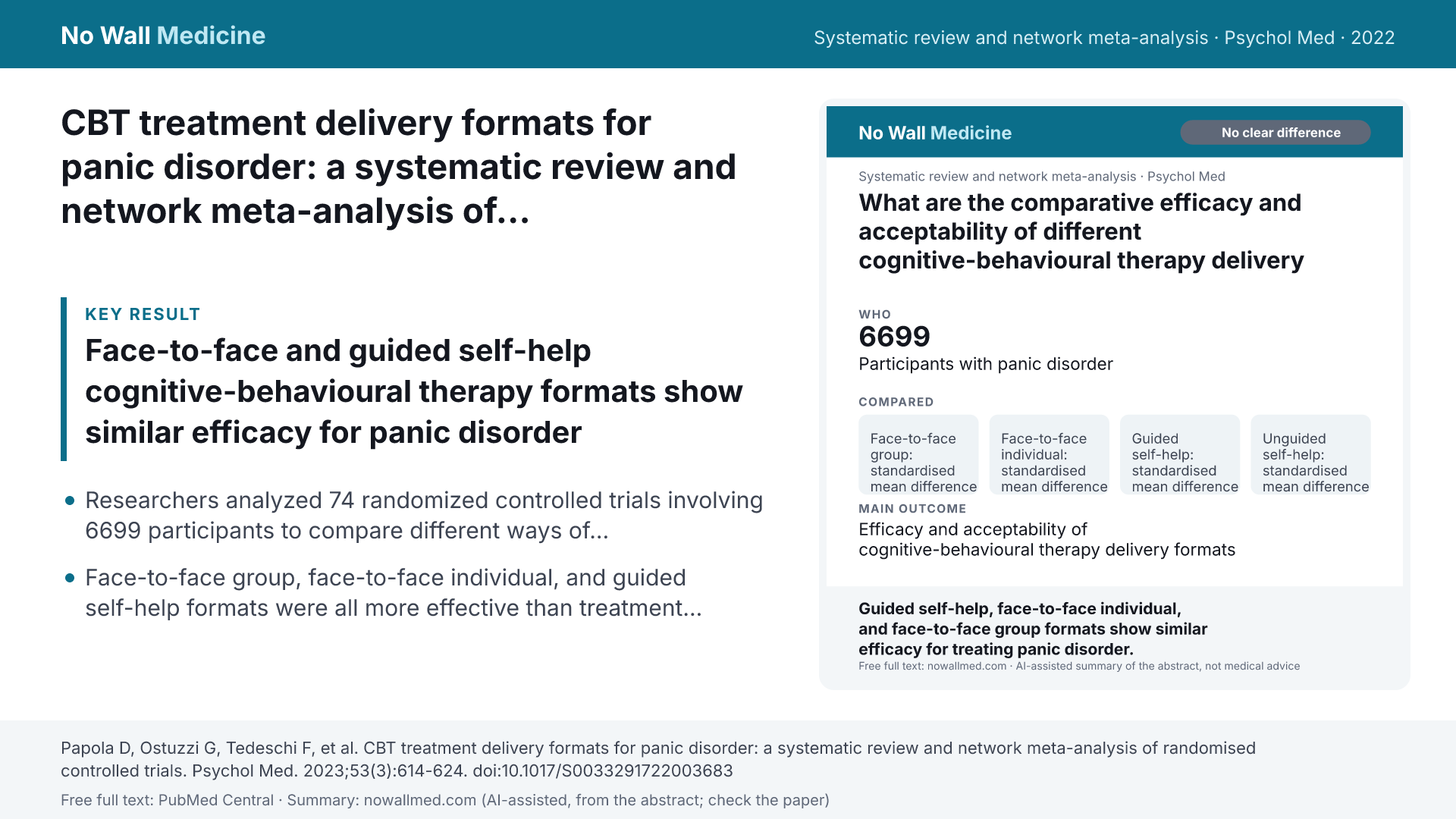
Face-to-face and guided self-help cognitive-behavioural therapy formats show similar efficacy for panic disorder
CBT treatment delivery formats for panic disorder: a systematic review and network meta-analysis of randomised controlled trials
Systematic review and network meta-analysisNo clear difference
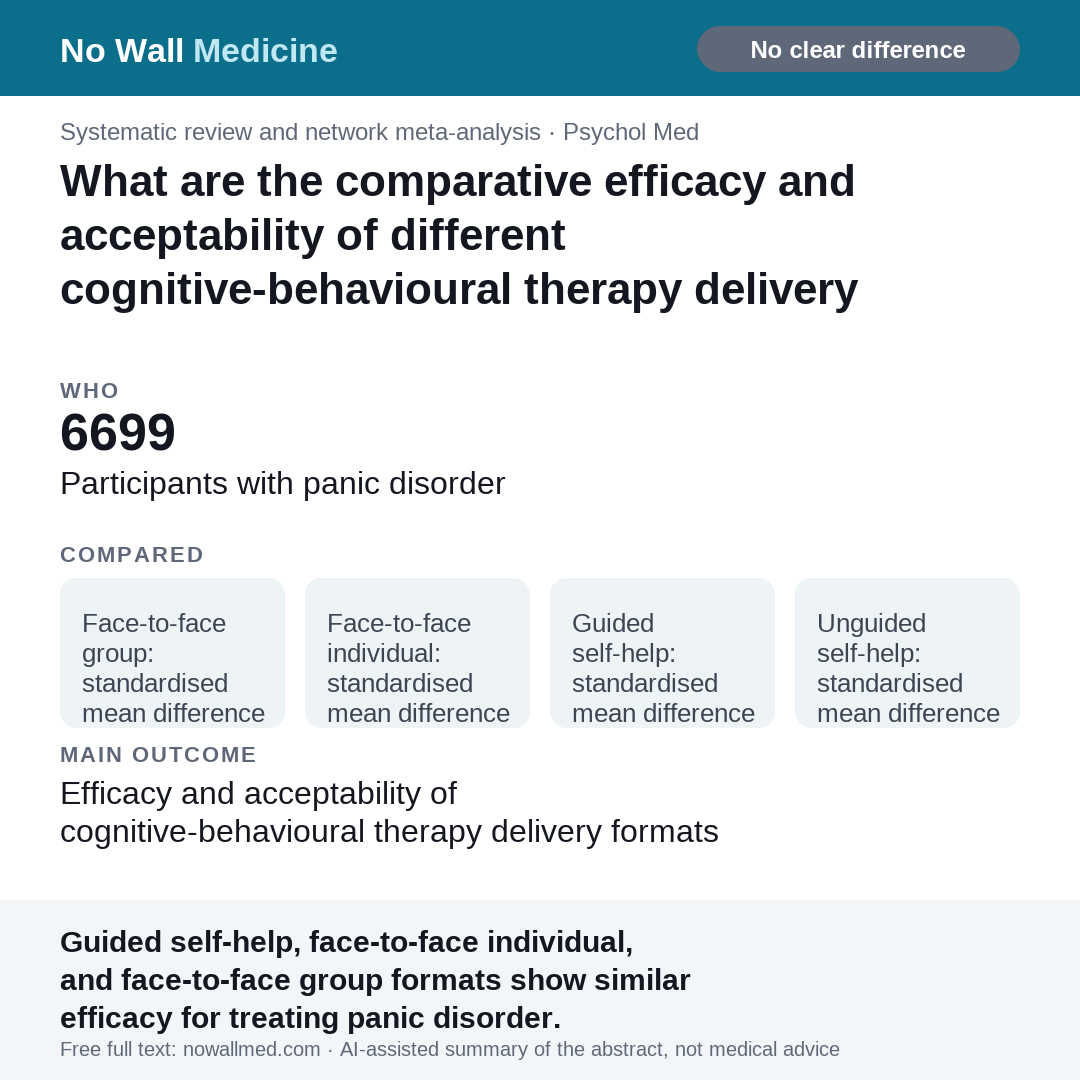
What are the comparative efficacy and acceptability of different cognitive-behavioural therapy delivery formats for panic disorder?
Who
6699
Participants with panic disorder
Compared
Face-to-face group: standardised mean difference -0.47
Face-to-face individual: standardised mean difference -0.43
Guided self-help: standardised mean difference -0.42
Unguided self-help: standardised mean difference -0.21
Main outcome
Efficacy and acceptability of cognitive-behavioural therapy delivery formats
Bottom line: Guided self-help, face-to-face individual, and face-to-face group formats show similar efficacy for treating panic disorder.
Psychol Med · 2022-12-09Download image
Clinical question: What are the comparative efficacy and acceptability of different cognitive-behavioural therapy delivery formats for panic disorder?
Why it matters: It was unknown how different in-person and remote ways of delivering cognitive-behavioural therapy compare regarding their effectiveness and how well patients tolerate them for panic disorder.
Key points
- Researchers analyzed 74 randomized controlled trials involving 6699 participants to compare different ways of delivering cognitive-behavioural therapy for panic disorder.
- Face-to-face group, face-to-face individual, and guided self-help formats were all more effective than treatment as usual, but showed no efficacy differences between them.
- Unguided self-help was not more effective than treatment as usual, and all delivery formats showed similar rates of participants stopping treatment early.
Headline and key points written with AI from the paper’s abstract, with every number checked against it. Read the paper before relying on them.
Was this summary helpful?
Subject terms
Cite this article
Papola D, Ostuzzi G, Tedeschi F, et al. CBT treatment delivery formats for panic disorder: a systematic review and network meta-analysis of randomised controlled trials. Psychol Med. 2022. doi:10.1017/S0033291722003683
Spotted a mistake? Suggest a correction