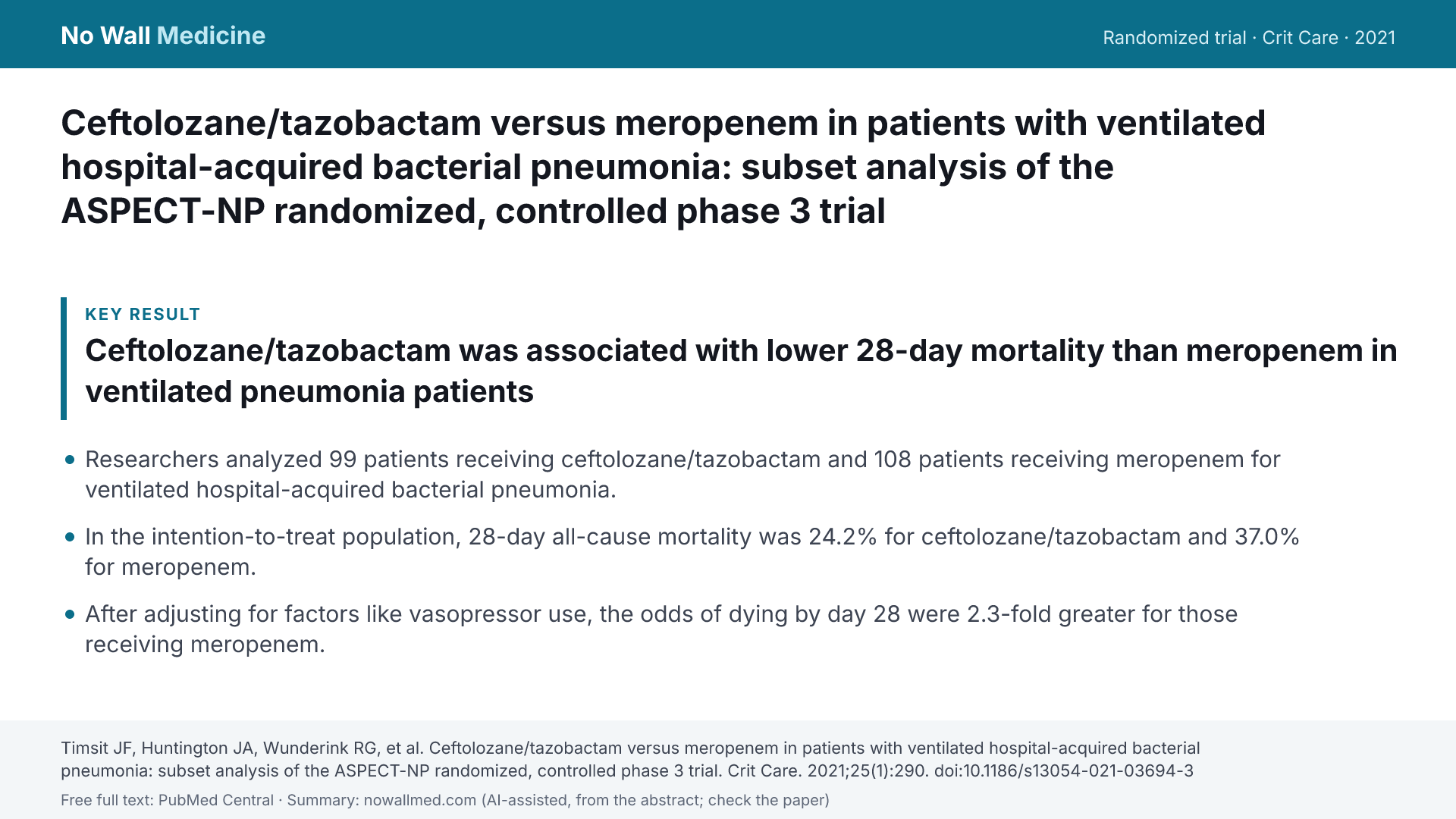
Ceftolozane/tazobactam was associated with lower 28-day mortality than meropenem in ventilated pneumonia patients
Ceftolozane/tazobactam versus meropenem in patients with ventilated hospital-acquired bacterial pneumonia: subset analysis of the ASPECT-NP randomized, controlled phase 3 trial
Why it matters: The survival rate for patients with pneumonia requiring a ventilator is among the lowest of all hospital-acquired pneumonia subtypes.
Key points
- Researchers analyzed 99 patients receiving ceftolozane/tazobactam and 108 patients receiving meropenem for ventilated hospital-acquired bacterial pneumonia.
- In the intention-to-treat population, 28-day all-cause mortality was 24.2% for ceftolozane/tazobactam and 37.0% for meropenem.
- After adjusting for factors like vasopressor use, the odds of dying by day 28 were 2.3-fold greater for those receiving meropenem.
Limitation the authors note: Subgroup analyses were not powered for noninferiority testing.
Headline and key points written with AI from the paper’s abstract, with every number checked against it. Read the paper before relying on them.
Was this summary helpful?
Abstract
Background
Ceftolozane/tazobactam is approved for treatment of hospital-acquired/ventilator-associated bacterial pneumonia (HABP/VABP) at double the dose approved for other infection sites. Among nosocomial pneumonia subtypes, ventilated HABP (vHABP) is associated with the lowest survival. In the ASPECT-NP randomized, controlled trial, participants with vHABP treated with ceftolozane/tazobactam had lower 28-day all-cause mortality (ACM) than those receiving meropenem. We conducted a series of post hoc analyses to explore the clinical significance of this finding. Methods
ASPECT-NP was a multinational, phase 3, noninferiority trial comparing ceftolozane/tazobactam with meropenem for treating vHABP and VABP; study design, efficacy, and safety results have been reported previously. The primary endpoint was 28-day ACM. The key secondary endpoint was clinical response at test-of-cure. Participants with vHABP were a prospectively defined subgroup, but subgroup analyses were not powered for noninferiority testing. We compared baseline and treatment factors, efficacy, and safety between ceftolozane/tazobactam and meropenem in participants with vHABP. We also conducted a retrospective multivariable logistic regression analysis in this subgroup to determine the impact of treatment arm on mortality when adjusted for significant prognostic factors. Results
Overall, 99 participants in the ceftolozane/tazobactam and 108 in the meropenem arm had vHABP. 28-day ACM was 24.2% and 37.0%, respectively, in the intention-to-treat population (95% confidence interval [CI] for difference: 0.2, 24.8) and 18.2% and 36.6%, respectively, in the microbiologic intention-to-treat population (95% CI 2.5, 32.5). Clinical cure rates in the intention-to-treat population were 50.5% and 44.4%, respectively (95% CI - 7.4, 19.3). Baseline clinical, baseline microbiologic, and treatment factors were comparable between treatment arms. Multivariable regression identified concomitant vasopressor use and baseline bacteremia as significantly impacting ACM in ASPECT-NP; adjusting for these two factors, the odds of dying by day 28 were 2.3-fold greater when participants received meropenem instead of ceftolozane/tazobactam. Conclusions
There were no underlying differences between treatment arms expected to have biased the observed survival advantage with ceftolozane/tazobactam in the vHABP subgroup. After adjusting for clinically relevant factors found to impact ACM significantly in this trial, the mortality risk in participants with vHABP was over twice as high when treated with meropenem compared with ceftolozane/tazobactam. Trial registration
clinicaltrials.gov, NCT02070757. Registered 25 February, 2014, clinicaltrials.gov/ct2/show/NCT02070757.
Abstract reproduced under the article’s CC BY licence.
Subject terms
Cite this article
Timsit JF, Huntington JA, Wunderink RG, Shime N, Kollef MH, Kivistik Ü. Ceftolozane/tazobactam versus meropenem in patients with ventilated hospital-acquired bacterial pneumonia: subset analysis of the ASPECT-NP randomized, controlled phase 3 trial. Crit Care. 2021. doi:10.1186/s13054-021-03694-3
Spotted a mistake? Suggest a correction