Censoring rates in immunotherapy trials were higher in control groups early and experimental groups later
Censoring in trials testing immunotherapy in advanced cancers: a systematic review and a meta-research study
Systematic review and meta-research studyMixed results
What are the censoring rates in immunotherapy randomized controlled trials for advanced cancers?
Who
140
Randomized controlled trials testing immune checkpoint inhibitors in advanced cancers
Compared
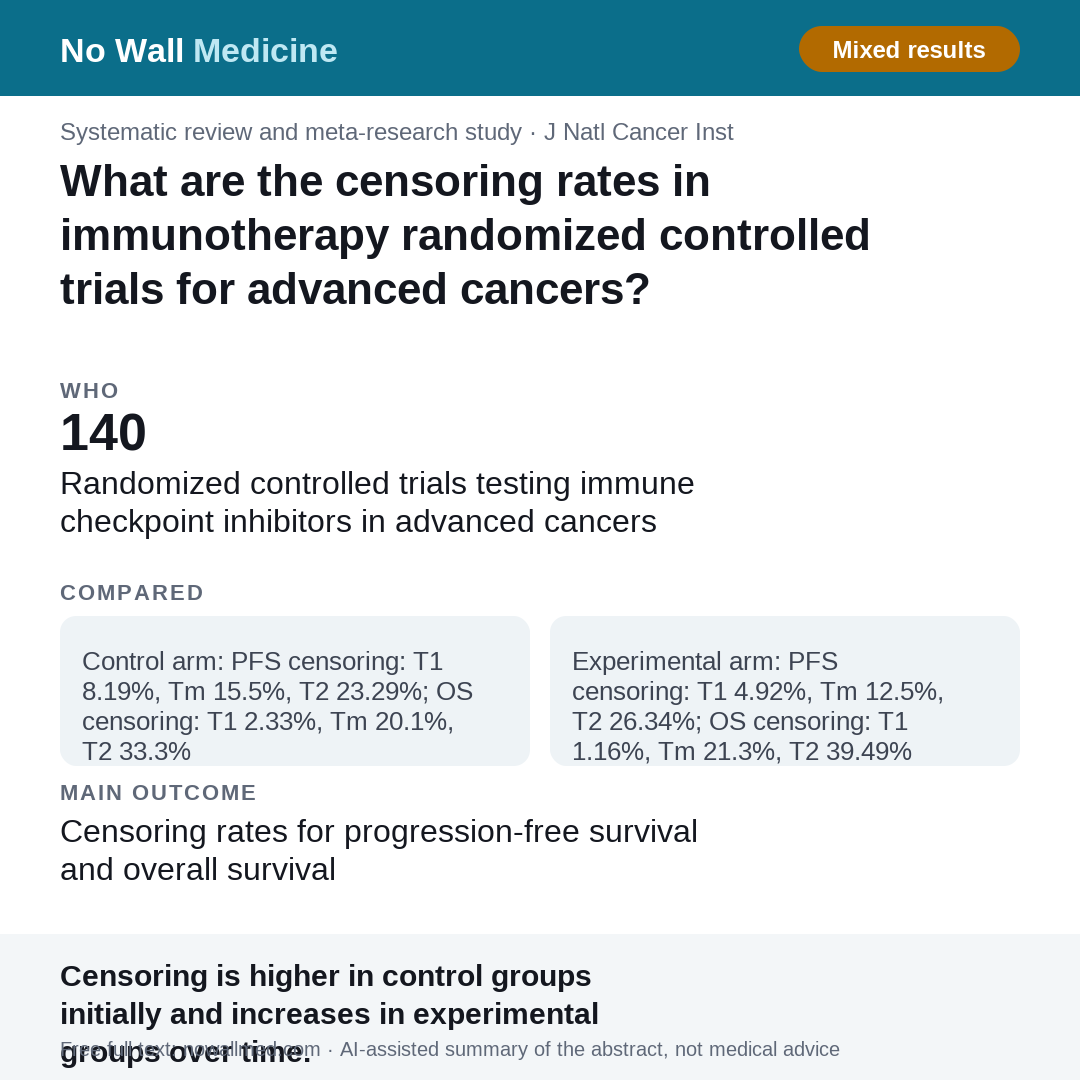
Control arm: PFS censoring: T1 8.19%, Tm 15.5%, T2 23.29%; OS censoring: T1 2.33%, Tm 20.1%, T2 33.3%
Experimental arm: PFS censoring: T1 4.92%, Tm 12.5%, T2 26.34%; OS censoring: T1 1.16%, Tm 21.3%, T2 39.49%
Main outcome
Censoring rates for progression-free survival and overall survival
Bottom line: Censoring is higher in control groups initially and increases in experimental groups over time.
J Natl Cancer Inst · 2025-08-26Download image
Clinical question: What are the censoring rates in immunotherapy randomized controlled trials for advanced cancers?
Why it matters: Informative censoring, where patients leave a study for reasons related to the treatment, can affect how researchers interpret the results of clinical trials.
Key points
- Researchers analyzed 140 randomized controlled trials testing immune checkpoint inhibitors, which are drugs that help the immune system fight cancer, for data on patient censoring.
- At the first interval, progression-free survival censoring was 8.19% in control groups versus 4.92% in experimental groups, while overall survival censoring was 2.33% versus 1.16%.
- By the last study interval, overall survival censoring was 33.3% in control groups and 39.49% in experimental groups.
Headline and key points written with AI from the paper’s abstract, with every number checked against it. Read the paper before relying on them.
Topics
Cite this article
Vitale F, Salomone F, Di Maio M, D'Ambrosio S, Avanzo A, Napolitano F. Censoring in trials testing immunotherapy in advanced cancers: a systematic review and a meta-research study. J Natl Cancer Inst. 2025. doi:10.1093/jnci/djaf237
Spotted a mistake? Suggest a correction
Top studies every Monday
The week’s key trials and guidelines in your specialties, by email. Free.
Get the weekly digest