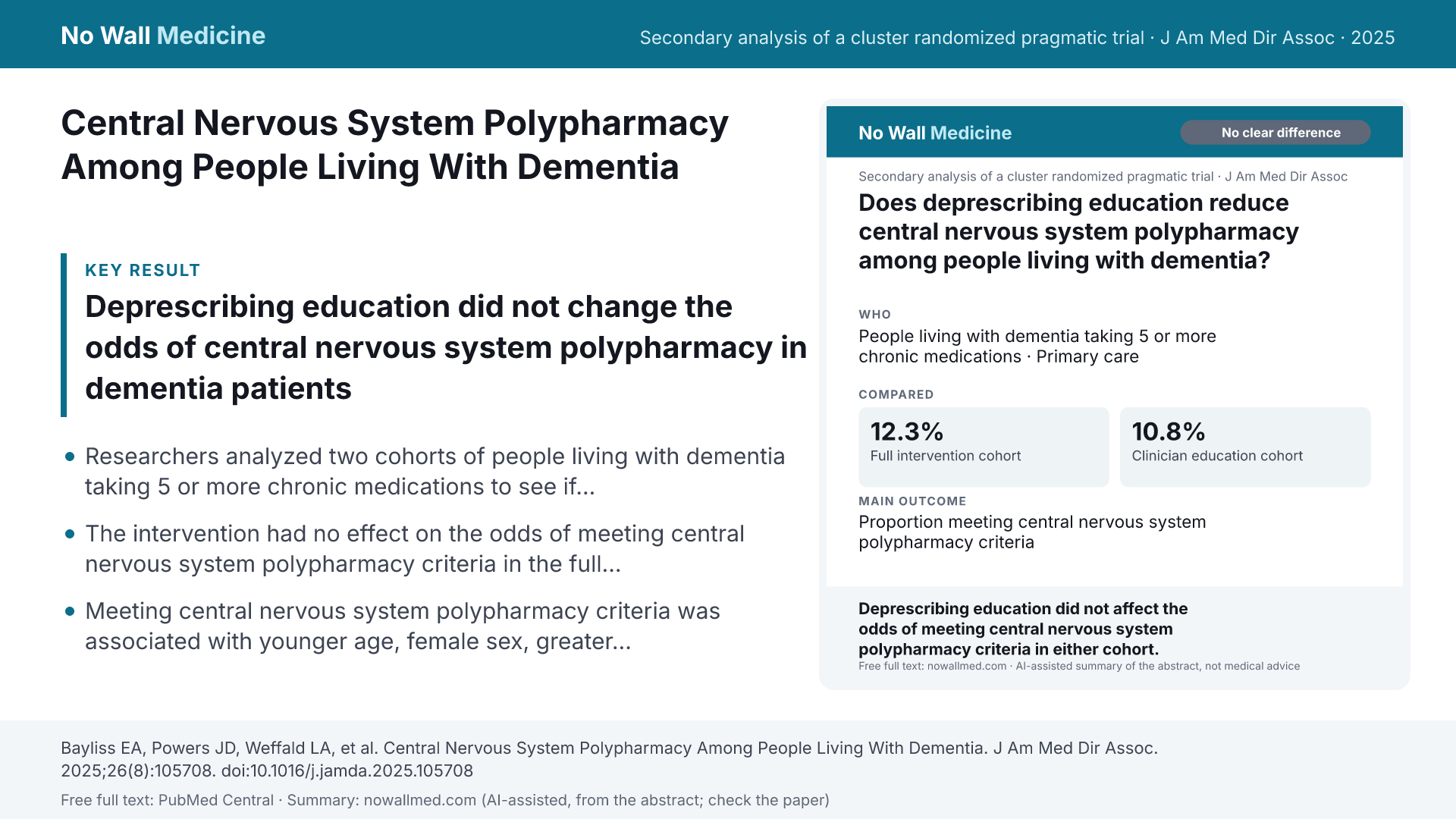
Central Nervous System Polypharmacy Among People Living With Dementia
Key result: Deprescribing education did not change the odds of central nervous system polypharmacy in dementia patients
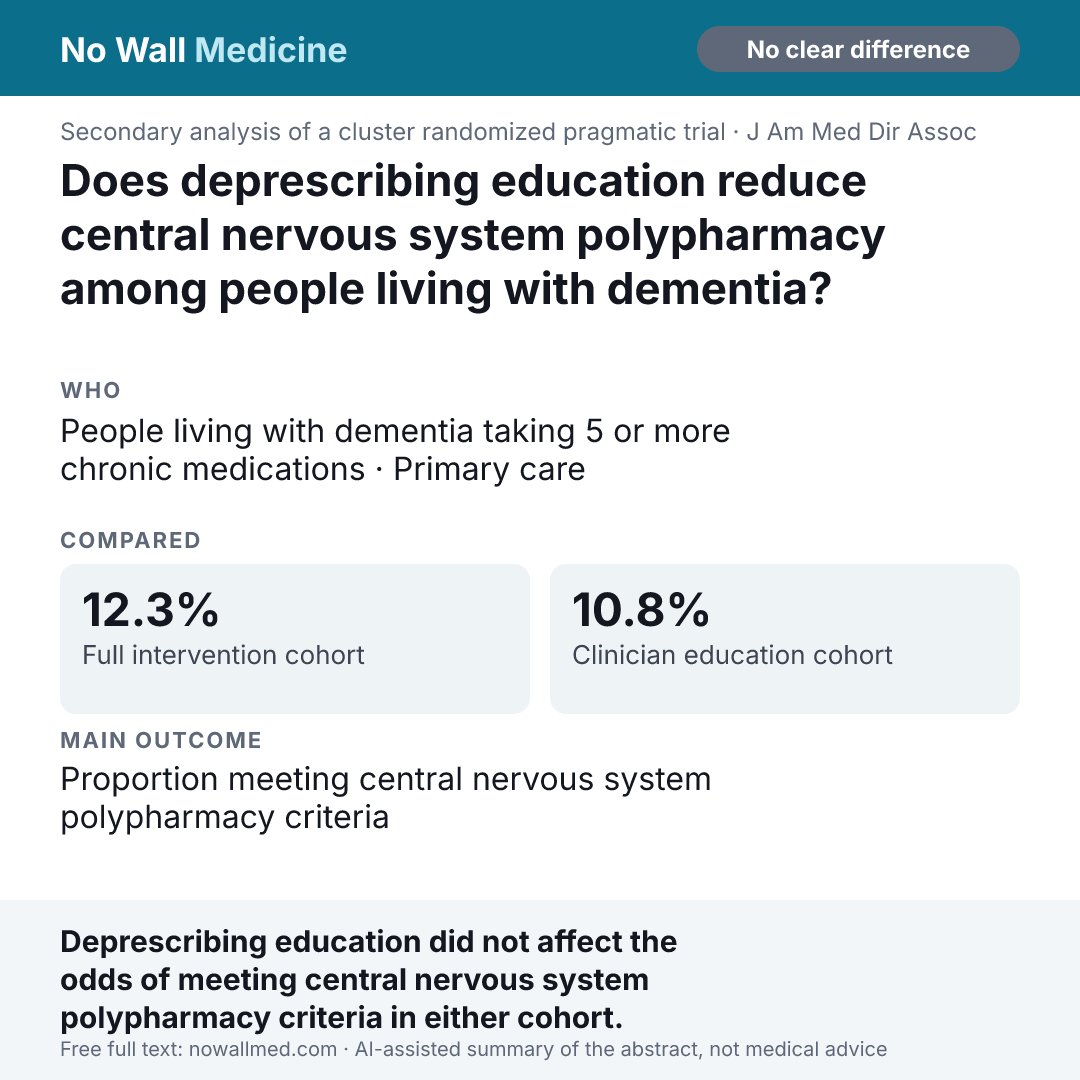
Secondary analysis of a cluster randomized pragmatic trialNo clear difference
Does deprescribing education reduce central nervous system polypharmacy among people living with dementia?
Who
People living with dementia taking 5 or more chronic medications · Primary care
Compared
12.3%Full intervention cohort
10.8%Clinician education cohort
Main outcome
Proportion meeting central nervous system polypharmacy criteria
Bottom line: Deprescribing education did not affect the odds of meeting central nervous system polypharmacy criteria in either cohort.
J Am Med Dir Assoc · 2025-06-14 · Save PNG
Key points
- Researchers analyzed two cohorts of people living with dementia taking 5 or more chronic medications to see if education materials reduced central nervous system polypharmacy.
- The intervention had no effect on the odds of meeting central nervous system polypharmacy criteria in the full intervention cohort (N = 2908) or the clinician education cohort (N = 5226).
- Meeting central nervous system polypharmacy criteria was associated with younger age, female sex, greater morbidity burden, and hospice use at baseline.
Discussion prompts
- Would these patients look like yours? Who was left out?
- Is the main outcome one that matters to patients?
- Is the difference large enough to change what you do?
Cite: Bayliss EA, Powers JD, Weffald LA, et al. Central Nervous System Polypharmacy Among People Living With Dementia. J Am Med Dir Assoc. 2025;26(8):105708. doi:10.1016/j.jamda.2025.105708
Free full text: PubMed Central · Summary and visual abstract: nowallmed.com/a/central-nervous-system-polypharmacy-among-people-living-with-c1g1yw/ (AI-assisted from the abstract; check the paper before relying on it).