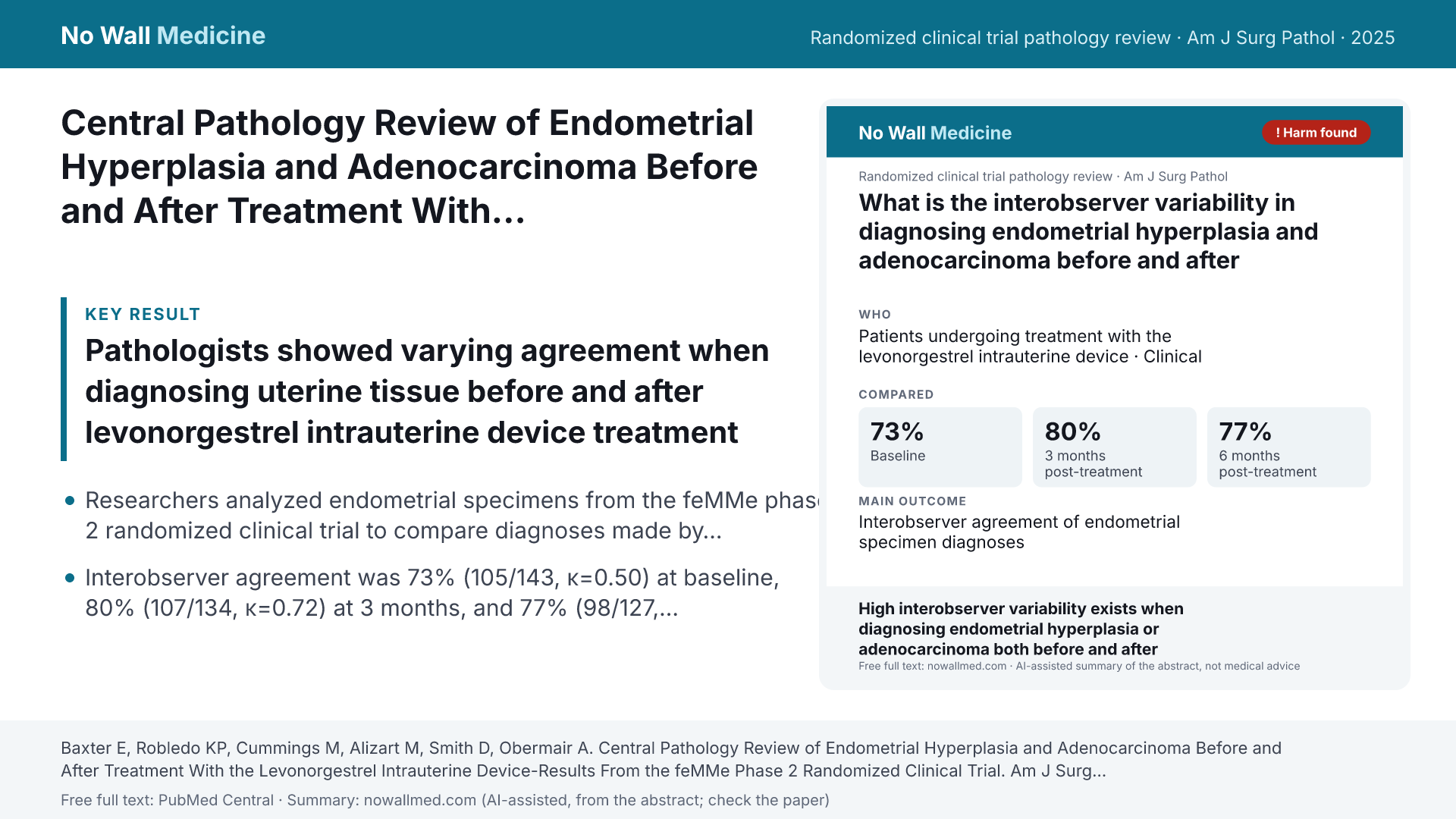
Pathologists showed varying agreement when diagnosing uterine tissue before and after levonorgestrel intrauterine device treatment
Central Pathology Review of Endometrial Hyperplasia and Adenocarcinoma Before and After Treatment With the Levonorgestrel Intrauterine Device-Results From the feMMe Phase 2 Randomized Clinical Trial
Randomized clinical trial pathology reviewHarm found
What is the interobserver variability in diagnosing endometrial hyperplasia and adenocarcinoma before and after treatment?
Who
Patients undergoing treatment with the levonorgestrel intrauterine device · Clinical trial sites
Compared
73%Baseline (105/143, κ=0.50)
80%3 months post-treatment (107/134, κ=0.72)
77%6 months post-treatment (98/127, κ=0.64)
Main outcome
Interobserver agreement of endometrial specimen diagnoses
Bottom line: High interobserver variability exists when diagnosing endometrial hyperplasia or adenocarcinoma both before and after progestin treatment.
Am J Surg Pathol · 2025-11-25 · Save PNG
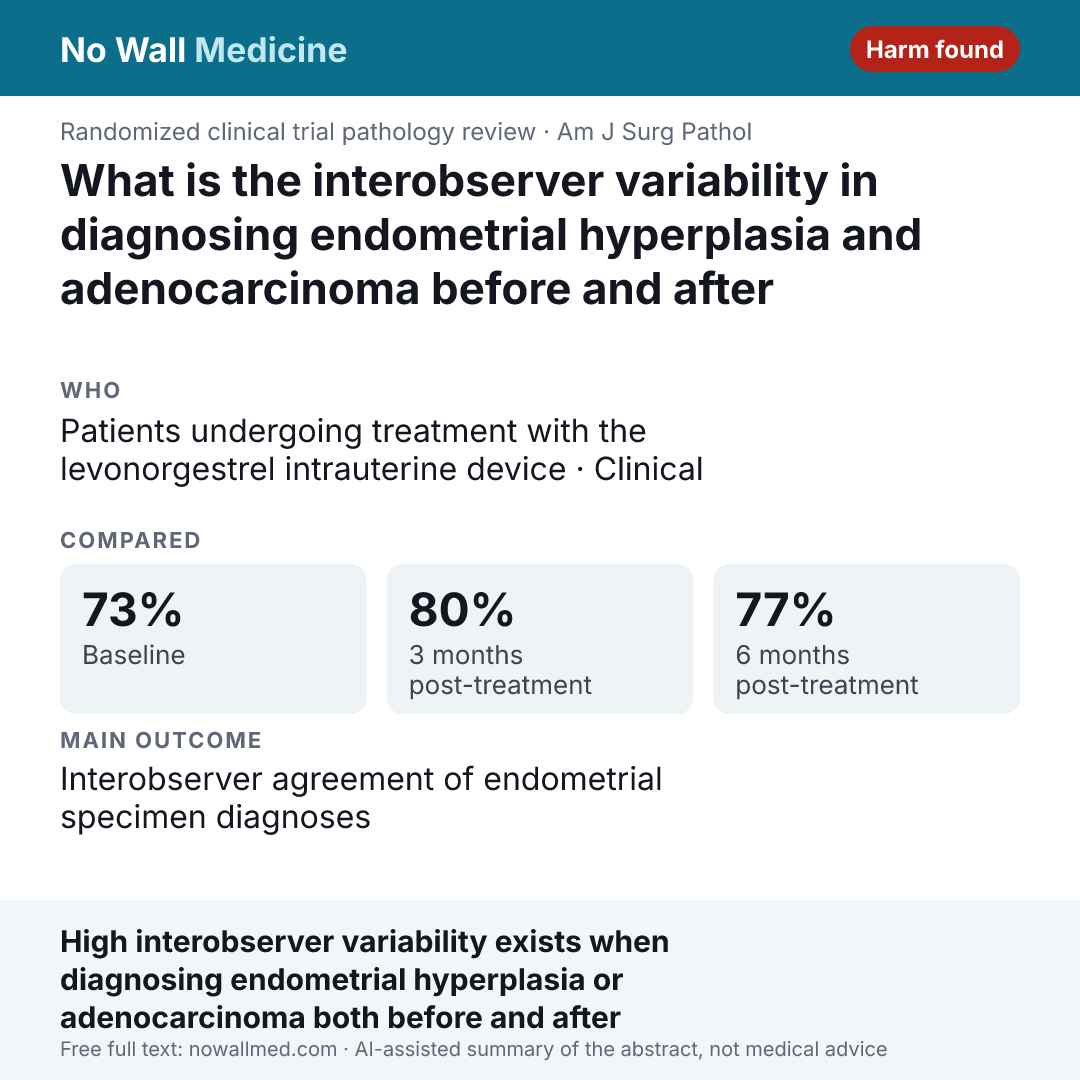
Clinical question: What is the interobserver variability in diagnosing endometrial hyperplasia and adenocarcinoma before and after treatment?
Why it matters: Distinguishing between endometrial hyperplasia, which is abnormal thickening of the uterine lining, and endometrial adenocarcinoma, a type of cancer, remains a histopathologic challenge.
Key points
- Researchers analyzed endometrial specimens from the feMMe phase 2 randomized clinical trial to compare diagnoses made by local site pathologists and a central pathology review team.
- Interobserver agreement was 73% (105/143, κ=0.50) at baseline, 80% (107/134, κ=0.72) at 3 months, and 77% (98/127, κ=0.64) after levonorgestrel intrauterine device treatment.
- Site-reported diagnoses of endometrial hyperplasia and endometrial adenocarcinoma were discordant in 42% (45/107) and 13% (21/161) of cases, respectively.
Headline and key points written with AI from the paper’s abstract, with every number checked against it. Read the paper before relying on them.
Was this summary helpful?
Subject terms
Headline, design, result, key points, caveat and citation as plain text.
Cite this article
Baxter E, Robledo KP, Cummings M, Alizart M, Smith D, Obermair A. Central Pathology Review of Endometrial Hyperplasia and Adenocarcinoma Before and After Treatment With the Levonorgestrel Intrauterine Device-Results From the feMMe Phase 2 Randomized Clinical Trial. Am J Surg Pathol. 2026;50(2):259-266. doi:10.1097/PAS.0000000000002492
Spotted a mistake? Suggest a correction