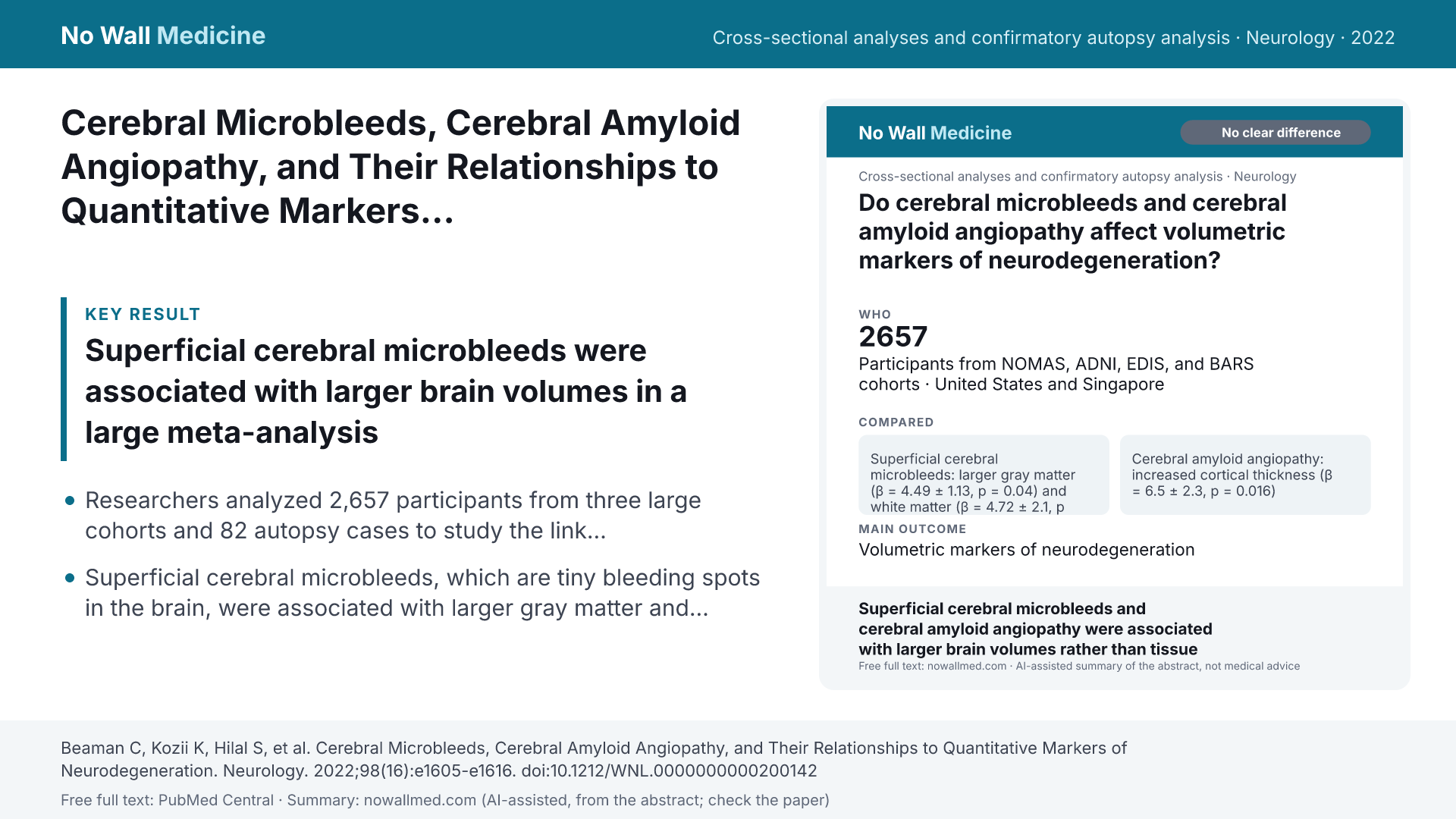
Superficial cerebral microbleeds were associated with larger brain volumes in a large meta-analysis
Cerebral Microbleeds, Cerebral Amyloid Angiopathy, and Their Relationships to Quantitative Markers of Neurodegeneration
Cross-sectional analyses and confirmatory autopsy analysisNo clear difference
Do cerebral microbleeds and cerebral amyloid angiopathy affect volumetric markers of neurodegeneration?
Who
2657
Participants from NOMAS, ADNI, EDIS, and BARS cohorts · United States and Singapore
Compared
Superficial cerebral microbleeds: larger gray matter (β = 4.49 ± 1.13, p = 0.04) and white matter (β = 4.72 ± 2.1, p = 0.03) volumes
Cerebral amyloid angiopathy: increased cortical thickness (β = 6.5 ± 2.3, p = 0.016)
Main outcome
Volumetric markers of neurodegeneration
Bottom line: Superficial cerebral microbleeds and cerebral amyloid angiopathy were associated with larger brain volumes rather than tissue loss.
Neurology · 2022-02-28 · Save PNG
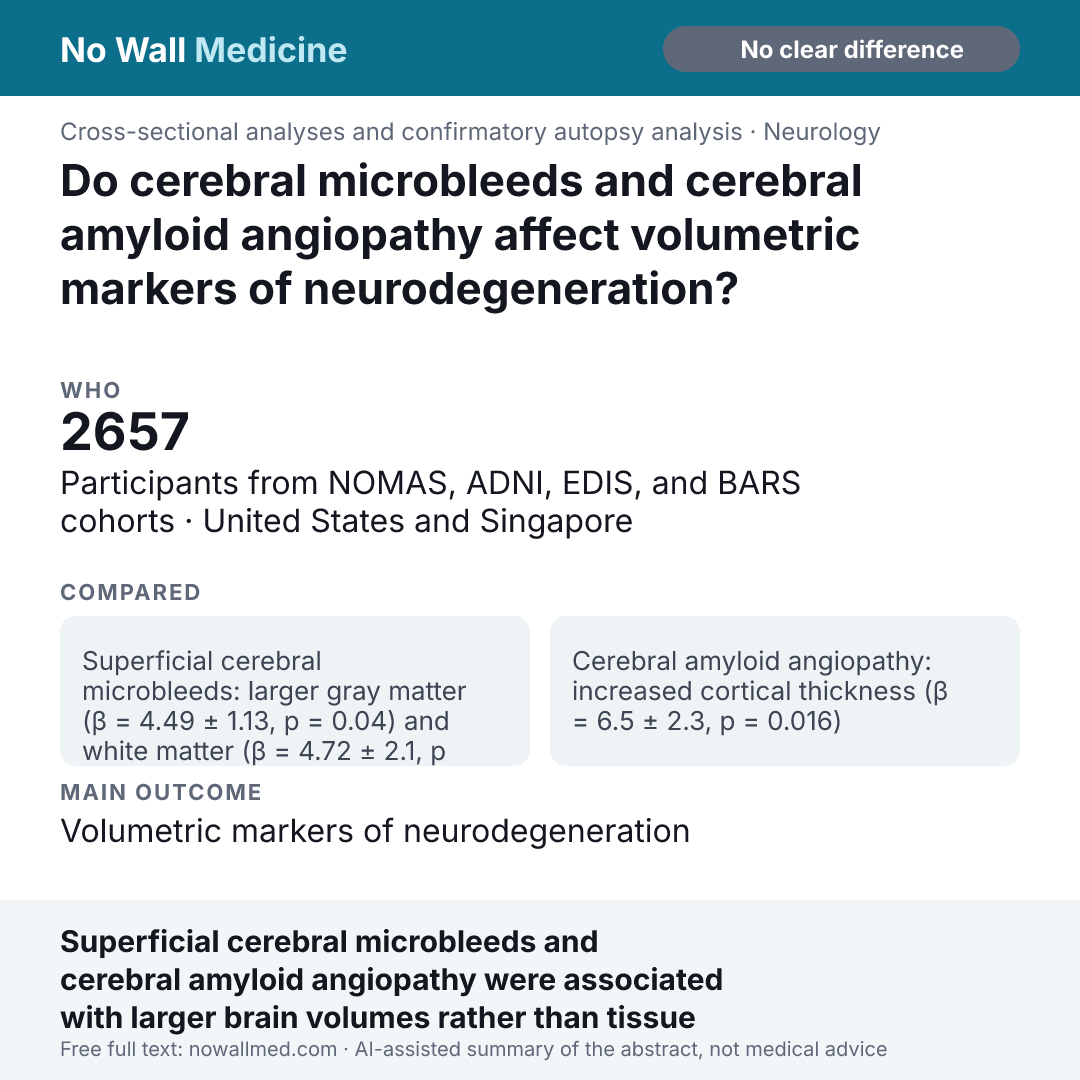
Clinical question: Do cerebral microbleeds and cerebral amyloid angiopathy affect volumetric markers of neurodegeneration?
Key points
- Researchers analyzed 2,657 participants from three large cohorts and 82 autopsy cases to study the link between microbleeds, amyloid angiopathy, and brain volume.
- Superficial cerebral microbleeds, which are tiny bleeding spots in the brain, were associated with larger gray matter and white matter volumes.
- In autopsy cases, cerebral amyloid angiopathy, a condition where proteins build up in brain vessel walls, was associated with increased cortical thickness.
Headline and key points written with AI from the paper’s abstract, with every number checked against it. Read the paper before relying on them.
Was this summary helpful?
Subject terms
Headline, design, result, key points, caveat and citation as plain text.
Cite this article
Beaman C, Kozii K, Hilal S, et al. Cerebral Microbleeds, Cerebral Amyloid Angiopathy, and Their Relationships to Quantitative Markers of Neurodegeneration. Neurology. 2022;98(16):e1605-e1616. doi:10.1212/WNL.0000000000200142
Spotted a mistake? Suggest a correction