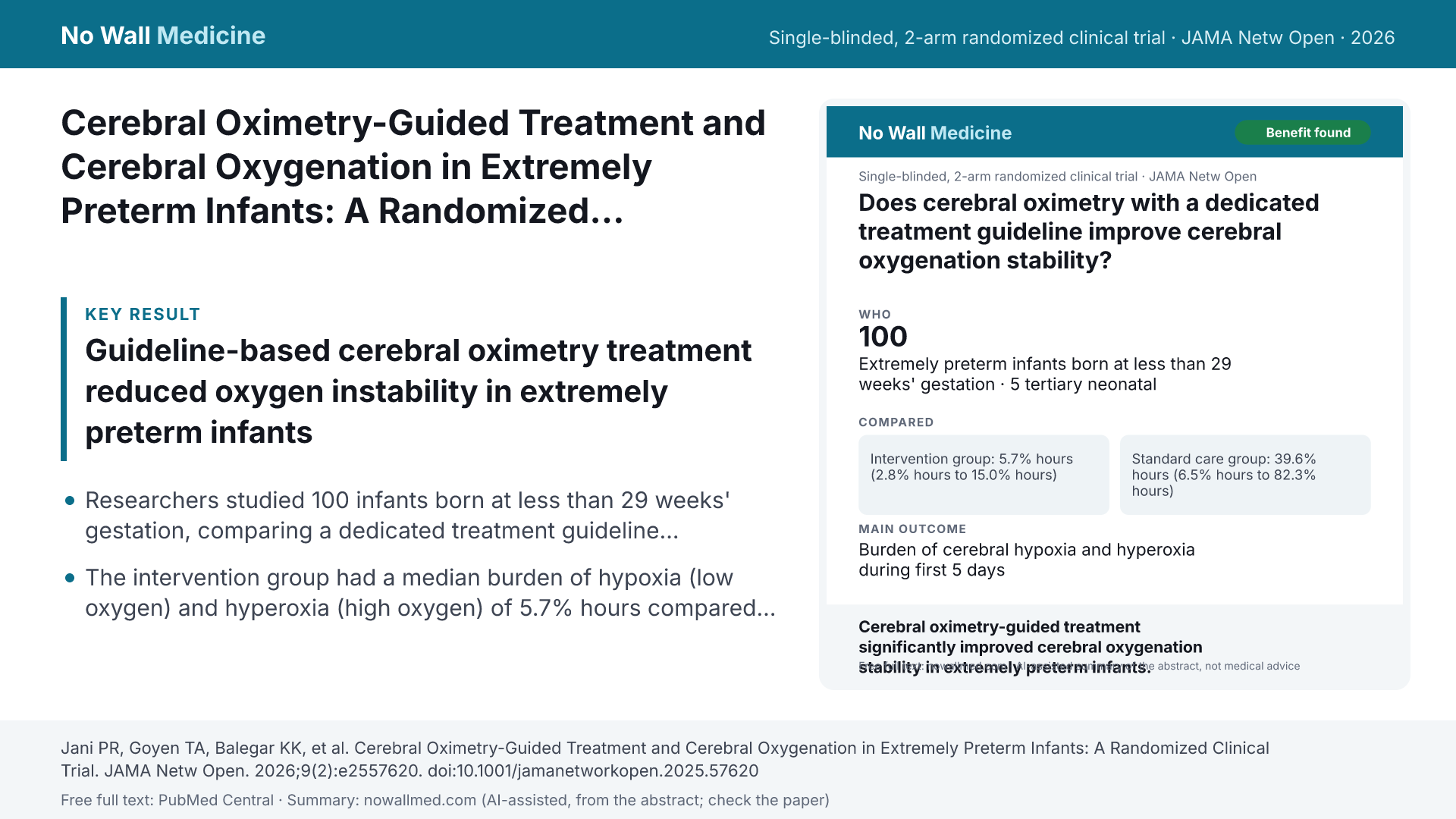
Guideline-based cerebral oximetry treatment reduced oxygen instability in extremely preterm infants
Cerebral Oximetry-Guided Treatment and Cerebral Oxygenation in Extremely Preterm Infants: A Randomized Clinical Trial
Single-blinded, 2-arm randomized clinical trialBenefit found
Does cerebral oximetry with a dedicated treatment guideline improve cerebral oxygenation stability?
Who
100
Extremely preterm infants born at less than 29 weeks' gestation · 5 tertiary neonatal intensive care units in Australia, New Zealand, and US
Compared
Intervention group: 5.7% hours (2.8% hours to 15.0% hours)
Standard care group: 39.6% hours (6.5% hours to 82.3% hours)
Main outcome
Burden of cerebral hypoxia and hyperoxia during first 5 days
Result: adjusted reduction of 42.8% hours (95% CI, 35.6% hours to 53.3% hours)
Bottom line: Cerebral oximetry-guided treatment significantly improved cerebral oxygenation stability in extremely preterm infants.
JAMA Netw Open · 2026-02-02 · Save PNG
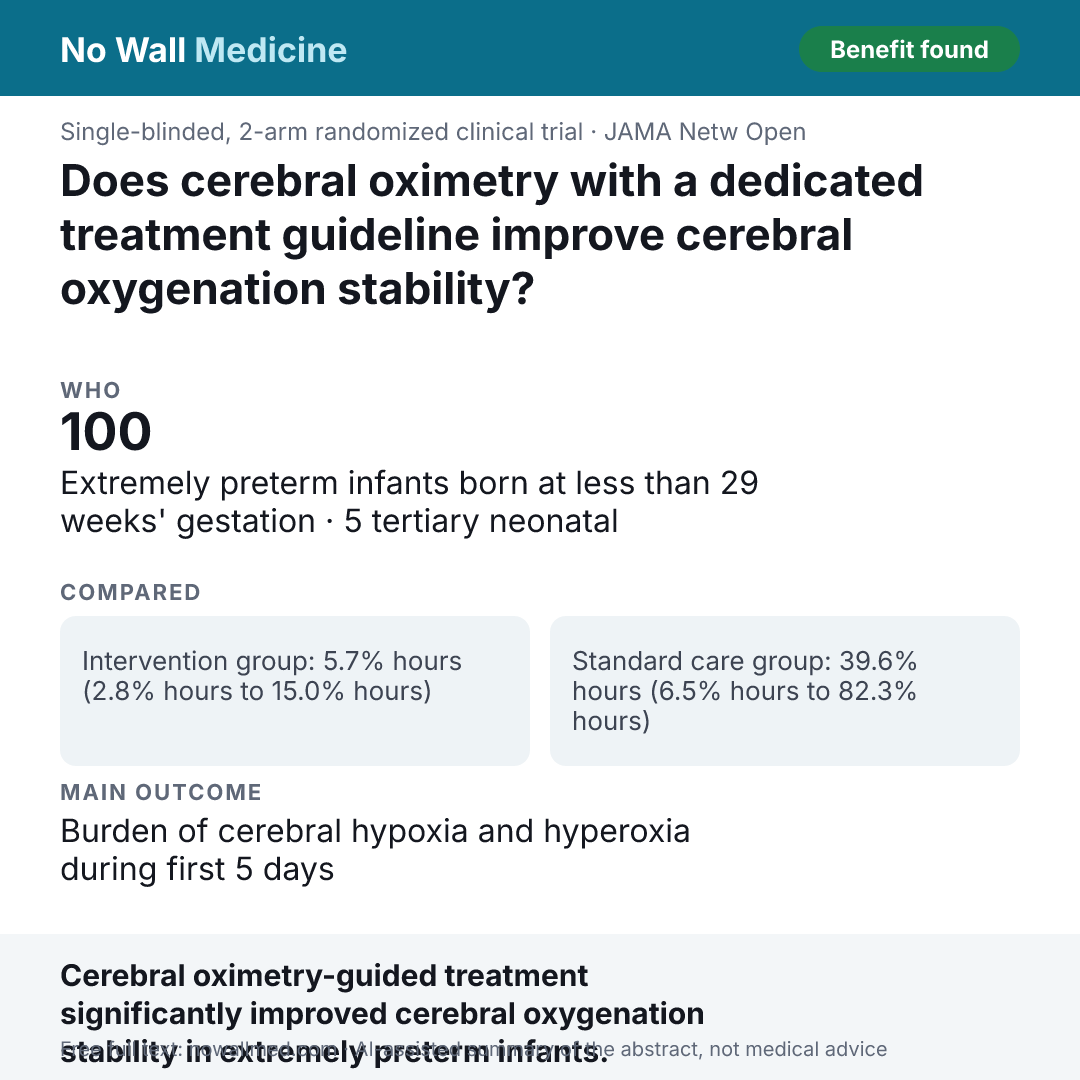
Clinical question: Does cerebral oximetry with a dedicated treatment guideline improve cerebral oxygenation stability?
Key points
- Researchers studied 100 infants born at less than 29 weeks' gestation, comparing a dedicated treatment guideline to standard clinical monitoring.
- The intervention group had a median burden of hypoxia (low oxygen) and hyperoxia (high oxygen) of 5.7% hours compared to 39.6% hours in the standard care group.
- There were no significant differences between the two groups regarding mortality, morbidities before discharge, or skin injuries related to near-infrared spectroscopy.
Headline and key points written with AI from the paper’s abstract, with every number checked against it. Read the paper before relying on them.
Was this summary helpful?
Subject terms
Headline, design, result, key points, caveat and citation as plain text.
Cite this article
Jani PR, Goyen TA, Balegar KK, et al. Cerebral Oximetry-Guided Treatment and Cerebral Oxygenation in Extremely Preterm Infants: A Randomized Clinical Trial. JAMA Netw Open. 2026;9(2):e2557620. doi:10.1001/jamanetworkopen.2025.57620
Spotted a mistake? Suggest a correction