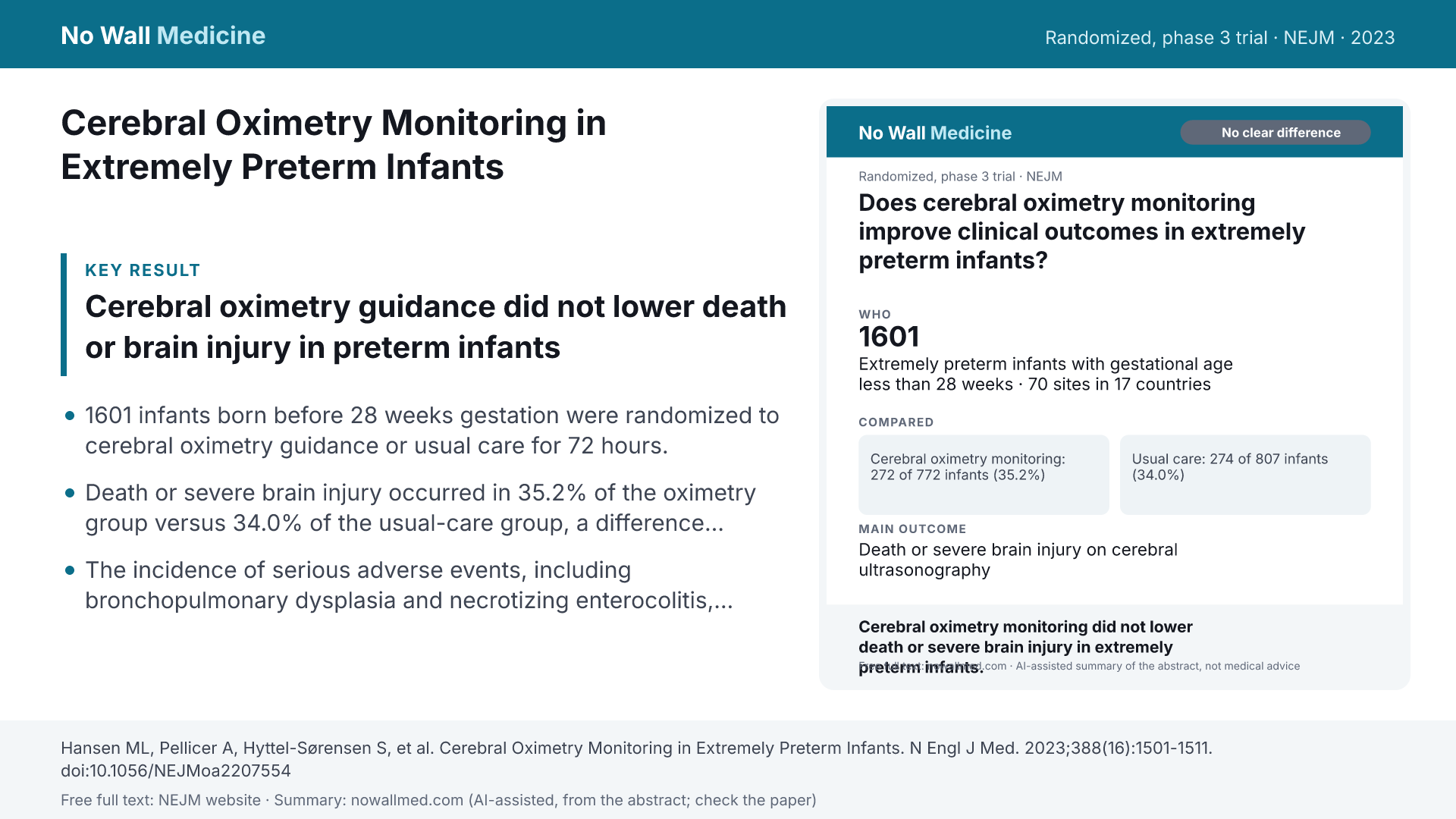
Cerebral oximetry guidance did not lower death or brain injury in preterm infants
Cerebral Oximetry Monitoring in Extremely Preterm Infants
Randomized, phase 3 trialNo clear difference
Does cerebral oximetry monitoring improve clinical outcomes in extremely preterm infants?
Who
1601
Extremely preterm infants with gestational age less than 28 weeks · 70 sites in 17 countries
Compared
Cerebral oximetry monitoring: 272 of 772 infants (35.2%)
Usual care: 274 of 807 infants (34.0%)
Main outcome
Death or severe brain injury on cerebral ultrasonography
Result: relative risk 1.03 (95% confidence interval, 0.90 to 1.18)
Bottom line: Cerebral oximetry monitoring did not lower death or severe brain injury in extremely preterm infants.
Funded by: Elsass Foundation and others
NEJM · 2023-04-19 · Save PNG
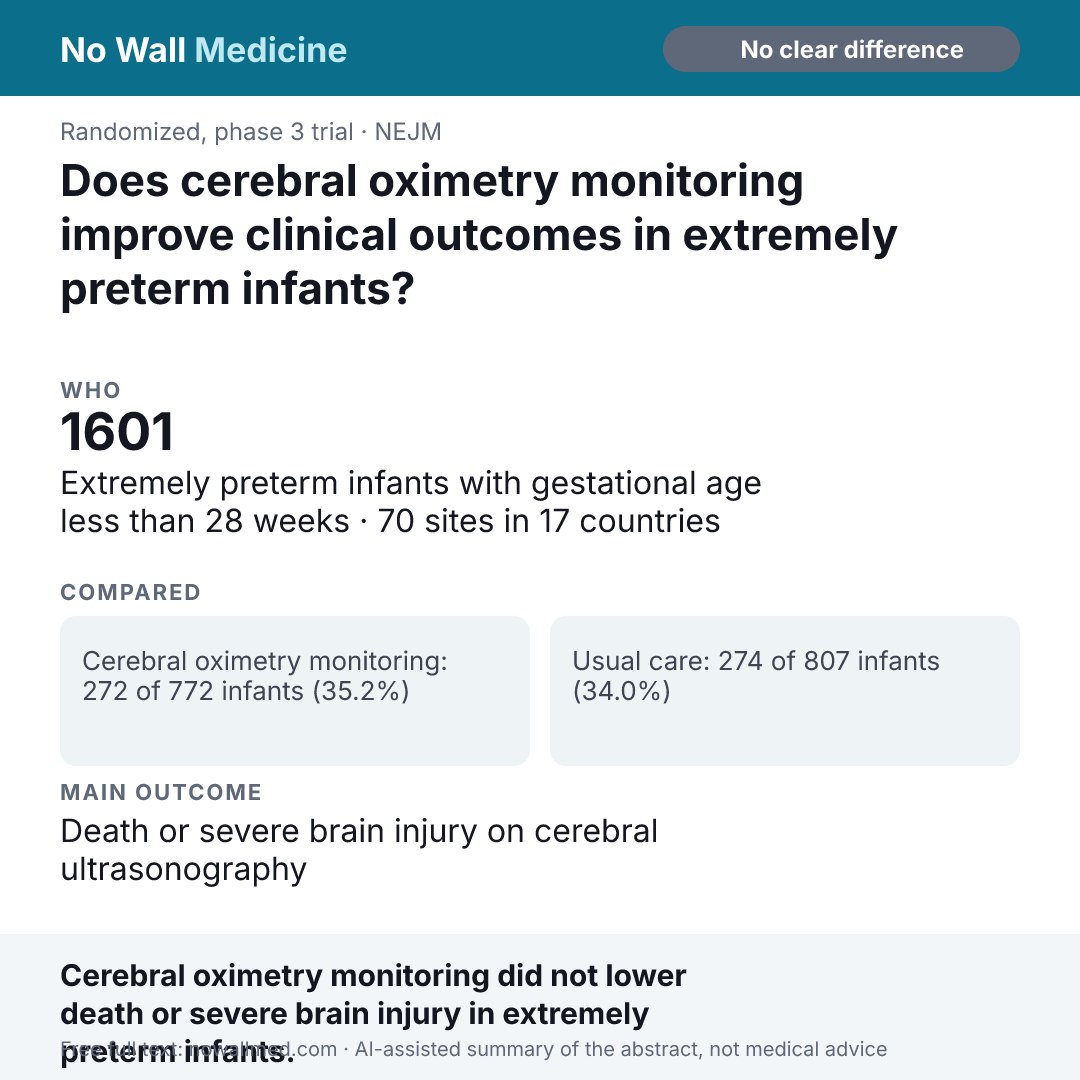
Clinical question: Does cerebral oximetry monitoring improve clinical outcomes in extremely preterm infants?
Why it matters: Evidence that cerebral oximetry monitoring improves clinical outcomes for extremely preterm infants was lacking despite increasing use.
Key points
- 1601 infants born before 28 weeks gestation were randomized to cerebral oximetry guidance or usual care for 72 hours.
- Death or severe brain injury occurred in 35.2% of the oximetry group versus 34.0% of the usual-care group, a difference that was not significant.
- The incidence of serious adverse events, including bronchopulmonary dysplasia and necrotizing enterocolitis, did not differ between the two groups.
Headline and key points written with AI from the paper’s abstract, with every number checked against it. Read the paper before relying on them.
Was this summary helpful?
Subject terms
Headline, design, result, key points, caveat and citation as plain text.
Cite this article
Hansen ML, Pellicer A, Hyttel-Sørensen S, et al. Cerebral Oximetry Monitoring in Extremely Preterm Infants. N Engl J Med. 2023;388(16):1501-1511. doi:10.1056/NEJMoa2207554
Spotted a mistake? Suggest a correction